
I read it that he has the idea of one day buying some stuff. The TC amp was just a cheapest best option and the cab he was looking at in Jan is out of stock.Bold face added for emphasis.

TalkBass has been independent since 1998. Add your voice.
Create a free account to reply to discussions, view embedded media, and browse with fewer display ads.
Join free Log in
Want zero display ads or expanded classifieds tools? Compare plans.
I read it that he has the idea of one day buying some stuff. The TC amp was just a cheapest best option and the cab he was looking at in Jan is out of stock.Bold face added for emphasis.

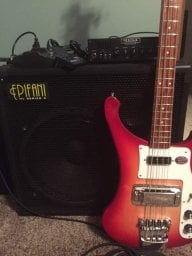
I have a 4 ohm amp 500 watts and a 8 ohm cab 300 watts. If I crank the amp will I blow the speaker or does the difference in impedance mean I will only get half of the wattage going from amp to speaker, thus making it impossible to ruin the cab?
Thanks in advance for any help you can give me. Have a great day.
Jordy
If you mean stage worthy bass amplifier and single driver cab then yeah but even then it's not hard to find exceptions with 100w tube amps thrashing away with impunity. I hope you aren't meaning the mythical square waved DC killing kind of little amp overdriving speakers to death thing that has to be debunked every month, it's only the 5th today.You can just about blow any speaker with any amp. For future reference.

Damn, this is so confusing!Your assumption about the output power of the amp is correct--that the power is reduced to half because the 8-ohm load, so it is basically safe to operate that cab with that amp. However, don't presume that it would be impossible to ruin the speakers just because they are a reasonably good match for the amp...it's possible to burn up a speaker system if you run it loud enough for long enough, even if the power applied is within the specification.
Now I'm starting to understad this equiation...The old rule of thumb was that the speaker capacity should be double the rated power of the amp if you wanted to be really safe. That was mainly for the days when both amps and speakers had limited capability so both were being thrashed. Amp rated at 500W into 4 ohms ought to be fairly safe into a 300W 8ohm cab if you don't go silly. If you do all bets are off.
[added]
Oh, and the other gotcha is whether both amp and cab are rated with the same watts. If the amp is rated at 500W RMS and the speaker at 500W peak or program or something then all bets are off and tears likely. Best to go back to manufacturers web sites to check that.
The never ending story Lol...but it's great, we're learning!(Unless someones using some speaker combination that's less than the "4 ohms".)
OP, if your amp is 500 watts @ 4 ohms, you should have zero issues running an 8 Ohm 300 watt cabinet.
Now, you haven't stated which cab it is, so I will say (as always) use caution and your ears. If you find that you have to crank your volume way up to be heard, then you should get a 2nd "matching" 8 ohm cabinet to achieve more volume.
As was stated, its easier for the gang to help if you post exactly what your equipment is that you are asking for advice on.
T$

So here's the plan so far:
1) The OP has an amp, believed to be solid state.
2) He's not playing Wembley stadium.
3) .......
4) Profit!


Your assumption about the output power of the amp is correct--that the power is reduced to half because the 8-ohm load, so it is basically safe to operate that cab with that amp.
WRT musical instrument amplifiers this double impedance = half power trope will never die and you’ll not see it stated by any electrical engineer, me for example, unless it’s a specific case like a DC circuit or we’re talking in really broad terms.Since you say you have a '4 ohm amp' I'm assuming it's a large tube amp? Yeah you cannot use an 8 ohm cab if your amp is on the 4 ohm setting. Your cab must match the transformer setting on your amp.

I'm going to need an explanation of why this is true, especially the last half of the statement. Are you saying that an amp that produces, let's say 250 watts into an 8-ohm load doesn't produce exactly half that (125 watts) when the load is 16 ohms? I'll need that math explained to me. Are you saying that because it's an AC signal, that it is not valid to use the formula Watts=Voltage squared/Impedance?IOW halving the load (say, from 8 ohm to 4 ohm) won’t double output power and doubling the load (say, from 8 to 16) won’t halve it.
Half with mosfets used to be ''close enough for jazz''. Then class D came along and it's more like 2/3 to 3/4. Which is still half close enough to half for jazz.I'm going to need an explanation of why this is true, especially the last half of the statement. Are you saying that an amp that produces, let's say 250 watts into an 8-ohm load doesn't produce exactly half that (125 watts) when the load is 16 ohms? I'll need that math explained to me. Are you saying that because it's an AC signal, that it is not valid to use the formula Watts=Voltage squared/Impedance?
If your cab is half low in wats to your amp it will react normally till the half max of your amp, if you add another cab you will get the full amp power.I'm going to need an explanation of why this is true, especially the last half of the statement. Are you saying that an amp that produces, let's say 250 watts into an 8-ohm load doesn't produce exactly half that (125 watts) when the load is 16 ohms? I'll need that math explained to me. Are you saying that because it's an AC signal, that it is not valid to use the formula Watts=Voltage squared/Impedance?

One could hardly blame him.OP seems to have bailed on this thread as well.


