• TalkBass has been independent since 1998. Add your voice.
    Create a free account to reply to discussions, view embedded media, and browse with fewer display ads.
    Join freeLog in
    Want zero display ads or expanded classifieds tools? Compare plans.

5 Sting bass and the E string. Sounds different to a 4 strings E string

OK, it might be a psychological effect but in general I have this experience. I even did a shootout between a 4 and a 5-string model Fender Am. Std. J bass otherwise identical, and the open strings sounded fatter, fuller on the 5-string one, and tighter, and more punchy on the 4-string one. I know there's a lot of factors that might cause this. I also know everything affects tone including the neck width etc. but I don't know what's happening really 😀

If I recall correctly, Marcus Miller said the same thing when he compared his 4 and 5 string models otherwise identical.
I'm sure it's all in Marcus' head though, right?;)
 
  • Like
Reactions: MYLOWFREQ
I think this is mostly psychological, but one thing I do think can be a factor sometimes is that a player will set up their bass, amp, and any other components of their signal chain differently to accommodate the low B string on a five string bass in a way that might impact the sound of the other strings. For example, as someone who plays a fair amount of fast and intricate music, I might sometimes make setup changes or EQ adjustments to keep the low B sounding articulate, which as a consequence might make the E string sound a little leaner too.
 
I'm sure it's all in Marcus' head though, right?;)
Could be in both his and my head! 😀

It is really hard to measure this really although one might get close. However, people who know more about acoustics and instrument building can maybe tell if in theory the width of a 5-string bass and the string-pull difference can affect the tone, and in what way.

The fact that the E string still sounds like an E string on both basses doesn't add to this conversation IMHO. Of course it will sound like an E string. We are discussing the possible tonal differences.
 
  • Like
Reactions: shojii and LowendG
My experience and for what it's worth:
That is the exact reason why I used to prefer BEAD over five stringed basses.
The same applies to a lesser degree to strings A, D and G.
I guess it has to do with the increased mass of the neck.
With graphite necks this effect is less noticeable.
Today and if I was still playing professionally would probably go five string / fanned frets.
 
Last edited:
  • Like
Reactions: Derek Kay
Anyone notice the E string on a 5 string bass sounds different than the E string on a 4 string bass?
It's not as loud and full.
Even if ALL things are equal... they aren't equal. Ken Smith (HIGH end legendary bass builder) has a lot of control over his wood sources. He once built 2 IDENTICAL basses, all from the same trees. So all 3 bodies from the same tree AND same section of tree. All the 3 necks the same. Every part was identical yet they each sounded slightly different.

When testing basses there are a LOT of factors at play:
  • Strings (type AND age). If not brand new AND same gauge & brand then the comparison stops here.
  • Manufacturer (I assume the same).
  • Woods (same species can vary a lot).
  • Finish (thickness, type).
  • Pickups. Even if same type, the 5 string will have a longer path for the signal to travel.
  • Pots and switches also matter.
Now for the other side of the argument. I was recently talking to an employee at Dingwall Guitars. He said more and more people are buying their 4 string basses and tuning them BEAD or even F#EAD. He said there is just something that is more meaty in the 4 string vs the 5 string. The only 2 things I can place that on is the pickups have less overall wire length and maybe the thinner, lower mass neck.
  • If a pickup needs to have 5,000 windings, the 5 string will have WAY more overall length. I'll just rough it and say each wrap is an extra inch. That's another 417 feet (127 metres)!
  • Perhaps the smaller neck focuses the signal more? It's another possibility.
I have a Dingwall 5 and 6 string. My E strings are killer! Amazing tone on both, I don't want or need anything more. That being said, I've never directly compared them to a 4 string.
 
I really don't understand the argument people are putting forth here, especially when they bring up the psychological aspects because this is just physics. As far as I've seen, 5 string basses have a thinner E string than 4 string basses since the B has to be so thick they make the E a bit thinner to balance the set, hence why I already would ASSUME it wouldn't be as "full" sounding. Thicker strings sound fuller, it was that way with guitar and it's that way with bass as well. I used to play 11's on guitar which is two steps up from a "standard gauges" and my tone was always fuller and meatier with those.
 
Could be in both his and my head! 😀

It is really hard to measure this really although one might get close. However, people who know more about acoustics and instrument building can maybe tell if in theory the width of a 5-string bass and the string-pull difference can affect the tone, and in what way.

The fact that the E string still sounds like an E string on both basses doesn't add to this conversation IMHO. Of course it will sound like an E string. We are discussing the possible tonal differences.
I hear ya. Who knows? It may simply be that the different "feel" is the main component of this phenomenon for some people. And if it feels different, you may be approaching the instrument differently, and will sound different. Heck, in my case I'm such a long-time dyed in the wool 4 stringer that fivers always feel weird to me!
 
As far as I've seen, 5 string basses have a thinner E string than 4 string basses since the B has to be so thick they make the E a bit thinner to balance the set, hence why I already would ASSUME it wouldn't be as "full" sounding.

That is simply not true, at least not in any industry-wide sense.

My main roundwound strings are GHS Bass Boomers, and the medium five string set (130, 105, 85, 65, 45) is exactly the same as the medium four string set (105, 85, 65, 45) with a low B added. The Chromes I have used for flats on four and five string basses are also the same gauges in the E to G strings.
 
I have an American Standard p5, strung with GHS Pressure Wounds and an American Professional p with the same strings., same gauge The only real difference in sound that I can discern is due to the different pickups (stock in the P5, Klein 62's in the P).
 
Nope, never noticed that. been playing 4s 5s 6s for decades... that isn't true of my basses, and I've had dozens. But certainly there are basses with different sounding E strings from each other, regardless of how many strings.

I can imagine that the playing technique might sound different with some players, without the B string in the way on the 4 string basses. I don't experience that, but I'm so used to contrabasses that I may not have playing technique changes in how I attack the strings? Just thinking through possible scenarios here.
 
I really don't understand the argument people are putting forth here, especially when they bring up the psychological aspects because this is just physics. As far as I've seen, 5 string basses have a thinner E string than 4 string basses since the B has to be so thick they make the E a bit thinner to balance the set, hence why I already would ASSUME it wouldn't be as "full" sounding. Thicker strings sound fuller, it was that way with guitar and it's that way with bass as well. I used to play 11's on guitar which is two steps up from a "standard gauges" and my tone was always fuller and meatier with those.
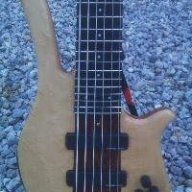
Most 5 string sets do NOT use thinner E strings, based on my experience selling bass strings in my day job at a music store. For example, D'addario doesn't change their gauge from 4 to 5, normally. I use 100 gauge E regardless of the number of strings, unless I'm in the mood for a different gauge.

Ernie Ball is the only brand I'm aware of that uses a slightly smaller gauge in their 5 string set... but it's not big enough to change the tone. Honestly, I don't hear much tone difference between gauges anyway, as long as the brand, materials, and design are the same.
 
  • Like
Reactions: Bassdirty
The outside strings are over magnets surrounded on 3 sides by copper wire. Every other string is over magnets surrounded on 2 sides with copper wire. Would that make a difference?

Plus fingerboard radius is almost never fully accounted for by staggered pole pieces. The staggering helps, but is almost never pronounced enough.
 
Last edited:
  • Like
Reactions: Riff Ranger