• TalkBass has been independent since 1998. Add your voice.
    Create a free account to reply to discussions, view embedded media, and browse with fewer display ads.
    Join freeLog in
    Want zero display ads or expanded classifieds tools? Compare plans.

5 String BEADG To EADGC Conversion?

I have been looking at some 5-string basses but for what I have in mind I don't need the B string. I think it would be pretty cool to have a C string though.

On a typical 5-string, would I need to replace or rework the nut to string it EADGC?

I'm thinking about doing this to a Ibanez AGB205 and have that as my "Coffee Shop" bass when I am playing with just an acoustic guitar. It sure would open up some chord work and I think that a high C would sing on a short scale where a B would just thud.
Invalid Link Removed

Thanks,
~NC

 
The original nut should work just fine. You may need to tweak the truss rod and/or bridge to get the setup back to your liking, though.

Cool, I think that bass with a set of TI Jazz Flats could be a real fun instrument. There doesn't seem to be any love on TB for any of the ArtCore basses. I don't know why that is. Once you get past the short scale bit they seem like good basses.
If I'm going to get another bass I want something that sounds completely different from my G&L SB-2 and something suited for a low volume folk(ish) duo.
 
I have a 5er stung with a high C and initially it did need a setup and a new nut.

You can potentially pull it off without a different setup and new nut but depending on how it's already done you may.
 
I don't know about the technical aspects but I dig having a high C. I may covert my Pedulla fretless 5 to high C, but I want to try a different set of strings with a low B first.
 
I have not tried eadgc. In fact I've never even seen a bass tuned that way. I'm not sure a high c would be much use in a Rock band, which is the only kind of band I was ever in.
Man, I dunno.
I'm 51 and a returning bass player. My "running with the wolves" days are past. I'm hanging out with this coworker my age and he brings in this homemade CD of him playing acoustic guitar in his shop. His style is sort of Johnny Cash (for lack of a better comparison) Folk/Americana. Really good songwriter with powerful lyrics and a big booming voice. He plays very percussive thumb and fingers style rhythm guitar but no lead. He says he has no interest in lead guitar playing or being in a group bigger than two.

In my brain I know there is no limitations with my 4 stringer, but I am sort of gassing for another bass. I do Programming and CAD work all day and my wrists aren't what they used to be. It seems that high C five string might be fun and open up some options.

I don't know how I would test this theory out with out just doing it.

I don't really get why DGCFBb would be any different. It is a whole step lower but why would that be any better?
 
On a typical 5-string, would I need to replace or rework the nut to string it EADGC?

I'm thinking about doing this to a Ibanez AGB205 and have that as my "Coffee Shop" bass when I am playing with just an acoustic guitar. It sure would open up some chord work and I think that a high C would sing on a short scale where a B would just thud.

Thanks,
~NC

I think you have the right idea, especially on an acoustic bass guitar. I had my Carvin AC50, strung EADGC for a while and it worked out very nicely! Quite frankly I would have preferred a 6 string but the Carvins only come in 5. Still the upper end is very useful for chords and solos just as you surmise.

As for the nut. I assumed that it would need a new one, but I just made the change on the old nut to see what would happen. I expected all kinds of nut buzz that would have me getting a new nut cut. But it never happened. It played just fine with the old nut. So you never know. Try it and if it works it works. If it buzzes, then get a new nut.

Let me also add that I had problems with the C string that LaBella sold me (They were all tape-wound laBellas) seemed WAY too small a diameter and sounded thin. Eventually I had to take a G string from a light gauge set of Fender tape wounds and use it for a C string. That one was just a tad heavy but worked MUCH better.
 
My fretless 5-string Valenti is strung EADGC. I have at times used it as my main player. I am using Ken Smith Slick Rounds (Light Gauge with .028 C string). No nut changes needed.

These: Invalid Link Removed

Two short audio clips: http://www.jamescarr.net/basses/stealthclips/StealthGroove1.wav
http://www.jamescarr.net/basses/stealthclips/StealthBossa.wav

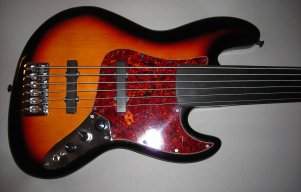
Pic of bass:

stealth_valenti_016.jpg
 
WOW Jim, great looking bass. Love the color. There's gotta be at least two extra knobs on that thing.... j/k
Thanks for posting the sound clips. Very nice to hear that C.

Here's something interesting. I switched to TI Jazz Flats a while back and my bass has developed a very fretless sounding mmmwwwaaaa on the D and G strings on the notes around the middle of the fretboard. Even with frets the notes have that bloom that I always associate with fretless. I like it. If you are playing 1/4 notes or faster it isn't really noticeable but if you hold the note you get that fretless kind of bloom. The effect is even noticeable unplugged.
 
Too funny reading this as I was just thinking about selling my Tacoma 5 string fretless as the B is kinda weak and I just don't play it much but now that I just picked up a 6- string ThunderBolt Pedulla, I thought of throwing a 6 string set on it and seeing how that would work out with the high C. Ill let you know as ill probably restring it early next week.
 
have you tried eadgc tuning yet ?

I tried it twice, never liked it one bit, the high c string is so thin, feels like a guitar string,...

You probably have noticed... the G string on our basses (the standard .100 gauge) looks an awful lot like the string used for the low E of guitars, only considerably longer. :eek:

I can only imagine a high C string... which may probably look like the guitars' A string. Still, I might dig it if I did more solo work.
 
I'd find a 6er tuned B to C at a shop and play it a bit. If you are SURE you like that tuning, I'd do it right and have a new nut cut for your Ibby. Frankly, the nut that comes from the factory leaves a bit to be desired. Further, it's not a very expensive swap and you can always go back to BEADG with yet another nut change should you so choose.
 
I don't know how I would test this theory out with out just doing it.

I don't really get why DGCFBb would be any different. It is a whole step lower but why would that be any better?

If you want to try the concept before committing then the suggestion to noodle around on the top five strings of sixers in stores is a good one. You could also put the top four strings from a six string set on your four to get some idea of how that top string would work for what you do.

I'm an odd duck in that I tune in fifths rather than fourths. I have a five string tuned CGDAE so it starts a half step above the B string in the traditional five string tuning and it ends two whole steps above the C string on a traditional six. Everyone is different but I have no trouble with that thin, guitar-like top E string. I can't say that I have really incorporated it into my regular playing much yet but I use that string a lot when I chord and that is why I got the fiver, to have four strings with a higher voice for chording. The higher tuning is great for that and there are a fair number of EADGC five string players here that find the C string great for regular bass lines too so you would not be the first by any means. Opinion is divided over whether you need to change the nut or not but I am going to say not. Like many I have never seen the need to do that so I am confident that you can retune a five to EADGC without a nut change at least until you decide if you want to keep it. If you want to stick with that tuning and you do find some minor problems with the stock nut you can have it changed then. If you decide you like neither EADGC nor five strings then you can sell your five string a lot easier if it has a BEADG nut. Setup changes are easy DIY jobs that are totally transparent to the next buyer. Truth be told the top five strings of a six string set may have nearly the same total tension as a five string set so a setup change may not be necessary.

There is some sense to the D standard five string tuning. It is awful in that only two of the five strings match what you are familiar with on your four string basses. You will have to learn the other three from scratch and unless you retune your four to match you have the tuning disconnect to deal with every time you switch basses. On the other hand about 85% of the time I drop below an E on my basses I go no lower than an Eb and 10% of the time I go down to the D. I use the Db and C about 5% of the time and while I have one bass with a Hipshot extender key set to switch from C to A, I have never used that capability while performing (in a church band, btw). The "need" to go below a D is highly exaggerated here on TB except for those who have producers, famous artists, or band leaders to work with who demand that. The D standard tuning is an excellent compromise that gives you the most important low notes but some extra range on top too. Maybe it is not for you but it has its charms.

Ken