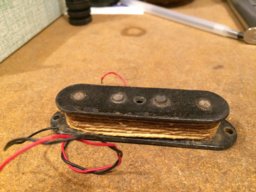
For me, the fix was installing the string twice. It happens to work on the E string, too. And the A, to a slightly lesser degree. I am a guy who believes you should wind your string to the bottom of the post. Every time a string is turned around its post, it twists. The bigger the string, the more it twists. I noticed long ago my B strings wouldn't vibrate evenly along their length. It was a problem I noticed on many basses. Many B string. You can look and see. Pluck the string and watch it vibrate. In my frustration with my B strings, I'd remove em and install another. I noticed when I'd pull the B off the post, it would quickly UN twist. So one day I let it UN twist, then turned the coiled post end til it was back straight with the post. The strings anchored end, now loose, would turn with it. Then, since the string was already coiled to go round the post, tuning it up would take hardly any turns at all, thus no re twist. After tryin this a few times, I started to see the B strings vibrate FAR more evenly. Many guys say not to wind the string to far around the post, and I think it's cuz they may have the same issue of string twist, and not realize what's causing it. Not only do I wind my strings around the post to the bottom, I then push the B string down in front of the bridge saddles, pickup side, HARD, touching the top of the pickup, creating a very distinct break angle. I do this after the UN twist procedure, so the witness point/break angle isn't moved when turning the string. I do all this only tuning the string up to a half step below my favored tuning, so as to not fatigue the string before I actually play it. After all the procedure, I tune the bass. I do this procedure now on my 3 biggest strings, as ritual. On occasion, the B is still a bit less than the others. I repeat the steps, especially the bridge saddle push down, and the B comes in 99% of the time. In fact, I can really tell if a companies string is gonna work for me doin this. I judge, harshly, the quality of the B string. It's important to me that it's useable up the neck. Other factors are HUGE, too. Pickup height is essential! Again, the out of phase sound can be a tell tale sign of string twist, or, too much magnetic pull on my strings. The B is massive, and has a lot of travel when fretted above the 12th. If it gets to close to a pickup when fretted up there, there goes accuracy and sustain. Each bass, each pickup, is different in this respect. Getting the height balanced for the performance expected is huge. Finding the right string for each individual is key, too. I put tone and performance before feel and my left hand's comfort. I had to raise my action, slightly, tho in my experience I've found the higher the string off the board, the better the performance. But I can get low(ish) action and still have my B string tight and defined. Cutting fundamental a bit on eq helps. Tho some newer amps already take this into consideration. And lastly, on scale length. It isn't the scale the frets are placed upon, between witness points, that makes a B tight. It is the length of the draw of the string between anchor points. If you built a bass with a 34" inch scale, but had the tuners and string anchor the length a 35" scale would draw, the strings works like a 35, but the scale is still 34". For example, a 3 over 2 headstock vs. a 2 over 3. The B strings tuning post would be farther from the bridge, thus achieving a longer draw on the string, without changing scale. I string my Fender thru the body, not cuz it resonates or plays different, but because it draws the string farther, adding an inch to a 34 scale bass. Whew... Told ya I was meticulous. All these factors come into play for me when picking a bass. But, I've had success with that string install procedure. Enuff I've made even Squier 5s play fantastic. By the way, play the bass unplugged, checking its sustain and performance acoustically, then plug it in. Pickups can be weak points, too. Playin acoustically and having a great B, then plugging it in and having it go away when amplified, is a clue it isn't the bass. Lower end basses do sometimes resist my call, heh. But it isn't usually the bass or string. It's almost always the pickups, whether they're too close to the string, or just a lesser set. I used to think steel was a better material for tight B strings, but in the last 5 years or so nickels seem to have caught up. It's a lot to consider, but I like my B strings. So I go thru it. It sounds like a lot, but in time you figger the steps you need to perform, and your procedure will get quicker. I've had a lot of success, and it free'd me up to play more basses to find my tones, cuz I didn't worry the B on certain instruments anymore.


 After much practice I can now hit the E String Cleanly without hitting the B. I'm at the point when I play 4 String it just feels naked