• TalkBass has been independent since 1998. Add your voice.
    Create a free account to reply to discussions, view embedded media, and browse with fewer display ads.
    Join freeLog in
    Want zero display ads or expanded classifieds tools? Compare plans.

6550 power tubes in an Ampeg V-4B?

The weird thing is that Ampeg, in the 1970s, was offering the upgrade to 6550s on the V4 and V4b. why?

I have seen comments that the the vintage V4 PT runs a bit hot with 6550. Whether it runs too hot I can't say.

The reissue amp should be consider separately. AFAIK Ampeg has not offered a 6550 conversion kit for the reissue.
 
  • Like
Reactions: Sunnampeg
I have seen comments that the the vintage V4 PT runs a bit hot with 6550. Whether it runs too hot I can't say.

The reissue amp should be consider separately. AFAIK Ampeg has not offered a 6550 conversion kit for the reissue.
yes i know the reissue can only run with 6L6 infact i ve specified the 70s vintage v4b
 
Last edited:
I have seen comments that the the vintage V4 PT runs a bit hot with 6550. Whether it runs too hot I can't say.

The reissue amp should be consider separately. AFAIK Ampeg has not offered a 6550 conversion kit for the reissue.

Mine ran pretty toasty with 6550s. It was the first V4 I owned so I didn’t have a comparison, but now that I’ve had a number of them it was significantly hotter. I usually ran a fan on the back to keep it cooler. With solid 7027As available these days I wouldn’t choose to run one with 6550s.

I’ve seen some posted here which have been modified to mitigate the heat a bit. Moving the PT over a bit away from the power tubes and adding a fan in the amp to keep it running cooler.
 
  • Like
Reactions: Wasnex
Mine ran pretty toasty with 6550s. It was the first V4 I owned so I didn't have a comparison, but now that I've had a number of them it was significantly hotter. I usually ran a fan on the back to keep it cooler. With solid 7027As available these days I wouldn't choose to run one with 6550s.

I've seen some posted here which have been modified to mitigate the heat a bit. Moving the PT over a bit away from the power tubes and adding a fan in the amp to keep it running cooler.
The problem with the modern 7027A is that they are 6l6, that's it, i had 6l6, when i ve just bought my 75 V4B 18 years ago after 6 months i had a tube failure so i had to replace the whole quartett, and my tech suggested me the 7581A to increase a headroom and a bit more volume, those are 35w per tube almost like a 6550, and i was quite happy with the results because the amp sounded cleaner and slightly louder with an overall bigger sound,. From that moment, I've always retubed with 7581A, but I've always wondered how it would sound with the 6550s since many say it would push out even more low end, almost like an SVT, and a bigger sound.
I'm afraid to try because I've read many times on Forums that using the 6550s can cook your PT.
 
There is speculation JJ is relabeling their 6L6GC as 7027A with added pins, and the datasheets show low 6L6GC type maximums and 30 watt dissipation.

New sensor makes 7027A and 7581A in their tung sol brand, and they are not just relabeled 6L6GC. They have a distinct internal structure from the tung sol 6L6GC tubes and the datasheets at least show proper voltage maximums/dissipation rating. I’ve been running these tubes for years in my V4, V2, and B25B amps without issue.


You can look at all of the plate and glass structures of their products, they are not the same internally.


Another incorrect assumption or statement.

Where do you get this stuff from?
I think it was a Tad Tec that said that to me, i was looking for 7027A and the originals (vintage) have 35wplate dissipation, but are very expensive, so when i ve asked the specs i saw the 30 Wplate dissipation so i ve asked many questions, they admitted that wereJJ7027A rebranded and that technically internally was a 6l6gc jj only with different number of pin. in the end i keep using the 7581A right now i ve tungsol 7581A.
 
I think it was a Tad Tec that said that to me, i was looking for 7027A and the originals (vintage) have 35wplate dissipation, but are very expensive, so when i ve asked the specs i saw the 30 Wplate dissipation so i ve asked many questions, they admitted that wereJJ7027A rebranded and that technically internally was a 6l6gc jj only with different number of pin. in the end i keep using the 7581A right now i ve tungsol 7581A.
That's not universally true, MAYBE that's true with their tubes but I have some new production 7027's that were used in amp testing and they are not repackaged 6L6 tubes.
 
  • Like
Reactions: Patrice B
That's not universally true, MAYBE that's true with their tubes but I have some new production 7027's that were used in amp testing and they are not repackaged 6L6 tubes.
Interesting, I'm open to suggestions, for future retubing, I've retubed the amp not long ago. I've tried the 7027 JJ on a v4, and they sound a bit delicate like the 6L6 JJ.
 
Tung Sol 7027A is a good tube.

Also note that there were different versions of the 7027, I'm talking about the A version which IIRC uses a slightly thicker plate. The A version is pretty similar but not identical to the 6L6GC, but then again there are quite a few variants of the 6L6 as well.
 
Last edited:
  • Like
Reactions: Sunnampeg
Here is the vintage V4 brochure. There is what they called a 6550 performance option, see page 3. It consisted of the 6550A tube set and a set of bear claw retainers to fit the tubes. The bias needed to be adjusted for the new tubes. Ampeg claimed that it boosted the output from 100W to 130W. The designer, Bill Hughes, has said that the power transformer was designed to deliver the required heater current for the 6550A's.

I wouldn't risk 6550A in a vintage V4B. The power transformer may not be up to spec.

The modern reissue V4B is designed for 6L6GC tubes, nothing else is recommended by the V4BR designer.

The 100W vintage amp configuration runs quite hot. By biasing the 6550A tubes cooler, the amp still sounds good and they have a long service life.


 
My magnavox-era V4-b has run 6550s since I bought it before 2000.

I, and later my wife, have gigged and toured it moderately since with nothing more than a few retubes.

It had practical and documented PS and bias modifications that my amp tech has had no problem working with. So I suspect the PO did good stuff, including creating a back panel with a fan.

So it can work. Since I’m not gigging that amp right now I’d try new 7027s if it didn’t require too much tech time.
 
Here is the vintage V4 brochure. There is what they called a 6550 performance option, see page 3. It consisted of the 6550A tube set and a set of bear claw retainers to fit the tubes. The bias needed to be adjusted for the new tubes. Ampeg claimed that it boosted the output from 100W to 130W. The designer, Bill Hughes, has said that the power transformer was designed to deliver the required heater current for the 6550A's.

I wouldn't risk 6550A in a vintage V4B. The power transformer may not be up to spec.

The modern reissue V4B is designed for 6L6GC tubes, nothing else is recommended by the V4BR designer.

The 100W vintage amp configuration runs quite hot. By biasing the 6550A tubes cooler, the amp still sounds good and they have a long service life.

Bass Gear Magazine benched a vintage V4B at 123 watts (5%THD). Seen here somewhere on this forum. Probably with 7027A's, not sure.

***EDIT: found the article, 8% THD and not 5. https://www.bassgearmag.com/v-4b-old-vs-new-head-to-head/
 
Last edited:
Bass Gear Magazine benched a vintage V4B at 123 watts (5%THD). Seen here somewhere on this forum. Probably with 7027A's, not sure.

Ampeg’s 100W vintage amp spec was 3%THD. Details are in the brochure. It’s important to specify output power with THD and a swept frequency range such as 20Hz-20KHz. Rating can be conservative which means that they put out more power than specified. Some companies specify 5% which has a higher output power but with more distortion. Some will do it at a fixed frequency. Those approaches are marketing more than engineering.
 
  • Like
Reactions: Patrice B
Ampeg's 100W vintage amp spec was 3%THD. Details are in the brochure. It's important to specify output power with THD and a swept frequency range such as 20Hz-20KHz. Rating can be conservative which means that they put out more power than specified. Some companies specify 5% which has a higher output power but with more distortion. Some will do it at a fixed frequency. Those approaches are marketing more than engineering.
In practice, most folks pretty much guess about how much THD is present in signal and make absurd assumptions. Ampeg in practice uses/used 5% THD though they also used 3% in some marketing. The Heritage uses 5% for example. In reality, it can be hard to "see" 5% THD, so folks make assumptions and then make ridiculous claims. It also depends heavily on AC line voltage and the THD of the incoming line power. Fixed frequency THD measurement spec is both common and useful because for bass guitar it doesn't matter one bit what the THD is at 5kHz or higher at rated power because it doesn't ever come into play. You will NEVER come close to rated power at 5kHz with bass guitar.
 
Ampeg's 100W vintage amp spec was 3%THD. Details are in the brochure. It's important to specify output power with THD and a swept frequency range such as 20Hz-20KHz. Rating can be conservative which means that they put out more power than specified. Some companies specify 5% which has a higher output power but with more distortion. Some will do it at a fixed frequency. Those approaches are marketing more than engineering.
8 percent finally after my edit, no doubt that it could reach ~120 w at this THD level… but not realistic as I understand!
 
  • Like
Reactions: beans-on-toast
Yes, specs involved creative writing. Few had the equipment and will to validate the numbers.

Too many players get hung up on specs which always need to be interpreted when comparing amps from different companies. Listening to make comparisons is always better but certainly difficult to do these days with so many products on the market.

I recall one manufacturer that set up the amp and determined the spec for the rated output power through listening tests. Then measured the output power, THD and other technical details. Yes the output power and distortion figures turned out to be higher but the approach of specifying numbers that still sounded good was deemed more useful to players.
 
Last edited:
  • Like
Reactions: Patrice B
Tung Sol 7027A is a good tube.

Also note that there were different versions of the 7027, I'm talking about the A version which IIRC uses a slightly thicker plate. The A version is pretty similar but not identical to the 6L6GC, but then again there are quite a few variants of the 6L6 as well.
The original 7027A had 35W plate dissipation, and the regular 7027, if I'm not wrong, 30W. Is the new Tungsol 7027A a tube with the same plate dissipation of 35W?? I'm not able to find the specs for the Tungsol 7027A.
 

Attachments

My magnavox-era V4-b has run 6550s since I bought it before 2000.

I, and later my wife, have gigged and toured it moderately since with nothing more than a few retubes.

It had practical and documented PS and bias modifications that my amp tech has had no problem working with. So I suspect the PO did good stuff, including creating a back panel with a fan.

So it can work. Since I'm not gigging that amp right now I'd try new 7027s if it didn't require too much tech time.
Curious to see this documented PS bias modification.
 
Here is the vintage V4 brochure. There is what they called a 6550 performance option, see page 3. It consisted of the 6550A tube set and a set of bear claw retainers to fit the tubes. The bias needed to be adjusted for the new tubes. Ampeg claimed that it boosted the output from 100W to 130W. The designer, Bill Hughes, has said that the power transformer was designed to deliver the required heater current for the 6550A's.

I wouldn't risk 6550A in a vintage V4B. The power transformer may not be up to spec.

The modern reissue V4B is designed for 6L6GC tubes, nothing else is recommended by the V4BR designer.

The 100W vintage amp configuration runs quite hot. By biasing the 6550A tubes cooler, the amp still sounds good and they have a long service life.
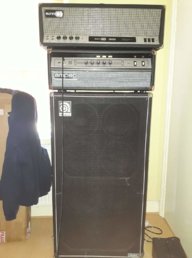
Hi, thanks, this is nice, but I had to change the original Power transformer since I'm in the UK, with a TAD (clone replacement 230v ahaha), I do not know if I could run the 6550s,i will re-ask my tech at the next retubing.
anyway, back in the day when i ve asked my tech how much the6550 s would have booset the output he said that itw would not be more than 10w maybe 15w, so 110 maybe 115w, but was safer running the 7581A and also 7581A would have given me more headroom and boost the output at110w so i went for the 7581A and infact he measured the output and everything he said it was right.
 
  • Like
Reactions: beans-on-toast