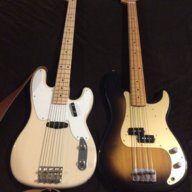
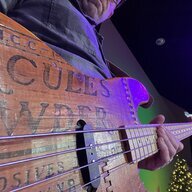
I would rout cleanly around, and then plug, the holes.
I would rout a "shelf" in at an angle, where the contour is – as deep as needed to fully eliminate the contour.
I would glue in a piece of ash, cut at a matching angle as in the step above, to fill the "shelf," and then rout that new chunk to match the curve of the body.
I would plane and then drum sand about 1/4" off the top.
I would cap the body with a 5/16" top of ash, joined exactly where the original body sections were joined.
I would drum sand the top, until the body got to its proper thickness, and make sure all joints were smooth.
I would rout as-original pickup and control cavities.
I would give that top an edge radius matching the bottom edge radius.
I would give the sucker a nice, thick coat of Fullerplast.
I would give it a thick blonde aliphatic urethane refinish, almost opaque but not quite – but making sure to make it 100 percent opaque around the edges.
I would track down and install original bridge and pickup covers, and other original parts, over time (use reproduction stand-ins for now).
I would install the new hardware and electronics.
I would install a faux neck heel in the neck pocket (as masking). Then I would leave the body in a window, alternating front and back, until it achieved a yellow tint that matched the yellowing of the neck.
I would send the body to Gord Miller to be ever so slightly aged to match the neck.
I would keep narrow-gauge tape wounds on it, to preserve the frets as well as possible (narrow gauge, i.e. .105s, to eliminate the need to widen the nut slots).
I would purchase a period-correct Fender hard case for it.
I would take it to Norm's, Elderly, or Gruhn's for a documented, in-person inspection and appraisal.
I would play it, but not beat on it.
I would sell it when I am too old to play.
That's what I would do.