• TalkBass has been independent since 1998. Add your voice.
    Create a free account to reply to discussions, view embedded media, and browse with fewer display ads.
    Join freeLog in
    Want zero display ads or expanded classifieds tools? Compare plans.

'78 P-bass. Nitro? How?

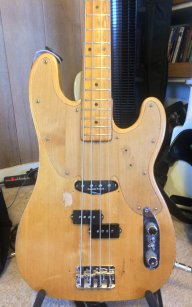
One of my favorite basses is my 1978 sunburst RW P-Bass. I am basing this year of manufacture on the S863xxx serial number on the headstock, the pickup codes, the pot codes (one '77 and one '78) and the neck code. The bass has never been refinished. I'm sure of it. It is, with few exceptions like the pickguard and nut, original and unmodified. What I noticed when I bought this bass about 5 years ago was that the finish was rather "soft". What I mean by that is you could press a fingernail into the paint and leave a dent. I never gave it much thought... for 5 years. I recently read some articles here on TB and some other forums about others with '78 P-Basses with similar "soft" paint. This got my curiosity. Most were asking if their bass could possibly be finished from Fender with "nitro" but the responses unanimously from TB'ers referred the "fact" that Fender did not use nitro finishes in '78, they used polyurethane. Some offered that the soft paint could be due to Fender using a "catalyzed poly" without enough hardener mixed in causing the paint to soften over time.

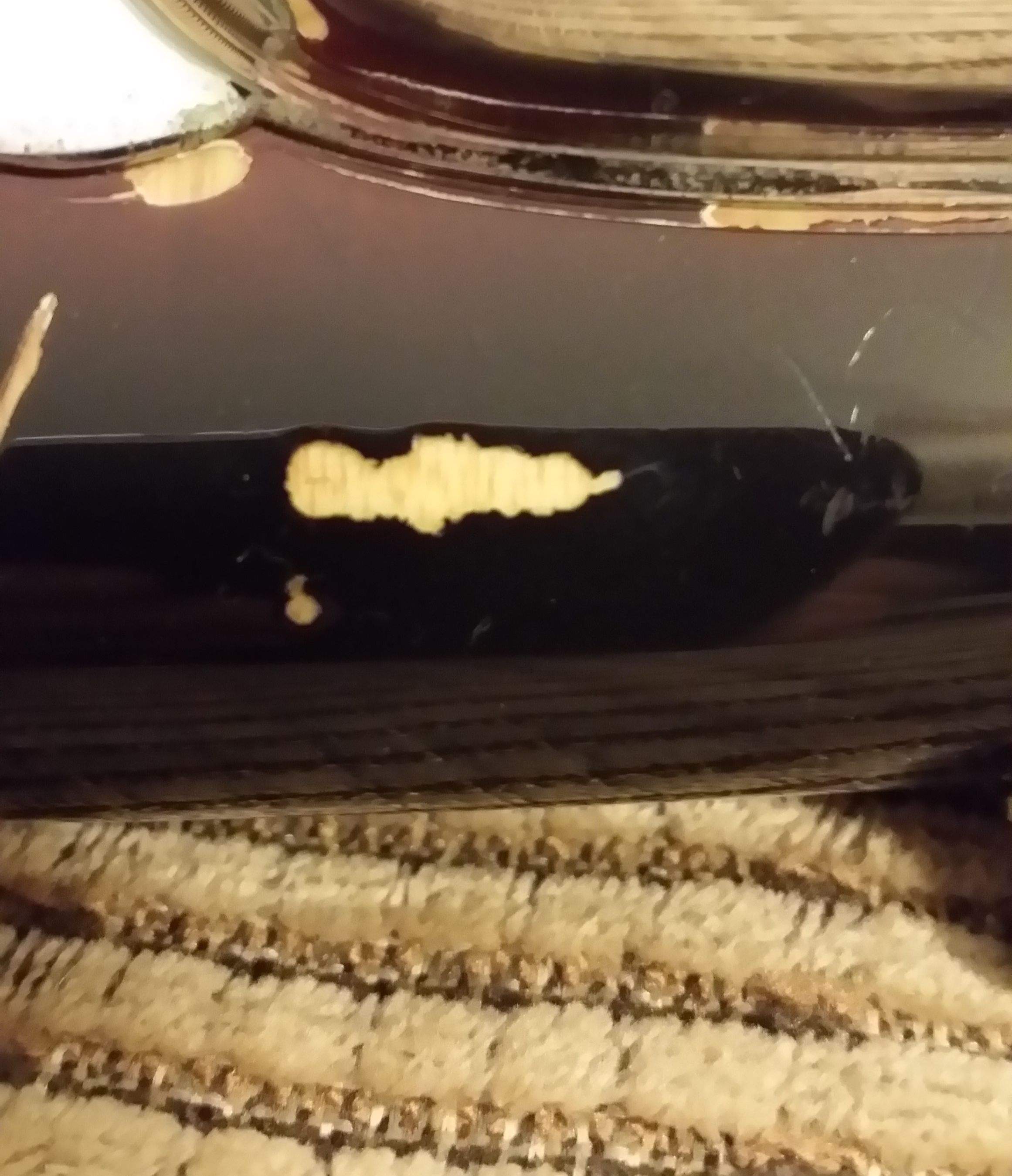
So, my question was "how do you test for what your finish is or isn't". On further internet investigation I learned that THE test for nitro is using a dab of acetone or lacquer thinner on a q-tip in an inconspicuous spot under the pickguard...just a dab. Nitro will immediately soften up leaving a rough spot in the finish from the nitro softening, getting disturbed by the cotton and then hardening back up again as the acetone evaporates. Poly will not react at all. Well, I just tested mine with acetone and if this is a true test for nitro... mine clearly is nitrocellulous lacquer paint and not polyurethane or catalyzed poly. The surface of the paint immediately started to breakdown with some of the paint color adhering to the q-tip. The remaining spot looked like you touched a dry q-tip to a tacky painted surface (see picture). I also attached a pic of some dings in the finish down to the wood. I do not see any fullerplast undercoating. Only wood. And the painted finish is very thin. Not thick like poly.

This leaves me happy and confused. My finish passed the finger-nail test and acetone test for nitro. It's a '78. It has not been refinished. What happened?
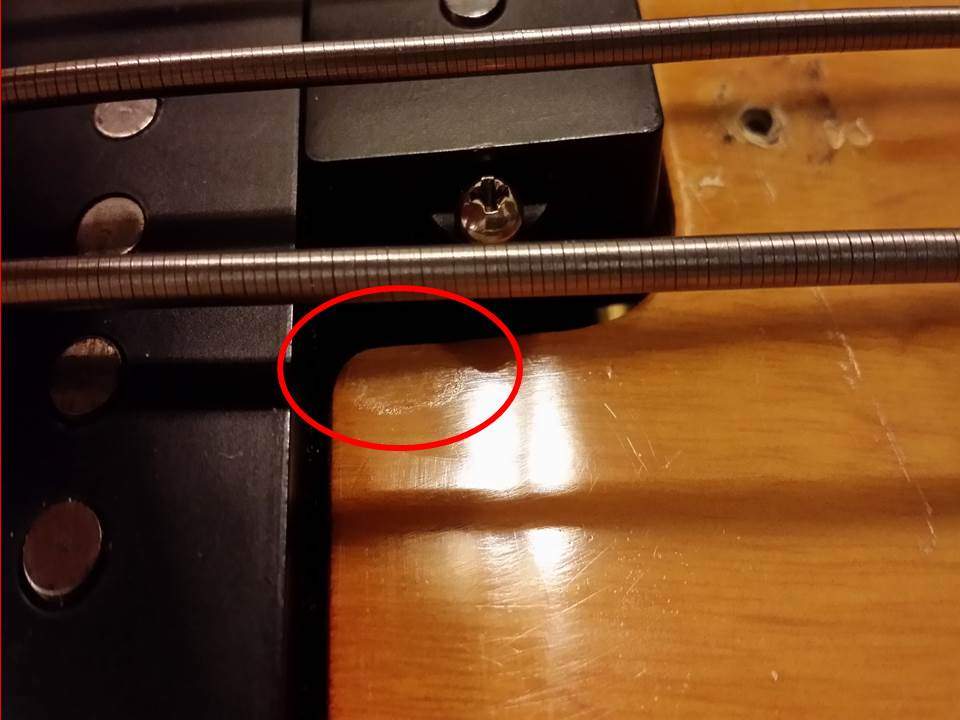
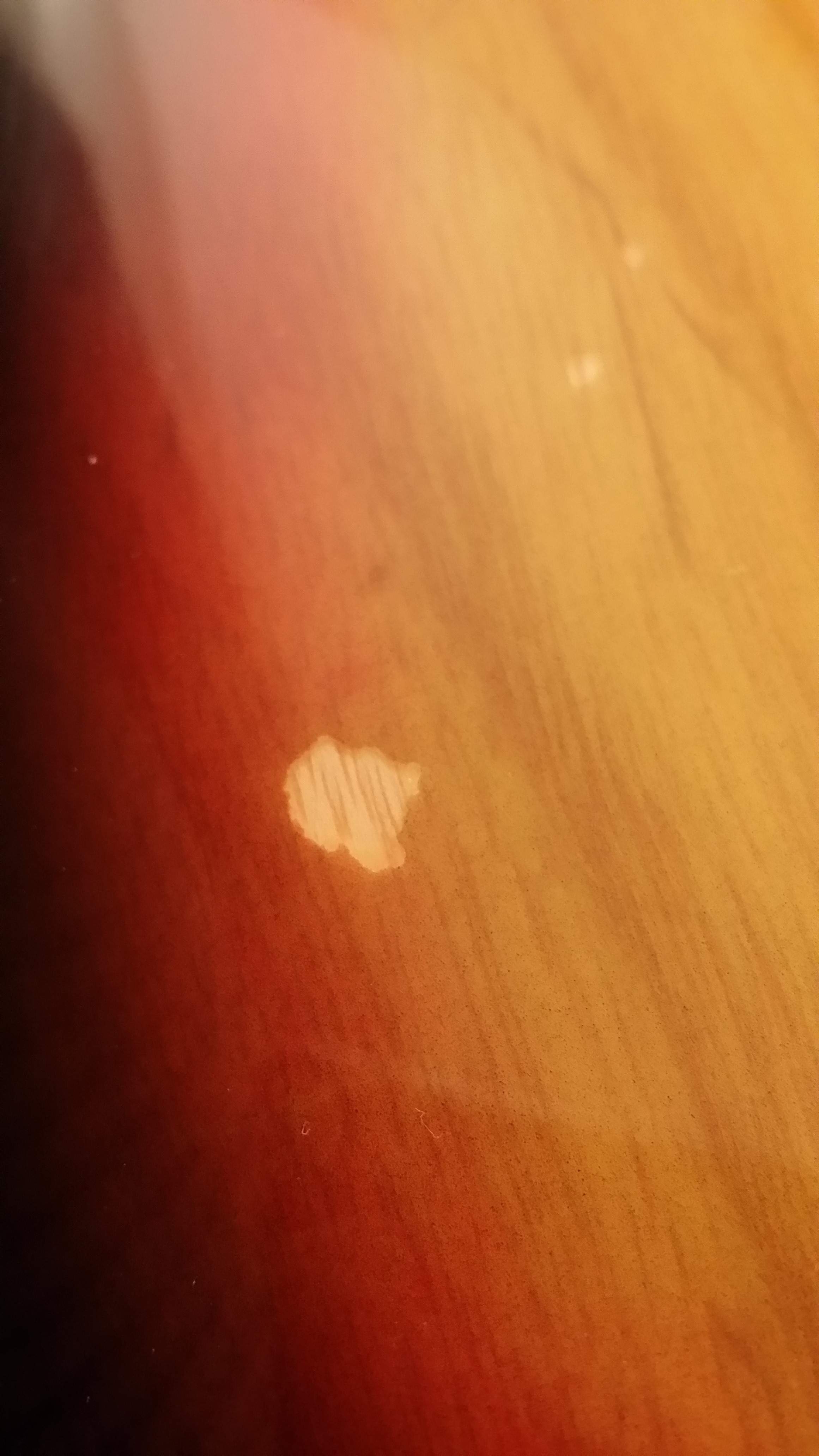
nitro test 78 p-bass.jpg


20150802_221351.jpg

20150802_2214211.jpg
 
IMHO, if it is nitro, it is either a refinished instrument, or it was finished when Fender used nitro. That could be either in the pre-CBS/transition period, or in the more modern era when nitro came back on various reissues of the P-bass.

A lot of instruments of that period were sanded down and finished in clear poly—only later to be refinished again.
 
  • Like
Reactions: seang15
Could we see clear closeup photos of the front and back of the body?

Judging from the dings and wear, it really looks like poly to me. Nitro is much thinner, and the edges of dings are not as sharp. Not that poly can't wear like that, it probably can, but once nitro starts to come off, it will usually come off in tiny bits, not flakes. The edges of the dings on all my Fender nitro instrument were quite different from the poly finished ones. The poly made flakey edges like yours.

Hard to describe. Look at a road worn or genuine vintage relic. The ding edges are thin, smooth, and often just taper smoothly right to the wood unless they are in the very thickest part of the finish.
 
Last edited:
I can tell you it's not a refin. As for the rest, I guess anything is possible but it seems like a real longshot that the body was painted in the 60's transition period and installed over 10 years later in '78. I am not aware of any RI's offering nitro in '78 but I could be wrong. Not very knowledgable on what bass or guitar RI models were issued in the 77 to 79 period. I have heard other people with 77 to 79 Strats and P-Basses asking on forums about their "soft paint" only to be told "it can't be nitro". I'm thinking it can be. Maybe Fender shot nitro over poly for part of the 70's for some cost cutting reason or production reason?
 
IMHO, if it is nitro, it is either a refinished instrument, or it was finished when Fender used nitro. That could be either in the pre-CBS/transition period, or in the more modern era when nitro came back on various reissues of the P-bass.

A lot of instruments of that period were sanded down and finished in clear poly—only later to be refinished again.

This right here. 1978 was the period when poly was glopped-on so think it was *mind boggling*.

And yes, refins were uber common back then for this (as well as other) reasons.
 
Could we see clear closeup photos of the front and back of the body?

Judging from the dings and wear, it really looks like poly to me. Nitro is much thinner, and the edges of dings are not as sharp. Not that poly can't wear like that, it probably can, but once nitro starts to come off, it will usually come off in tiny bits, not flakes. The edges of the dings on all my Fender nitro instrument were quite different from the poly finished ones. The poly made flakey edges like yours.

Hard to describe. Look at a road worn or genuine vintage relic. The ding edges are thin, smooth, and often just taper smoothly right to the wood unless they are in the very thickest part of the finish.

I would agree had I not tried the acetone on it. If the outer coat was poly nothing would have happened. Nothing discussed so far can explain away that fact.

Maybe it's nitro over poly? They continued to use nitro for years over the headstock face so as not to mess up the Fender decal. The poly on the necks would wrinkle up the decal so just the headstock face was shot with nitro to cover the decal. Lord, I wish this bass could talk...
 
Could we see clear closeup photos of the front and back of the body?

Judging from the dings and wear, it really looks like poly to me. Nitro is much thinner, and the edges of dings are not as sharp. Not that poly can't wear like that, it probably can, but once nitro starts to come off, it will usually come off in tiny bits, not flakes. The edges of the dings on all my Fender nitro instrument were quite different from the poly finished ones. The poly made flakey edges like yours.

Hard to describe. Look at a road worn or genuine vintage relic. The ding edges are thin, smooth, and often just taper smoothly right to the wood unless they are in the very thickest part of the finish.

20150803_001733.jpg
20150116_010139.jpg
 
So my question becomes "if it's not lacquer, what is it"? It reacts to acetone similar to nitro lacquer. If it was polyurethane it wouldn't react at all with acetone. I am not an expert on this subject so I don't know what other paint types were being used during the CBS days, if any.

That body is Ash, not Alder. IME, Ash bodies were used by Fender for solid colors or clear finishes, but not for 3tSB. I believe that this is likely a refinished Ash instrument.
 
When you removed the pickguard, was there any color difference in the finish that was covered by the guard? Nitro lacquer will yellow more in areas exposed to light. Even the headstock faces would yellow noticably over time, compared to the rest of the neck.

It certainly sounds like nitro lacquer on there (by the acetone test). The amount of yellowing could indicate how long ago the lacquer was applied.

You might also try testing with acetone on an area that would be hard to reach when refinishing; maybe in a pickup cavity or neck pocket. Could be remnants of the original finish there.

How do you know it wasn't refinished? Not doubting, just curious.

-
 
I can tell you it's not a refin. As for the rest, I guess anything is possible but it seems like a real longshot that the body was painted in the 60's transition period and installed over 10 years later in '78. I am not aware of any RI's offering nitro in '78 but I could be wrong. Not very knowledgable on what bass or guitar RI models were issued in the 77 to 79 period. I have heard other people with 77 to 79 Strats and P-Basses asking on forums about their "soft paint" only to be told "it can't be nitro". I'm thinking it can be. Maybe Fender shot nitro over poly for part of the 70's for some cost cutting reason or production reason?

Not nitro just because it is soft. I have had soft poly 60's P-basses, even. You shouldn't spray lacquer over poly, unless it is a specially formulated primer. It easily peels away, as will poly over nitro.

Fender couldn't bring nitro back 14 years after they dropped it in the late '70s because of the Clean Air Act and California Clean Air laws, which were far stricter than anywhere else in the world at the time.

IMHO, if it is nitro, it is a refin or a later body.
 
Last edited:
Yep. There are a number of 70's ash 3TSB Fenders on the web right now. (Reverb, Pinterest, Gbase and Ebay).

Jim Carr... I seriously do appreciate your feedback but you gotta let go of the "refin" angle. ;) This bass was NOT refinished. No way. No how. If I had nothing to do I would disassemble the body and you would be able to see that but that ain't happening. I'm 64 and been buying (and selling) basses since 1971. I know what a refin looks like. Even a good one.

I have held on to this P-Bass because it sounds better with flats than any of the 20+ P-Basses that I have owned including my late 60's and early 70's CBS transition basses, an American Vintage '63, two Select P-Basses and a flock of American Standards. This one just has "the" sound (I hate that term).

So further searching of numerous forums last night just confuses the issue more since a number of people are saying that all poly isn't created equal and some poly's are impervious to acetone (one person actually used it to clean his finish) and some poly's get disolved quickly by acetone just like nitro would. So, IF this is true, that tells me acetone is not the best test for identifying nitro. Had I known that I wouldn't have bothered to test it with acetone.
 
  • Like
Reactions: Jim Carr
Yep. There are a number of 70's ash 3TSB Fenders on the web right now. (Reverb, Pinterest, Gbase and Ebay).

Jim Carr... I seriously do appreciate your feedback but you gotta let go of the "refin" angle. ;) This bass was NOT refinished. No way. No how. If I had nothing to do I would disassemble the body and you would be able to see that but that ain't happening. I'm 64 and been buying (and selling) basses since 1971. I know what a refin looks like. Even a good one...

No worries, except I'm even older! Got my first bass in '63! :roflmao:
 
When you removed the pickguard, was there any color difference in the finish that was covered by the guard? Nitro lacquer will yellow more in areas exposed to light. Even the headstock faces would yellow noticably over time, compared to the rest of the neck.

It certainly sounds like nitro lacquer on there (by the acetone test). The amount of yellowing could indicate how long ago the lacquer was applied.

You might also try testing with acetone on an area that would be hard to reach when refinishing; maybe in a pickup cavity or neck pocket. Could be remnants of the original finish there.

How do you know it wasn't refinished? Not doubting, just curious.

-


There is significant fading of the finish comparing to finish under the pickguard. The paint in the neck pocket and routes is exact in color to the surface. All of the fender stamps are in place. The finish under the bridge, neck plate and bridge cover are not faded and continuous with the surface paint and the same color and brightness as under the pickguard. There are no sanding marks. There is no changes to the body contours evident. There is no over spray. There is no paint in any of the screw holes, etc...etc...etc. There are a number of "things" that set off the alarms for someone who has looked at the internals of a lot of original basses when you see a refin. I don't see them here. Check the pictures of the finish I attached. Hard to see but the surface is checking... not cracking. It is on several places, like where you rest your right forearm, on the back along the contour edges, on the front of the top horn. The only one I could get to photograph is the area on the back. The checking is going both with and against the grain... mostly against and most of it starts at the edge of the guitar and runs to the center typical of checking and not cracking. The check lines are VERY fine, parallel to each other and close together.

And there is this kind of info out there too. Lots of it:
Invalid Link Removed