
Enjoy the benefits of a premium membership!
Upgrade Account
-
TalkBass has been independent since 1998. Add your voice.
Create a free account to reply to discussions, view embedded media, and browse with fewer display ads.
Join free Log in
Want zero display ads or expanded classifieds tools? Compare plans.
You are using an out of date browser. It may not display this or other websites correctly.
You should upgrade or use an alternative browser.
You should upgrade or use an alternative browser.
'78 P-bass. Nitro? How?
- Thread starter Frank Orlando
- Start date
More options
Who Replied?

As Narud said above, the '70s poly finish was much different than the modern polyester finish.
look at my sunburst 72 j:
[Invalid or Expired Link Removed]
'77 heavy ash sunburst jazz:
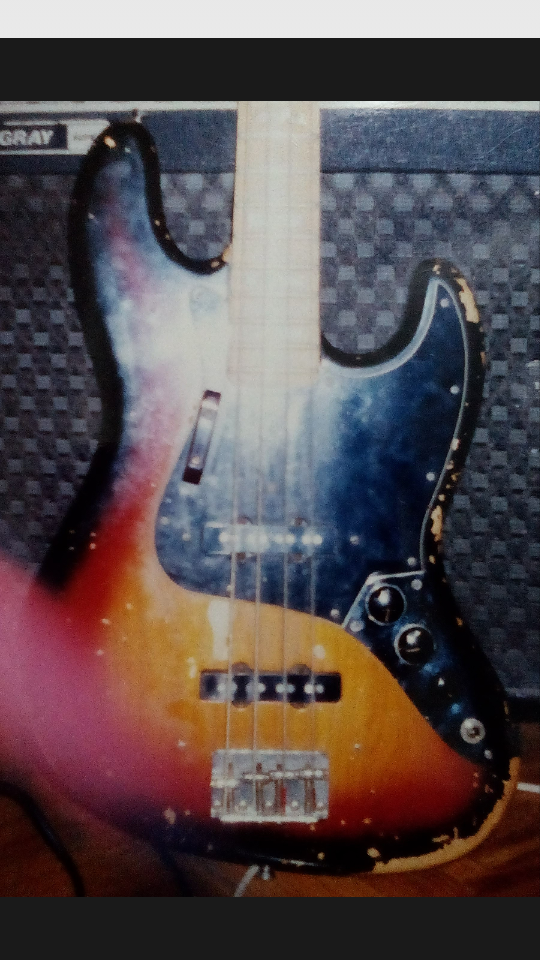
look at my sunburst 72 j:
[Invalid or Expired Link Removed]
'77 heavy ash sunburst jazz:

Looks like poly to me. And yes I've seen many Fender ash bodies finished in SB.
Yup, all fender basses (including the sunbursts) were ash in the late '70s (1976-1984)
I've owned lots of '70s Fenders too. Your finish is old poly and what you see is common for the era. As Narud said, the poly from back then is not the same (or as consistent) as today's modern poly. I've had many '70s poly Fenders that checked and were sprayed thinner than average like yours. Put it under a blacklight.. 35 year old nitro will glow like a radioactive green milkshake. Poly will not.

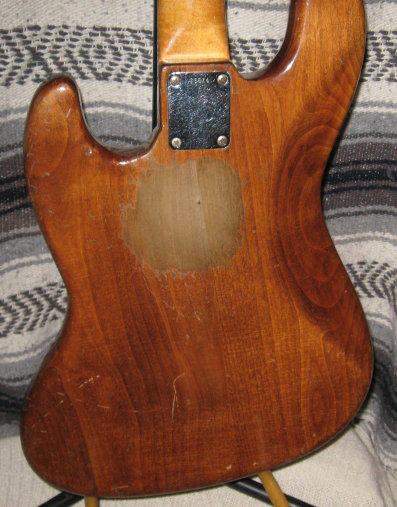
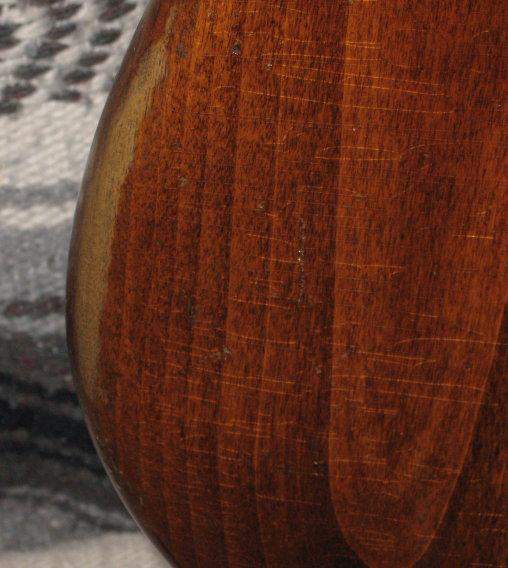
I can't help you with your finish, but I can tell you that old poly can and will wear and check much the like nitro. This is a 1962 Fender Jazz that I refinished with poly sometime between 1965 and 1971. It is clear poly sprayed directly on the alder wood surface. I sprayed several coats, however, the total finish thickness remained fairly thin, due to sanding between each coat.


DiabolusInMusic
Functionless Art is Merely Tolerated Vandalism
I've owned lots of '70s Fenders too. Your finish is old poly and what you see is common for the era. As Narud said, the poly from back then is not the same (or as consistent) as today's modern poly. I've had many '70s poly Fenders that checked and were sprayed thinner than average like yours. Put it under a blacklight.. 35 year old nitro will glow like a radioactive green milkshake. Poly will not.
You learn something new every day.

My experience with this is confined to my '78 P-Bass, which I bought from the original owner in 1988. It was/is a 3TB, and is most definitely ash-bodied.
- You probably won't see the Fullerplast; it's a sealer, and dried pretty clear. It lets the wood grain show through, but won't let the finish soak in.
- The finish on mine came off just like the picture - only in much larger pieces, and pretty much all at once (long story). The pieces were pretty brittle, too, which would incline me away from a poly finish, and more toward nitro - or enamel, given Fender's long use of Dupont car color paints.
- Mine was refinished in '91, although, since the total original finish left barely covered 2/3's of a business card, "refinish" is a stretch.
- Whatever the original finish on mine was, it's nitro now .
.
edit: Consensus seems to be "Poly - old stuff was different". If so, I'm glad the new stuff is better.
- You probably won't see the Fullerplast; it's a sealer, and dried pretty clear. It lets the wood grain show through, but won't let the finish soak in.
- The finish on mine came off just like the picture - only in much larger pieces, and pretty much all at once (long story). The pieces were pretty brittle, too, which would incline me away from a poly finish, and more toward nitro - or enamel, given Fender's long use of Dupont car color paints.
- Mine was refinished in '91, although, since the total original finish left barely covered 2/3's of a business card, "refinish" is a stretch.
- Whatever the original finish on mine was, it's nitro now
. edit: Consensus seems to be "Poly - old stuff was different". If so, I'm glad the new stuff is better.
Last edited:

I've owned lots of '70s Fenders too. Your finish is old poly and what you see is common for the era. As Narud said, the poly from back then is not the same (or as consistent) as today's modern poly. I've had many '70s poly Fenders that checked and were sprayed thinner than average like yours. Put it under a blacklight.. 35 year old nitro will glow like a radioactive green milkshake. Poly will not.
I have a 78 P in black, definitely poly, has some chips and cracks like OP's and it glows like crazy in black light. I opened it in a club once and thought someone stole my bass until I realized it was the lights.
The bass in question. You can see some chips on the lower side in one of the pictures:

One of my favorite basses is my 1978 sunburst RW P-Bass. I am basing this year of manufacture on the S863xxx serial number on the headstock, the pickup codes, the pot codes (one '77 and one '78) and the neck code. The bass has never been refinished. I'm sure of it. It is, with few exceptions like the pickguard and nut, original and unmodified. What I noticed when I bought this bass about 5 years ago was that the finish was rather "soft". What I mean by that is you could press a fingernail into the paint and leave a dent. I never gave it much thought... for 5 years. I recently read some articles here on TB and some other forums about others with '78 P-Basses with similar "soft" paint. This got my curiosity. Most were asking if their bass could possibly be finished from Fender with "nitro" but the responses unanimously from TB'ers referred the "fact" that Fender did not use nitro finishes in '78, they used polyurethane. Some offered that the soft paint could be due to Fender using a "catalyzed poly" without enough hardener mixed in causing the paint to soften over time.
So, my question was "how do you test for what your finish is or isn't". On further internet investigation I learned that THE test for nitro is using a dab of acetone or lacquer thinner on a q-tip in an inconspicuous spot under the pickguard...just a dab. Nitro will immediately soften up leaving a rough spot in the finish from the nitro softening, getting disturbed by the cotton and then hardening back up again as the acetone evaporates. Poly will not react at all. Well, I just tested mine with acetone and if this is a true test for nitro... mine clearly is nitrocellulous lacquer paint and not polyurethane or catalyzed poly. The surface of the paint immediately started to breakdown with some of the paint color adhering to the q-tip. The remaining spot looked like you touched a dry q-tip to a tacky painted surface (see picture). I also attached a pic of some dings in the finish down to the wood. I do not see any fullerplast undercoating. Only wood. And the painted finish is very thin. Not thick like poly.
This leaves me happy and confused. My finish passed the finger-nail test and acetone test for nitro. It's a '78. It has not been refinished. What happened?
View attachment 663111
View attachment 663113
View attachment 663115
It's definitly an ash body looks like a 1piece. Looks like a legit fender sb. If you can push your nail into it, it's definitly poly. The only thing I can think of is it's a nitro sb with a poly clearcoat. Also the body is reflective, nitro finishes were not very shiny. Fender did use nitro on the front of headstocks back then because the logo sticker wouldn't work with poly. I have a 1975 natural p-bass with nitro on the front of the headstock and it's a much darker color than the rest of the neck. It's also got checking (fine cracks) on the front of the headstock but nowhere else. Yours might be too. I don't know why but it looks looks like there is white primer under the paint around the edges. That shouldn't be there, only on solid colours like candy apple red, and black. Either way it is an awesome bass, hold onto it.
Yep. There are a number of 70's ash 3TSB Fenders on the web right now. (Reverb, Pinterest, Gbase and Ebay).
Jim Carr... I seriously do appreciate your feedback but you gotta let go of the "refin" angle.This bass was NOT refinished. No way. No how. If I had nothing to do I would disassemble the body and you would be able to see that but that ain't happening. I'm 64 and been buying (and selling) basses since 1971. I know what a refin looks like. Even a good one.
I have held on to this P-Bass because it sounds better with flats than any of the 20+ P-Basses that I have owned including my late 60's and early 70's CBS transition basses, an American Vintage '63, two Select P-Basses and a flock of American Standards. This one just has "the" sound (I hate that term).
So further searching of numerous forums last night just confuses the issue more since a number of people are saying that all poly isn't created equal and some poly's are impervious to acetone (one person actually used it to clean his finish) and some poly's get disolved quickly by acetone just like nitro would. So, IF this is true, that tells me acetone is not the best test for identifying nitro. Had I known that I wouldn't have bothered to test it with acetone.
I wouldn't spend too much time on the acetone thing. There would be a definite date that fender switched. Try calling a reputable vintage dealer like Gruhn. Thats a 62, and a 63 p-bass. You can see the left 62 has a refin headstock and the 63 is original and much darker. Bodies are orig, and pretty dull. Ya the pics old. (I paid 750 for each of those basses in 1990.) I tried to sell both of them together for 1950.00 and nobody wanted them.


