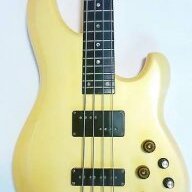
wow...a pbass?
this should have its own thread.
I don't think I have enough for a new thread, because unfortunately I don't have any photos of it's construction, except when I made the new neck, which also required inlaying a maple block to rout a new neck pocket.
I have a few photos of the new neck being made.
The history of the bass is a long one. It started off as something the singer in my band at the time got from a local guitar maker. He had moved the split pickup to the bridge position (where is still is) and made his own humbucker, which was installed at the neck position, but closer than the P pickup. It had a thin white single ply pickguard that extended up to the repositioned P at the bridge, kind of the way it is now, but different. It was sunburst with a maple fingerboard.
The fingerboard was in bad shape, and a lot of the frets were lose. It also needed to be planed flat.
I ended up with the bass (I traded her a Gibson EB-2 I wasn't using... wish I had that bass now) and removed the homemade humbucker, and put two DiMarzio Model P's in the bass. The was the late 70's, so those had just come out. I made a new pickguard out of black acrylic, and had series/parallel for each pickup, as well as phase and series for both pickups. I removed the sunburst and left it natural alder, and installed a Badass II. I also cut the headstock to look like a Music Man.
It was a cool bass, but the frets were still a mess.
Since it wasn't my main bass (I was playing a '74 Ric 4001) I decided to make it into an 8 string. I cut parts of the original headstock off, and spliced on a new piece of hard maple, using an odd joint I made up. It seemed to hold up well enough.

I made a new brass nut for the bass, and added a metal bar to hold the strings down.
I got 4 Schaller mini bass machines, and 4 Gotoh guitar machines. I drilled four holes through the Badass all the way through the body, and installed ferrules in the back for the octave strings.
I wasn't confident about doing the fretwork myself, since it was such a mess, so I took it to a local repair shop, and explained the frets needed to be removed, and the board had to be planed down and new slots cut.
I got the bass back worst then it went in! The guy went on and on about how the fret slots were shot... totally ignoring the fact that I told him it needed to be planed and reslotted!
That was the last time anyone ever did any work on one of my basses. So he did me a favor since I learned to do the work myself!
In 1980 I cut the body to the shape you see, and painted it hot pink! I had added a varitone by then to try and tame the harsh midrange the bass got.
I was playing in a new wave band called the Jetsonz (not the band from Arizona), and it got a lot of use.
After a while I didn't use it much, and started experimenting with new pickups for the bass. I would a low impedance pickup and ran it into a Barcus Berry preamp made for piezo pickups. That sounded so good that I based my current pickup off that original experiment.
Some years later I dug the bass out of storage and made a new neck for it. It's 7 piece maple and walnut, with an ebony fingerboard, two truss rods, and graphite. It totally changed the tone of the bass for the better.
I painted the body black, and made a new pearl pickguard. It has two low impedance P pickups, with FET buffers and an op amp based pickup mixer with bass and treble controls.
Here's a song from 1980 featuring the bass. That's the bass starting the song off. (I'm playing bass, guitar, and farfisa organ).
[Invalid or Expired Link Removed]
I don't want to hi-jack the thread, but this goes to show what you can do to alter a bass.
Here's a few photos.
Here's the body, partly stripped of its paint, and all the parts for the new neck. The neck blank was all ready glued up. You can see that the body started off as day-glo pink, and then was a sort of fuchsia. Hey, it was the 80's!

Here's the back of the neck before carving, and also before the back strap was applied to the head. You can see the scarf joint. There's no reason for the head to have walnut lams.... I just felt like it.
Here's the finished neck after I sprayed clear lacquer on it. The unfinished body is on my very messy work bench. You can see the new neck block, and I also contoured the lower horn. You can also see where the holes for the through body octave strings were plugged.
Taa daa... the finished bass, strung up with 4 flatwounds, along with some of its cousins. Yes, it was 1996. That's in our old shop in Hoboken, in the same space that Guild Guitars once occupied. If only the walls could talk!