
Enjoy the benefits of a premium membership!
Upgrade Account
-
TalkBass has been independent since 1998. Add your voice.
Create a free account to reply to discussions, view embedded media, and browse with fewer display ads.
Join free Log in
Want zero display ads or expanded classifieds tools? Compare plans.
You are using an out of date browser. It may not display this or other websites correctly.
You should upgrade or use an alternative browser.
You should upgrade or use an alternative browser.
810 cab for guitar?
- Thread starter bigmuff113
- Start date
More options
Who Replied?If Jimmy Hendrix played guitar through an 810 bass cab, it would sound great.
If I played guitar through an 810 bass cab it would not.
Either way, it's not practical, because there are a lot of great sounding, easier to move guitar rigs out there.
I'll also be using this as my bass rig, so I'll only ever have to worry about one amplifier
Ive put guitar through a 1x 15 , 2 x10 and 4 x10.not at the same time of course.
Thought it sounded great. Shuttlemax 6 with a Benz 2x10 sounded lovely with an acoustic guitar.
Thought it sounded great. Shuttlemax 6 with a Benz 2x10 sounded lovely with an acoustic guitar.
I'll also be using this as my bass rig, so I'll only ever have to worry about one amplifier
I'd be running a minimum 100 watt tube amp then with a master volume. Getting everything you can get out of it on bass and turning the master quite a ways down on guitar would at least have a chance at ending up at a similar volume for both.

You'd be better off with something that has a mid speaker and a tweeter if you're going to use it for a guitar, if not you'll just sound bad.
You're joking, right?

You're joking, right?
Not at all. I used a homemade 212+2x6 with 2 tweeters as my guitar rig (this being two separate cabs of course). Distortion usually clips away most of the frequencies going to the tweeter anyway. I actually really liked sound I get out of it, but I don't have my guitar head anymore.
Hi.
Unless this is a joke (as I thought the first one was as well), could You elaborate a bit?
That's the first time I've heard anything like that, and I do have blown several tweeters with a distorted guitar.
I was young and ignorant then though.
Now I'm just ignorant .
.
Regards
Sam
Distortion usually clips away most of the frequencies going to the tweeter anyway.
Unless this is a joke (as I thought the first one was as well), could You elaborate a bit?
That's the first time I've heard anything like that, and I do have blown several tweeters with a distorted guitar.
I was young and ignorant then though.
Now I'm just ignorant
.Regards
Sam

I’ve got a dumb idea… rig it like two separate 410 cabs in one, put guitar-friendly speakers in one half for that, and the other half for when you’re playing bass.
Yeah... I'm not sure how that would sound good, at all. So I'm a bit curious.Hi.
Unless this is a joke (as I thought the first one was as well), could You elaborate a bit?
That's the first time I've heard anything like that, and I do have blown several tweeters with a distorted guitar.
I was young and ignorant then though.
Now I'm just ignorant
Regards
Sam
I can see tweeters being useful for ultra-clean bass, and even though I'm not really that fond of said sound, I can see liking it.Tweeters on a guitar? BLECH! Even worse than bass!
I use overdrive on bass, though, so tweeters aren't for me. The idea of preferring them for overdriven guitar is very strange to me.

Distortion usually clips away most of the frequencies going to the tweeter anyway.
BRO!?!?!
I occasionally fire up the Hiwatt DR201 clone with one Ampeg SVT410HE (tweeter turned off) and a guitar and it's always a deafening, comforting experience..The Weber 6S100 works for guitar to but it doesn't break up as nice as the DR201. Insane volume though, so I'm building a Deluxe now to keep the neighbourhood happy.
Hi.
If my memory serves me correctly, it didn't sound THAT bad. Until the tweeter blew that is.
The times were different though.
In the 80's all the affordable speakers/drivers did benefit from a bit of high frequency "assistance" and the tweeters I learned to dislike and avoid, were those god-awful Monacor cheapies.
With just a cap as a "cross-over".
IMO the tweeters were just the means to get closer to the sound of the more expensive rigs though, and absolutely by no means were preferred.
More like tolerated if one was on a budget and couldn't afford to buy a Celestion.
We were teens with all sorts of other money sinkholes besides MI & PA gear, so that must've had something to do with it as well.
While cheap, those blowing tweeters were abandoned from most of the cabs I was around eventually, we probably adjusted our ears to less high frequency content or something.
We also got jobs and bought those Celestion equipped cabs we had ben drooling over, or upgraded our old ones
Regards
Sam
Yeah... I'm not sure how that would sound good, at all. So I'm a bit curious.
The idea of preferring them for overdriven guitar is very strange to me.
If my memory serves me correctly, it didn't sound THAT bad. Until the tweeter blew that is.
The times were different though.
In the 80's all the affordable speakers/drivers did benefit from a bit of high frequency "assistance" and the tweeters I learned to dislike and avoid, were those god-awful Monacor cheapies.
With just a cap as a "cross-over".
IMO the tweeters were just the means to get closer to the sound of the more expensive rigs though, and absolutely by no means were preferred.
More like tolerated if one was on a budget and couldn't afford to buy a Celestion.
We were teens with all sorts of other money sinkholes besides MI & PA gear, so that must've had something to do with it as well.
While cheap, those blowing tweeters were abandoned from most of the cabs I was around eventually, we probably adjusted our ears to less high frequency content or something.
We also got jobs and bought those Celestion equipped cabs we had ben drooling over, or upgraded our old ones
Regards
Sam

Ive got a dumb idea rig it like two separate 410 cabs in one, put guitar-friendly speakers in one half for that, and the other half for when youre playing bass.
So in each case you carry an 8x10 to get the benefit of a 4x10. Why would you bother???
So in each case you carry an 8x10 to get the benefit of a 4x10. Why would you bother???
I said it was a dumb idea... I was just trying to accommodate the one-cab-for-both idea
I personally would (and do) have separate guitar and bass cabs.

Pretty sure Keith Richards & Mick Taylor played through Ampeg SVT 8x10s during early 1970s Rolling Stones gigs. I used to have a poster of the Stones on my wall when I was a teenager, and the backline was this unending sea of SVT cabs!
edit: Something like these (though admittedly these cabs look shorter than SVTs)
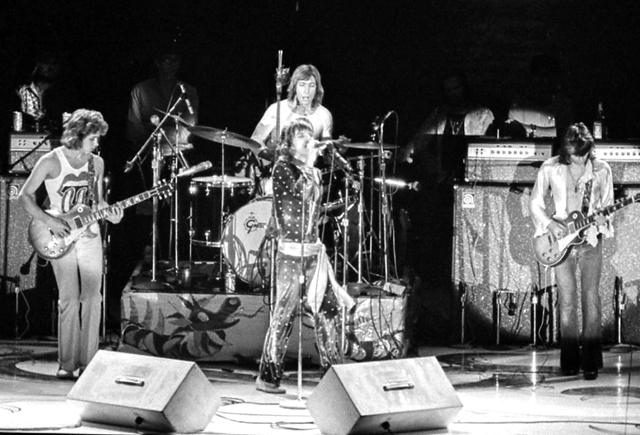
You can hear that full SVT backline on the live album "Get Yer Ya-Ya's Out". Also a credit for "amps by Ampeg" on the back cover.
BRO!?!?!
What? The way I understand the distortion I use (diode clipping) removes part of the signal, the highest and lowest frequencies, turning your nice smooth valleys and peaks of your sine wave to a flat line, giving a distorted sound.
THIS IS NOT THE CASE for DIGITAL DISTORTION, where you're just pushing out all the frequencies a clean guitar would, just as a different wave shape.
Hi.
Not quite the case with either form of distortion.
Rather the opposite really.
Both (all) forms of distortion usually create high frequency content that will destroy a tweeter in no time if precautions aren't taken.
Some easy reading that may shed some light to the subject:
General information:
http://en.wikipedia.org/wiki/Distortion
In popular music:
http://en.wikipedia.org/wiki/Distortion_(music)
Regards
Sam
What? The way I understand the distortion I use (diode clipping) removes part of the signal, the highest and lowest frequencies, turning your nice smooth valleys and peaks of your sine wave to a flat line, giving a distorted sound.
THIS IS NOT THE CASE for DIGITAL DISTORTION, where you're just pushing out all the frequencies a clean guitar would, just as a different wave shape.
Not quite the case with either form of distortion.
Rather the opposite really.
Both (all) forms of distortion usually create high frequency content that will destroy a tweeter in no time if precautions aren't taken.
Some easy reading that may shed some light to the subject:
General information:
http://en.wikipedia.org/wiki/Distortion
In popular music:
http://en.wikipedia.org/wiki/Distortion_(music)
Regards
Sam
Thanks for setting me straight. Guess I missed a couple steps along the way.
Can't fix the fact that I like my guitar rigs with tweeters though!
Wikipedia is one of the places I went when I was tinkering with home made distortion, and I got the idea of signal clipping with diodes from
http://en.m.wikipedia.org/wiki/Clipping_(music)
Right before finding out that everyone else in the world had done it already. . .
Can't fix the fact that I like my guitar rigs with tweeters though!
Wikipedia is one of the places I went when I was tinkering with home made distortion, and I got the idea of signal clipping with diodes from
http://en.m.wikipedia.org/wiki/Clipping_(music)
Right before finding out that everyone else in the world had done it already. . .


