AWW Thats what I wanted to know. Thank you.
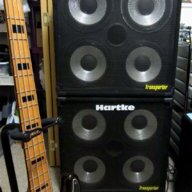
When you add a second identical speaker the
total power handling doubles and the impedance halves.
When you have two speakers playing close to each other, you get acoustic coupling that nets a theoretical +6dB across the frequency range in which the drivers are within approximately 1/4 wavelength. In other words you get enhanced sensitivity in the low in. This is why it's often better to increase the number of cabs rather than increase the level of power.
However it's unusual to actually realize the full 6dB because most amps do not double their power when the impedance is cut in half. With a tube amp, for example, the power is the same regardless of impedance as long as the amp sees the expected load. So if you add an identical speaker that changes the load from 8 to 4 ohms and reconfigure the output of the amp from 8 to 4 ohms, the amp will make exactly the same power. The power is then split equally between the speakers which drops the SPL each speaker makes -3dB before the +6dB of acoustic summing occurs. Therefore you only get -3+6=+3dB.
A few solid state amps actually do double the power when the load changes from 8 to 4 ohms. So when you plug the second speaker, the first speaker continues at the same power/volume and the second speaker matches the power/volume. This is the situation where you get the full +6dB.
Let's use the actual spec for one of my amps to see what typically happens. Let's assume a speaker with a 97dB sensitivity rating, and a series I GK 700RB that makes 225W at 8 ohms or 380W at 4 ohms. As you see this amp does not double its power; rather it makes about 170% more power when the load is cut in half.
First lets find the dB difference for 1-225W. I don't know the math so I will use
Watts to dBm conversion calculator
1W = 30dBm
225W = 53.52dBm
I rounded these figures up to the second significant digit. We will drop the "m" from the unit of measure since we are concerned with calculating the dB change.
53.52-30=23.52dB. This is the dB change from 1W to 225W
Add this to the 97dB sensitivity rating of one cab. 97+23.52=120.52dB. This is max calculated SPL of one 8 ohm cab.
Remember with identical two speakers in parallel, the power is split evenly between them and at 4 ohms the amp makes 380W.
380/2=190W per speaker.
From the Watt to dBm calculator
190W = 52.79dBm
52.79-30=22.79dB. This is the dB change from 1-190W.
Add this to the 97dB sensitivity rating of one cab. 97+22.79=119.79. So we see that each speaker is now playing a bit lower than if if were only using one speaker. But then we get ~+6dB from acoustic summing in the low end where most of the power is used. 119.79+6=125.79dB. This is the max calculated SPL with two 8 ohm cabs in parallel.
125.79-120.52=5.27. In this case, adding the second speaker gives us +5.27dB, which is a noticeable difference, and definitely more than you would get by doubling the power into a single speaker.
So adding a second speaker allows your rig to play louder while putting less stress on the speakers. In this example, when we added the second speaker the max power level presented to each speaker dropped from 225W to 190W.