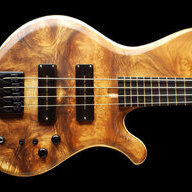
It's going to be a fanned fret project, right? But would the fret position of the tapping strings be correct? Maybe they won't be able to intonate correctly that way. But, if I'm wrong, just ignore me. I'm a beginner when it comes to luthiery.

TalkBass has been independent since 1998. Add your voice.
Create a free account to reply to discussions, view embedded media, and browse with fewer display ads.
Join free Log in
Want zero display ads or expanded classifieds tools? Compare plans.

...Oops, wrong person, wrong thread. Sorry, John. I could blame it on the impersonality of internet, but more likely it's early senility.Never have, do you have a link or some more info. Thanks. BTW I'm John not Scotty.


It's fine, I checked. But thanks for the concern.It's going to be a fanned fret project, right? But would the fret position of the tapping strings be correct? Maybe they won't be able to intonate correctly that way. But, if I'm wrong, just ignore me. I'm a beginner when it comes to luthiery.
Hi Pilot, or should I call you Mr. Jones....Oops, wrong person, wrong thread. Sorry, John. I could blame it on the impersonality of internet, but more likely it's early senility.
Pic at the top of this page, "Victor Wooten's Step Neck Bass," and then follow the two links next to it.
Invalid Link Removed
Jack stopped building basses and switched to only amps a few years ago, and then I think disappeared. Too bad, he was very good and by all reports helped out people who asked him luthiery questions.
 . I clicked the link but no luck. I even googled it "Victor Wooten's Step Bass" interesting stuff, I'll need to read more about it. I was really looking to see pics. (I hate reading)
Thanks, when I think of a harp guitar, I think of the one Steve Miller plays. I saw an interview of him and he said he found it in a box at a music store for something like $100. I could be wrong, it might have been a pawn shop or a thrift shop.I'd take this over the harp guitar
It really quite simple, you can play bass like usual, slap, thumb, dig in or what ever you want and reach over with the right hand and tap out chords, melodies, ect will playing bass lines with the left hand.


With tappers there's a damper, usually a piece of foam between the first fret and the nut. The last tapper I made a removable damper out of velcro.Interesting.
How will you keep the melody side from resonating when using both hands to play the bass side?
It will basically be like a normal long scale tapper aka Chapman Stick/Warr Guitar. But the melody will just be shorter on this build and you don't need to cross your hands to play it. Also with a Stick you have to play it horizontally (straight up and down) with this it will be like a regular bass and the tapper section will be easy to reach. The other thing is the bass will be in standard 4ths not 5ths.That's a really interesting idea, actually more like a reverse harp
Even though I would never be able to play it (tapping eludes me) it's great to see somebody trying something new and different, I've certainly never seen anything like it before and the collective wisdom of TB seems to have a rare instance of not coming up with a previous example of something similar. I'm very curious to find out if this concept works as promised.
I think that resonance of the melody side may be a creative benefit but could easily be damped by a palm or forearm if needed.
One thing though. Are you going to have to photoshop the melody side of the build out for the benefit of those on the forum that only want to see bass builds?
Just kidding...
I don't think I will, I'm going to use guitar strings. Besides on tappers the strings don't have as much tension as regular basses or guitars. Most of the time they use a lighter gauge string. One example is the Megitar brand, on the low string they come with a 100 gauge. http://www.megatar.com/english/tunings/String_Gauges/string_gauges.html
I hope these links work. I don't know whether archive.org allows cross-linking.jworrelbass said:I was really looking to see pics.
readcustom.com site said:Invalid Link RemovedInvalid Link Removed
The Innovative Step Neck Bass!
Shown here is Victor Wooten's Step Neck bass.
The Step Neck bass offers the feel of a four-string in the lower registers but the range of a five-, six-, or more-string bass in the upper range. The unique design of this bass gives players easily reachable low notes and wide string spacing for the plucking hand.
In this unique bass design, the shorter strings are fed through ferrules in the back of the neck and down to tuners at the bridge, leaving the back of the neck smooth and unobstructed. The shorter strings can be tuned as drones in any key or, in a more conventional arrangement, could be tuned in fourths. In any arrangement, the bass offers composition options never available to the bassist before.
Step Neck basses are available in limitless configurations, based on four- or five- (full length) string necks stepped out with one, two, or more short strings.
The bass pictured is outfitted with Lane Poor pickups and a Bartolini 3 band preamp. Vic's tapping and chording talents will no doubt make good use of the low action and ample string access. Michael Hulsey, designer of the Step Neck, has begun developing Step Neck guitars and is licensing the concept to Read Custom Instruments.
Invalid Link Removed
Since this is somewhat of an experiment I'll be playing with several string gauges. The tension on the short scale will be what it needs to be for the tap action to work best. I'm also going to build 2 separate necks and pickups. I really don't see any problems, but then I could be wrong.yes, but will the tension be uniform across the neck? You know what i mean?
Pete, your the man. Thanks a bunch, what a cool bass!I hope these links work. I don't know whether archive.org allows cross-linking.

Correct me if im wrong since ive heard this from a friend but wouldnt the frets have to be on an angle where the 9 strings are to keep the correct notes?
With tappers there's a damper, usually a piece of foam between the first fret and the nut. The last tapper I made a removable damper out of velcro.
It will basically be like a normal long scale tapper aka Chapman Stick/Warr Guitar.