• TalkBass has been independent since 1998. Add your voice.
    Create a free account to reply to discussions, view embedded media, and browse with fewer display ads.
    Join freeLog in
    Want zero display ads or expanded classifieds tools? Compare plans.

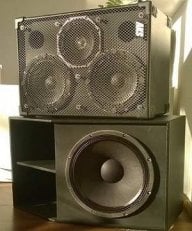
A little on DNA cabs

These come pretty close though.
Invalid Link Removed
Close, but no cigar. And as is always the case there's no such thing as a free lunch. Compare the SPL charts to the Deltalite II 2510, you'll see the 2510 crushes the 10HP1020 in the mids. Then model the two and you'll see that the low Qes/Qts of the 10HP1020 chokes off the bass response. The Faital works very well in its intended application, for PA mids, but as an electric bass driver it doesn't make the grade.
 
Compare the SPL charts to the Deltalite II 2510, you'll see the 2510 crushes the 10HP1020 in the mids.
Thats mainly because of the very ugly resonance peak of the 2510. In the usable mid-range they perform pretty much the same.

About xmax, like I said earlier, the so called calculated xmax doesn't say sh... These manufacturers need to show us the distortion plots below 100hz.
 
Thats mainly because of the very ugly resonance peak of the 2510. In the usable mid-range they perform pretty much the same.

About xmax, like I said earlier, the so called calculated xmax doesn't say sh... These manufacturers need to show us the distortion plots below 100hz.
That resonance peak is responsible for what most players refer to as tone. If one does use the 2510 in a multi-way system crossed over at the -6dB/30 degree off-axis frequency (which not one manufacturer of bass cabs using them does) that peak is an octave above bandwidth, rendering it moot. Eminence xmax figures are all Klippel based.

 
That resonance peak is responsible for what most players refer to as tone.

Yes and no.
If "coloration" is the bassplayers thing, go for it.
But if you want to reproduce the true sound of your bass, you do not want this peak. This membrane resonance peak will also have a long decay, which doesn't make the sound accurate.

I know eminence uses klippel(saw it on the klippel site).
But what I want to know is how fast does the distortion rise, e.g. at 50hz, 95dB and at 50hz, 105dB.
it's a pitty I threw the 2510 into the garbage can, else I could have measured the 2nd and 3rd order distortion. But what I know is that the Oberton 10B200 only has a slightly higher xmax, but the distortion in the low end is a lot lower.
Farting out is just the audible distortion, and thats measurable.
Another example, I have two old 12" philips woofers (one from the 70's and one from the 80's). Both have aprox the same tsp's and the same voicecoil height and plate height. You would think that they should fart out at aprox the same level, hell not. The ol'70's woofer farts out much earlier as the 80's model. The 80's model has way lower distortion, probably due to the use of demodulation/shorting rings.
 
What replaced the Venza, Mike?

My wife stole it, traded it in on a Highlander and I got her old car, which is not conducive to hauling gear at all. So now I have to borrow her car to get my gear to gigs. Here's the hand-me-down.

CARSCOOP2008_GS460_01.jpg
 
If "coloration" is the bassplayers thing, go for it.
But if you want to reproduce the true sound of your bass, you do not want this peak.
Tell that to the owners of 99% of the electric bass cabs ever made, which all have highly colored response. Not that I agree that it's necessarily desirable, but it is a fact of life. I wouldn't run a 2510 to 2.5kHz in a direct radiating alignment either, but only for reasons of dispersion, not response.
And to tie it back to this thread, the DNA would also have colored response, because it doesn't cross to a mid driver at less than 1.5kHz. By no means does that say it wouldn't sound good. I bet it sounds just fine. But it will still fart out at least 400 watts shy of that 1400 watt rating. :p
 
Tell that to the owners of 99% of the electric bass cabs ever made, which all have highly colored response.

But why do some many bassplayers like their sound in the studio when they go directly into the board?

I agree that a lot of players like that coloured sound, but when you want the same sound through the pa you need to mic it. So what's wrong with having the coloration coming from you pre-amp instead. In that case you don't have to use a speaker in the range where it produces a resonance peak.
I like the sound of my bass when I hear it through my focusrite saffire le (without tone shaping) and run it trough my small monitors that do not have any resonance peaks. It sounds very detailed, real and punchy.

I wouldn't run a 2510 to 2.5kHz in a direct radiating alignment either, but only for reasons of dispersion, not response.

I would not use the 2510 for both reasons you mentioned, there are better options.
 
Back to the DNA cabs over view.....

I have 2 DNA 210's and I certainly do not miss my Mesa 410's. The DNA speakers seem to have a lot of midrange - it's thick sounding the entire way through with decent grind in the upper mids for great pick playing tones. They are loud cabs and have been cutting through on stage next to a loud drummer - then again, I roll off most of the sound below 80hz. So I can not comment too much about low end response, but they sound great for any style of music I play through them.

Numbers aside, the DNA 410 is a beast! I was lucky enough to hear Bill Dickens (in person and about 10 feet away from him) punish the DNA 410 and it got FREAKISHLY loud without farting out. I had never heard slap bass that loud before. When people say it can go toe to toe with an 810, they are not kidding. It's a loud cab!

I feel these cabs are much better than the Eden XST series - those cabs did not have much of a midrange response at all. It was way too clear sounding and had no thickness.
 
OK, I made it back over to BSD today to pick up the Nordstrand pickups for my Mustang RI. While I was there, I played an F Bass BN5 through the same TC Electronic amp into the DNS-112N and the DNS-112N Micro. Both sounded good, but the DNS-112N sounded a little boxy to me ... not enough articulation in the highs. On the other hand, I liked the DNS-112N Micro better, even though the cab is much shallower. It seemed to cover the high end better, while still giving plenty of substance to the B string. I played them pretty loud, with no farting on the horizon. Good cabs. BTW, I didn't play the 115 again, but I still hate it.
 
But why do some many bassplayers like their sound in the studio when they go directly into the board?
who says all studio gear is near-flat response? there's plenty of high end studio gear that isn't, especially when it comes to monitors.

i used to think i could tell flat response when i heard it...found out quite quickly that i can't. still can't either, unless i'm really calibrated to the system i'm listening to it on. and i'd bet money that 95% of bass players can't either. so the sad fact is that the vast majority of bass players THINK they know what they want, but very few of them have any clue whatsoever to what they're listening to.

 
who says all studio gear is near-flat response? there's plenty of high end studio gear that isn't, especially when it comes to monitors.

Studio standards ask a max deviation of +/-2dB (60-16.000hz) for monitors, that's reasonably flat.
What I have at home for hifi and my homestudio is easily within that spec.
I don't know any high-end (studio)gear(speakers, (pre-)amps) that isn't nearly flat. Maybe the yamaha 10ns or whatever they are called. They are definitely not flat, and thats also what you hear. I know the whole story why they have such a rugged frequency response, but I don't think they can be used with todays recording standards.

so the sad fact is that the vast majority of bass players THINK they know what they want, but very few of them have any clue whatsoever to what they're listening to.
True
 
who says all studio gear is near-flat response? there's plenty of high end studio gear that isn't, especially when it comes to monitors.
Most high-end studios I've worked in will "voice" the control room monitors with a spectrum analyzer from time to time, to assure as flat a response as possible.
i used to think i could tell flat response when i heard it...found out quite quickly that i can't. still can't either, unless i'm really calibrated to the system i'm listening to it on. and i'd bet money that 95% of bass players can't either. so the sad fact is that the vast majority of bass players THINK they know what they want, but very few of them have any clue whatsoever to what they're listening to.
+1.....ain't dat the truth! :p