• TalkBass has been independent since 1998. Add your voice.
    Create a free account to reply to discussions, view embedded media, and browse with fewer display ads.
    Join freeLog in
    Want zero display ads or expanded classifieds tools? Compare plans.

A math guy looks at scales

Should be able to put them all in order off brightness and see the evolution

I have been aware of progressive flatting in the diatonic major from the Lydian down for a long time, but never thought to blend the melodic minor on the same scale.

Soloing, i move one up or down to add variety to liven it up.
 
Should be able to put them all in order off brightness and see the evolution

The cool thing about the Lydian and Locrian scales is that they both have an innate tritone (aug4 in Lydian and dim5 in Locrian). Of course, the "darkening" is just the addition of flats in the relative intervallic makeup of each mode of the major scale:
#4 Lydian
-- Ionian (Major)
b7 Mixolydian
b3b7 - Dorian
b3b6b7 - Aeolian (Pure minor)
b2b3b6b7 - Phrygian
b2b3b5b6b7 - Locrian

edit: Interesting that they chose James Hetfield on the dark side. I think that it stems from the fundamental misapprehension that modern metal is diatonic. It isn't; it's tonal (in the sense that it works around tonal centres - beyond that, anything goes). An extreme example that illustrates this gratuitously:

Ron's approach to music is entirely mathematical, employing a strange sort of pseudo-serialism. Rather than strictly requiring that each chromatic note must be used before allowing repetition, he instead builds phrases using all 12 tones, and arranges them rhythmically to make sense against other phrases.
 
Last edited:
  • Like
Reactions: mikewalker
....
Consider Schenkerian analysis of music...

I get Schenkerian Analysis. These charts when viewed at 'reading speed', all look the same to me. I just can't visually process them at anything like the speed I can visually process a score, where I can hear what I'm reading at tempo (having been taught to sing at sight as a child).


View attachment 3607802
Harmonic Minor, Harmonic Major, Double Harmonic Major
 
Last edited:
I felt the same way. Wait, you mean i can do ODE with algebra! I am not a EE .. who are the guys that really use this stuff proficiently. I used it in heat and flow simulation with step inputs. I understand the math purists fought LTs for decades, as the proofs lagged the results and Heaviside didnt care.

Actually all the preparatory grunt work did come in handy some time later, when working with plasma physicists. Once they knew they couldn't baffle you with Maxwellian BS, they got a lot more collegial to work with. :thumbsup:
 
  • Like
Reactions: IamGroot
Actually all the preparatory grunt work did come in handy some time later, when working with plasma physicists. Once they knew they couldn't baffle you with Maxwellian BS, they got a lot more collegial to work with. :thumbsup:
Back in the 7s, our plasma physicists ran the copper power bars feeding the Tokamak less than a foot apart. The first time they pulsed it, the bars immediately got a lot further apart. I guess they didnt understand Maxwell either. Btw, the 4 Maxwell eqns you love are actually the rewrites by Heaviside.
 
  • Like
Reactions: okcrum
I get Schenkerian Analysis. These charts when viewed at 'reading speed', all look the same to me. I just can't visually process them at anything like the speed I can visually process a score, where I can hear what I'm reading at tempo (having been taught to sing at sight as a child).
The charts werent intended for speed, but i bet you could fin a tritone in any of them real fast.
 
The charts werent intended for speed, but i bet you could fin a tritone in any of them real fast.

True, but when represented in a cyclical manner there is no ambitus, so for every interval in a scale it's inversion also must exist. So I still need a letter name on the slice with the dot (or I have to count the shaded slices in between - which to be fair isn't difficult even in peripheral vision) to know if it's an augmented 4th or a diminished 5th.

It might be easier with a modal melody having a typical constrained ambitus of, say, Final to 8va+9th where not every interval can be inverted without busting through the upper or lower limits. Imagine a melody using G myxolydian with an ambitus from G to A'. The diminished 5th tritone B-F cannot be inverted to an augmented 4th as neither of the low F or high B required to do so are allowable. Of course if the ambitus was from F below Final to Final +8va, also common, or the mode were locrian or lydian (the purest, most literal, tritone) then the tritone inversion can exist, even within the octave, so we're back where we started, counting shaded wedges.

Anyway, I realise this post is a bit of a derail, so please accept my apologies... I do have a genuine interest in analytical tools and methods but I'm struggling to see the value here. Must be missing something fundamental...
 
Last edited:
I created what effectively is a graphical representation of the Whole / Half step treatment of scales. I like the visual aspect as it corresponds to how I "think" scales....by scale degree and steps.

Like it, dont like it. Its a choice. I thought it was rather cool.

WWJAD*


*What would Jamie Aebersold do?
 
Yes, I watched that, too. Nice presentation of the ideas.

I have a thought about another way to look at this - if I can get some time, I'll put it together and post it today.

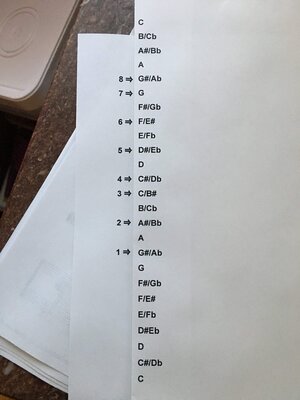
[EDIT] I did it. The idea would be any scale/mode on the left, and a two-octave chromatic scale on the right. Use one piece of paper for each, slide to get the one you want. Shown for an Ab major scale below.

ADE1601F-C74D-445C-A71B-90DE8B171729.jpeg

-S-
 
Last edited:
My next step would be to create circular flashcards on projection mylar without the reference dot.

I always start from the 9 oclock position and can find the p4, p5 etc by location immediately.
 
The spatial relationship of the tritone to the root (immediately opposite ) and the 4 and 5 to either side is nice. The b3 and 6 at right angles.

This is all stuff we know, but its nice to see in an uncluttered graph.
 
Yes, I watched that, too. Nice presentation of the ideas.

I have a thought about another way to look at this - if I can get some time, I'll put it together and post it today.

[EDIT] I did it. The idea would be any scale/mode on the left, and a two-octave chromatic scale on the right. Use one piece of paper for each, slide to get the one you want. Shown for an Ab major scale below.

View attachment 3609870

-S-
My vision is too old to read that.
 
I created what effectively is a graphical representation of the Whole / Half step treatment of scales. I like the visual aspect as it corresponds to how I "think" scales....by scale degree and steps.

Like it, dont like it. Its a choice. I thought it was rather cool.

WWJAD*

*What would Jamie Aebersold do?

I think it's cool as well, and created the same circle for the major scale several years ago before I even picked up a bass guitar.

I also think of multi-octave scales as a 3-D spiral and not just another rotation of the circle.
 
  • Like
Reactions: IamGroot
There was a guy named Martin Gardner who wrote a recreational mathematics column for Scientific American for 30 years. Most of his stuff was fun and light hearted, but a couple of things he brought up...like tessellation... really caught on.

This was my Martin Gardner moment.