• TalkBass has been independent since 1998. Add your voice.
    Create a free account to reply to discussions, view embedded media, and browse with fewer display ads.
    Join freeLog in
    Want zero display ads or expanded classifieds tools? Compare plans.

A Review: You think Furman power conditioners are worthless?

Status
Not open for further replies.
You think Furman power conditioners are worthless?

Maybe worthless is too strong a word. Everyone needs a paperweight on a windy day. These are my preliminary impressions of the Furman PL-PLUS II line conditioner. It has a voltmeter on the front, some pullout rack lights, and claims to do nifty things to keep your power clean and safe. This is going to be kind of stream-of-consciousness since I don’t have much time to write.

First impression as the unit comes out of the box: For a $200 rackmount piece of equipment, this thing is really lightweight. And why does this one rack light keep sliding out on its own? The other one requires a firm tug to pull it out all the way. Every time I move my rack, the light is going to extend. I feel the quality already. Or not.

Well, let’s plug it in and turn it on. Plugged in. Switched on. There’s something interesting. It switched power on to the outlets right away, before I even had a chance to read the voltmeter. Oh, that was pretty. The row of display lights ran back and forth for a few seconds before reading out what the voltmeter was actually sensing.

Look at that, it just went into protect mode after 15 seconds of normal operation. OK, cycle the power. Another pretty light show. Seems to be running normally now.

These rack lights are actually pretty bright. They are a combination of one white LED and two yellowish LEDs that create a somewhat soft color. Each light is a circuit board mounted inside a tubular housing. It is some kind of conduit pipe cut down into small sections with a crude hole drilled in it. Painted silver, I think. The lights are retained by plastic clips to the front panel. They feel cheap and loose.

I’ll take a look under the hood. There’s no warranty seal or anything.

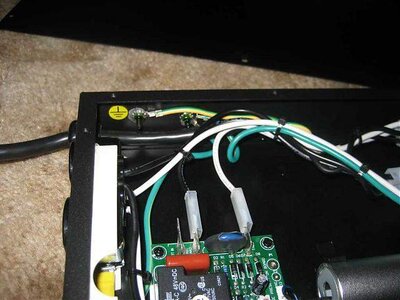
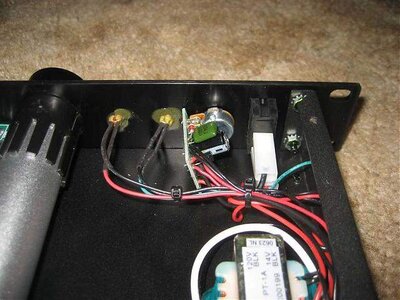
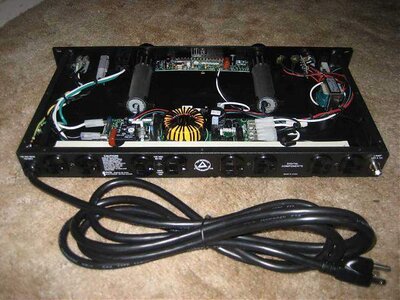
Uh, wow. Is underwhelmed a standard English word? This is certainly not what I would call robust. There is no isolation between the outlets. The dimmer board is at a weird angle. Wait. What. Is. That. That is a metal fragment. Just floating around inside the casing.

Guess it’s a good thing I opened it up. That’s how fires start.

I have attached some pictures that I snapped while the case was open. Considering how well amplifier power supplies are made these days, a line conditioner like this is really an optional component of your rack. Unless you are using a bona fide line regulator, you’re not going to gain much except to maybe isolate a ground loop. Series mode protection is nice.

You can see in the pictures the minimal build-out inside the PL-PLUS II. This could be expected, but what really bothers me is the overall poor build quality and the loose piece of metal inside. And that damn light. For 200 bones, I really expected more. Thanks, Furman.
 

Attachments

  • furman_pl-plus_ii_inside_01.jpg
    furman_pl-plus_ii_inside_01.jpg
    53.1 KB · Views: 8,752
  • furman_pl-plus_ii_inside_02.jpg
    furman_pl-plus_ii_inside_02.jpg
    41.3 KB · Views: 4,197
I am looking at it now, wondering if I want to use it. Functionally, it is what I want it to be. But my early experience has me very wary. That's really weak manufacturing to have debris inside the device.
 
I have the, I think, RP8-D. It's got the digital readout. It only gives me a voltage reading after I turn the master switch on, and takes a few seconds to get the correct voltage reading. It kinda floated up from 0 to 120.

My brother's got the actual voltage regulator. His unit gives a voltage indication the moment the plug sees juice.

Now that I think about it, yes, that voltage readout SHOULD be wired before the master switch.

I'm really curious to rewire this thing to read voltage before the switch. Looking at the blood and guts of your Furman, can you tell if it'll be easy enough to do this modification?
 
And as for the slipping light tube, yup, mine's loose like that. Except mine has a rubber gasket that acts to hold it in place, yours looks like it's got some kind of slotted sleeve the tube slips through. I'd say, dismantle that tube, and squeeze that slotted sleeve to give more grip and keep the light from sliding around.
 
I have a Furman A/C Line regulator. I'm sure that like me, dough is always an issue for most folks. But if someone is gonna pop for a 200 dollar piece of gear of the kind described, 200 bucks more gets you so much farther IMO.

I'm starting to agree with the opinion that a real good surge protector gets you the same thing as these simple conditioners.

I have a gig coming up where I know for a fact that the power is not good. I have been using this unit for about 8 or 9 months now and I have not experienced any power related anomalies whatsoever. This upcoming show will be quite an acid test. My particular unit the way I understand it, does it's level best to keep the power consistent when the incoming voltage is anywhere between 97 and 140 volts. This is a very basic explaination, the long version of which makes my head hurt.

JKT
 
Some EE needs to chime in, but it is my understanding that a power conditioner is pretty much worthless. All the power going into your amp or nearly any other 110 v musical device goes through a transformer first, which is a power conditioner in itself.

With that said, I have a cheap Furman (PL-8?). No bells or whistles at all. 8 outlets and an on/off switch. I use it to save the wear and tear on my other power switches and it makes a nice outlet gang device. The guitarist even plugs his Rivera into it. One switch kills our entire side of the stage.
 
I have a Furman A/C Line regulator. I'm sure that like me, dough is always an issue for most folks. But if someone is gonna pop for a 200 dollar piece of gear of the kind described, 200 bucks more gets you so much farther IMO.

I take a Tripplite regulator to generator-driven gigs. It does as you say auto-tap to keep low and high average voltages at a constant 117 volts or so. It's not rack-mount but I put it in a padded bag in the back of a rack for portage. Not being rackable, it was also WAY cheaper - that also opens ones options to a few more brands and thus competitive pricing.
 
Some EE needs to chime in, but it is my understanding that a power conditioner is pretty much worthless. All the power going into your amp or nearly any other 110 v musical device goes through a transformer first, which is a power conditioner in itself.

Interestingly, I am a EE, I'm just trying not to be too high and mighty about it since my gripe is more with build quality than overall function.

The transformer itself doesn't have much in the way of power conditioning characteristics. There are some inductive things going on in there, but not really that are practical in terms of managing power quality. It is the regulating circuitry following the transformer that produces correct DC voltage, and in most modern amps it will invoke a shutdown state if there is an over/undervoltage condition.

It appears that the original PL-PLUS models would display voltage before the mains were switched on, but the Series II models do not. I will take another look tonight and see what can be done about fixing that.
 
I take a Tripplite regulator to generator-driven gigs. It does as you say auto-tap to keep low and high average voltages at a constant 117 volts or so. It's not rack-mount but I put it in a padded bag in the back of a rack for portage. Not being rackable, it was also WAY cheaper - that also opens ones options to a few more brands and thus competitive pricing.

Can you elaborate on this piece of gear? I know nothing about them.

JKT
 
Can you elaborate on this piece of gear? I know nothing about them.

Specs and description: TRIPP LITE Automatic voltage regulator / Power conditioner / AC surge suppressor

[Invalid or Expired Link Removed]

It's not hard to nab this 1800 watt version for $150-160 these days (when I bought in nearly 20 years ago it was nearly twice that much). That's about the same price as some of the "premium" conditioners, which are really little more than surge protectors with light shows on the front panel. But it'll often protect all the non-amplifier audio electronics typically used in a small or mid-sized club setting. If you want to run high-drawing power amps to their full rating you'll need to have more service and use the like of the 2400 watt models, maybe several if you aren't using Class D/SMPS.

Pretty much any company that's into UPS and conditioners has a lineup of REGULATORS, and usually you can get the same spec in a package like this considerably cheaper than the rackmount equivalent - and considerably lighter in weight too.
 
@dje

If you want more solid build quality I might suggest the Elite15i. Same unit (SMP+, LiFT, EVS), nicer fit and finish, and it costs $379.

I don't work for Furman but I am a distributor of theirs and I know the engineers in Petaluma. There's no excuse for the metal shavings in the case but as they have told me, the Pro Line gear has that kind of wobbly feeling because guys that are going to throw it into a rack aren't too worried about that stuff. It's tough enough and it's going to get beat up.

As for the voltage LEDs not displaying anything until the mains are thrown, the units are designed like that. The mains switch is exactly that: a mains switch and when it is open there is zero power flowing through. The SMP+ module has a fast enough reaction time and low enough clamping voltage that if there are voltage problems on the line, when the switch is thrown the unit will go into protection and the Extreme Voltage LED will light.
 
Specs and description: TRIPP LITE Automatic voltage regulator / Power conditioner / AC surge suppressor

[Invalid or Expired Link Removed]

It's not hard to nab this 1800 watt version for $150-160 these days (when I bought in nearly 20 years ago it was nearly twice that much). That's about the same price as some of the "premium" conditioners, which are really little more than surge protectors with light shows on the front panel. But it'll often protect all the non-amplifier audio electronics typically used in a small or mid-sized club setting. If you want to run high-drawing power amps to their full rating you'll need to have more service and use the like of the 2400 watt models, maybe several if you aren't using Class D/SMPS.

Pretty much any company that's into UPS and conditioners has a lineup of REGULATORS, and usually you can get the same spec in a package like this considerably cheaper than the rackmount equivalent - and considerably lighter in weight too.


Thanks!

JKT
 
Hmmm. Onlyclave, interesting reasoning. See, when I get to a stage, I use an outlet tester to make sure I got a ground, a clean hot and common, and no weird miswirings inside the wall. Then I turn on my Furman, wait to see that the voltage readout steadies out at 115-120 volts, then I turn on my amp. But I'd love to have the voltage readout light up before even sending power to my tuner or wireless receiver. Those devices, their power buttons are quite inaccessible due to my rack-mounting them. I know, those are really extraneous devices, not my actual tone. But it's a preference.
 
Hmmm. Onlyclave, interesting reasoning. See, when I get to a stage, I use an outlet tester to make sure I got a ground, a clean hot and common, and no weird miswirings inside the wall. Then I turn on my Furman, wait to see that the voltage readout steadies out at 115-120 volts, then I turn on my amp. But I'd love to have the voltage readout light up before even sending power to my tuner or wireless receiver. Those devices, their power buttons are quite inaccessible due to my rack-mounting them. I know, those are really extraneous devices, not my actual tone. But it's a preference.

The older PL-PLUS units turned on their voltage meters before the mains. The new SMP+ module in the PL-PLUS series II clamps the voltage and shuts the unit down before and damage to your downstream gear occurs. And the SMP+ is non-sacrificial so after the voltage returns to a safe state it resets itself. MOV based surge suppressors can/will blow up once the spike exceeds the number of Joules the unit is rated for. The clamping voltage on the PL-PLUS II is 188 V with 1 ns response time. You won't hurt your digital gear.
 
Status
Not open for further replies.