I have an idea for a couple of Squier Jag-H basses and could use some ideas, especially regarding the pot values.
I friend of mine has a Jag-H with a Seymour Duncan Alnico SMB-4A. I have a stock Jag-H with a SD Ceramic SMB-4D coming in the mail. I'd like to wire these two basses with 2 volume pots and NO tone pot, which should be easy enough given the attached diagrams. So, the dual coil humbuckers will be wired like a Jazz bass, but with no tone control.
I plan to use Switchcraft jacks, copper shielding and silver plated, Teflon coated copper wire from the Aerospace industry.
I'm unsure of what values and type of pots to use in these projects. I have the following on hand.
- CTS 250k Audio Taper
- CTS 250k Audio Taper NO-Load
- CTS 500k Audio Taper
- CTS 500k Linear Taper
What would be the advantages of using one over the other? Please explain as I'm not an electrician by trade.
Thank you!
View attachment 7226749View attachment 7226756
You are not gaining anything by trying to wire two volume controls. You would be just making a mess. You would be better off with a coil tap, a series/parallel swtich, or a Washburn-style VCC. Furthermore, unless you drill for a side jack, there is not enough room in the control cavity for another control. And the coils are not far enough apart, as they are on a J-bass, in order to have any meaningful tone distinction between one or the other.
I had to do this on one of my Jag-H basses, which I had my luthier rout for a battery compartment for an EMG active pickup with an EXB to get the variable scoop into the signal chain. Yes, I had to have a side jack routed. If you want each coil to be separate, then what you essentially have is parallel operation, which deprives the bass of the humbucking nature and girth of the pickup.
I have another Jag H bass that I have wired with CTS audio taper 250 kohm pots in the style of a '62 P-bass wiring to the stock pickup. This makes the pickup sound big, smooth, and with La Bella flats is my version of a "funk machine." This gives a big, round tone that is versatile, authentic, and useful for a variety of genres and applications. Picture attached.
The other pots you mention:
CTS 250 no-load: essentially no advantage over a 500 kohm pot; the purpose of either is to lessen the loading to try to achieve marginally more brightness. The 500 kohm pot has more control than the either/or of a no-load pot. I say this having played instruments, both guitar and bass, since Fender invented the no-load pot all those decades ago. Of course, you will see debate on this issues, as with any detail of electric guitar/bass construction. Maybe on a guitar for a more "airy" or "brighter" tone, but we are bassists, laying foundation. Any top end will be overshadowed by guitar players in the mix.
There is no advantage or much difference on using 500 kohm pots for the tone control. You will read debates on linear v audio, but most players keep the tone dimed anyway. The linear may have a little more flexibility if you routinely temper the tone to between, say, 6 and 9.
I do like the feel of a Jag H bass. I now have three of them, all wired differently and with different stringing, for different applications, as well as some other 32-inch scale basses. Over the last few years as my hands have started to get arthritis since I first started playing bass in summer junior high jazz band camp in 1976, so I have transitioned to these basses. One thing I suggest is putting an extension on the upper bout strap button and lightweight tuners, whether Hipshot or others, to balance the bass better.
These are my experiences from 49+ years playing bass. Other posters' who may follow mileage may vary.



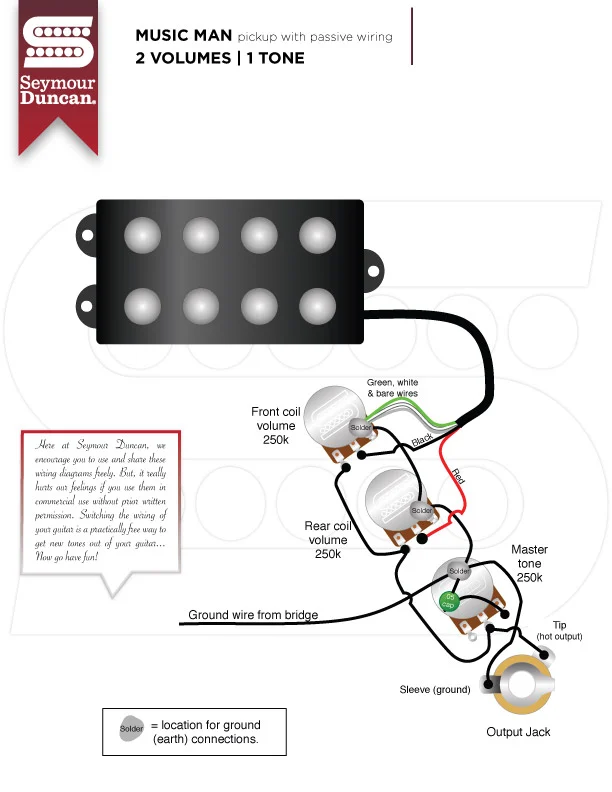



 My buddy still wants me to wire his up with 2 volumes and no tone so we will have a chance to hear what it sounds like before I mess with mine. That way if it turns out to be crap, which it may, I'll simply wire mine up in parallel with 1 volume and 1 tone.


