• TalkBass has been independent since 1998. Add your voice.
    Create a free account to reply to discussions, view embedded media, and browse with fewer display ads.
    Join freeLog in
    Want zero display ads or expanded classifieds tools? Compare plans.

Accent layer veneer options and sourcing

Apr 7, 2010
4,421
3,833
37
I’m doing some accent layers between top and body, and I’m wondering what you guys are using for that?

What’s the deal with the LMII fiber veneer, is that appropriate for this application? Would it be compatible with titebond I?


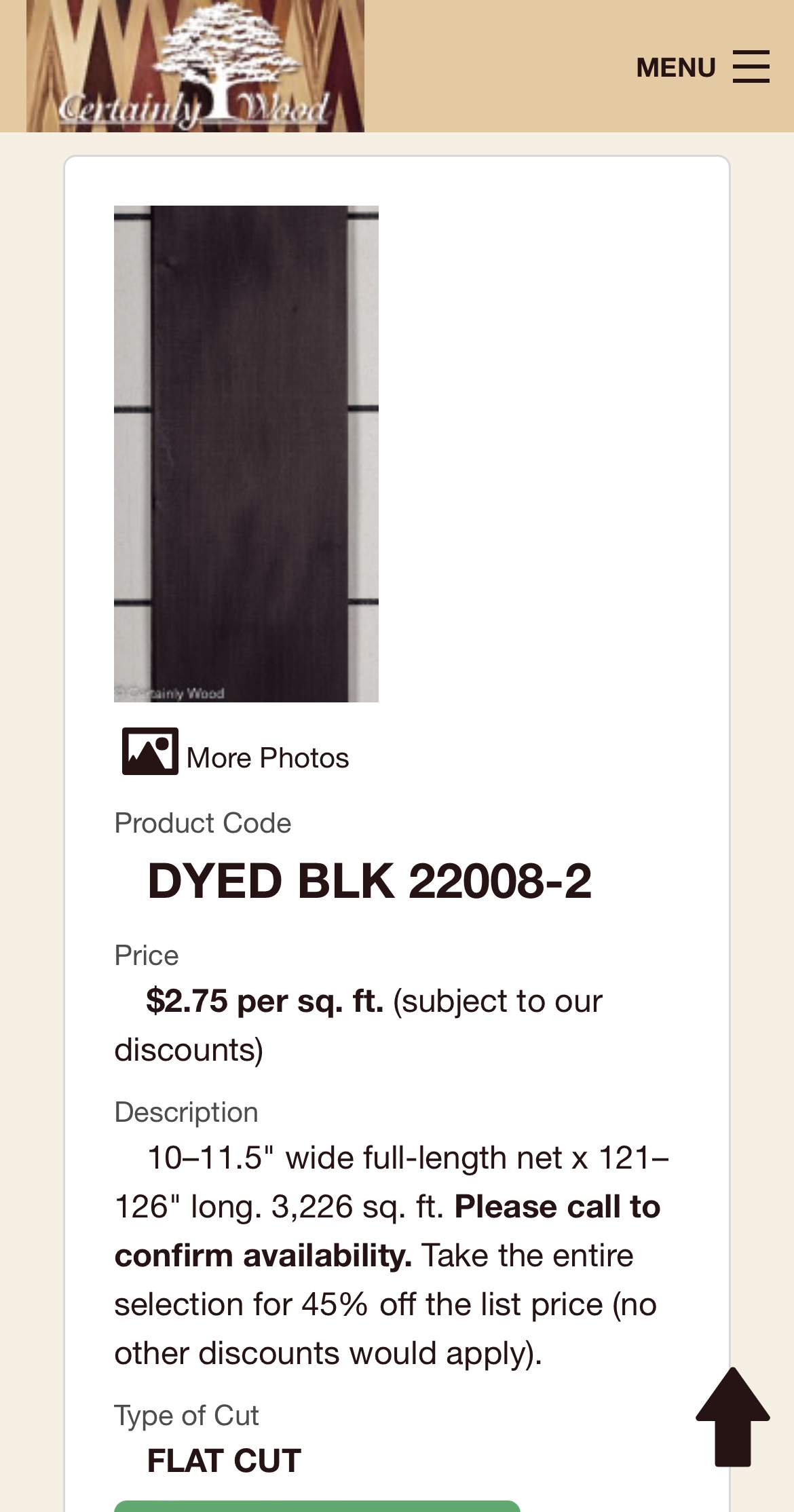
I’ve perused Certainly Wood, and they have a great reputation here, but I am a little confused at the purchasing/
54C98F3B-31A5-4C84-A7FF-FBB44B121FA4.jpeg

I’ll be calling them tomorrow, but can any of you enlighten me; I don’t understand what the 3226sqft is, because it certainly isn’t ~11” x ~125”. Is that just what they have available from this particular lot, which is mostly in sheets of 11x125 etc? As in, can I purchase a sheet of 11x125, or is the purchase of the larger sqft number, in this case 3226sqft?


Beyond that, any and all veneer suggestions are welcome and requested!

 
Dyed poplar veneer is the most popular choice. I'd stay away from fiber veneers for a body sandwich. Fiber veneers are typically used as headstock veneers (Gibson) or purfling. If you use real wood veneer you can be sure that it machines and sands just like the rest of the body. It is convenient to use a piece that is wide enough to do the whole body in one piece, but of course you can also join two or more pieces together if necessary.

I don't know where you're located, but I ordered the 1mm black poplar veneer for my Supersymmetry build from Metz veneers in Germany. However, they seem to be out of stock.
 
  • Like
Reactions: eddododo
My interpretation would be that they have about 3,226 square feet in stock and they’re willing to sell it piecemeal but they will give a big discount if you buy the lot.
That's exactly how they sell. I've purchased a couple of times in the past taking the entire lot. Most of their large lot veneers are also consecutive flitches and easy to book match as many pieces as you need for your desired width. The width varies because the consecutive flitches get wider as the cut is closer to the center of the log.

They ship with the veneers rolled up lengthways in a large box.

I purchased oak and walnut thick veneers which are a full 1/16" thick.
 
Last edited:
  • Like
Reactions: Max Bogosity
I'll just mention that there's another approach to doing these "accent veneers" that doesn't involve trying to buy those mystical veneers.

Say you want a thin walnut line between an ash top and back. Buy a fairly thin walnut board, like 3/4" thick or whatever you can find. Glue that board, at full thickness, onto the ash back. Then trim that whole thing down in thickness with your planer, router planer, wide belt sander, or hand plane, taking the walnut down to whatever thickness you want. Then glue on your top. Now you've got a structurally strong veneer-thin layer of good wood.

The point is that it's much easier to plane a sheet of wood down to veneer thickness when it's glued down to a thicker flat plank of wood.
 
OK, and for those of you who stuck around for the end credits, I just got off the phone with what I believe must have been the owner of Certainlywood-

he mentioned that they had been getting in some good Holly for the first time in a couple of years, and they have some thick 1/16 holly for the first time in apparently a decade or so. Get it while it’s hot!


I'll just mention that there's another approach to doing these "accent veneers" that doesn't involve trying to buy those mystical veneers.

Say you want a thin walnut line between an ash top and back. Buy a fairly thin walnut board, like 3/4" thick or whatever you can find. Glue that board, at full thickness, onto the ash back. Then trim that whole thing down in thickness with your planer, router planer, wide belt sander, or hand plane, taking the walnut down to whatever thickness you want. Then glue on your top. Now you've got a structurally strong veneer-thin layer of good wood.

The point is that it's much easier to plane a sheet of wood down to veneer thickness when it's glued down to a thicker flat plank of wood.

My earliest draft was to do exactly that, but I’ve been a little dodgy about whether or not my router sled setup was giving me a dead flat surface reliably enough… my experience has been that it’s dead flat glue-ready whenever it doesn’t need to be, but if I’m trying to surface joint a large surface that i just can’t get it right :rollno:

A buddy of mine does INCREDIBLE work out of the colorful ply from recycling skateboards, and he has a drum sander, so I’ll definitely keep this approach in my back pocket.

edit: off topic but here’s his work. I think you guys would appreciate his milling process and solutions!
Barousse Works
97A06ADC-C4D1-4F7C-8D35-711E94222A2C.jpeg
 
Last edited:
My earliest draft was to do exactly that, but I’ve been a little dodgy about whether or not my router sled setup was giving me a dead flat surface reliably enough… my experience has been that it’s dead flat glue-ready whenever it doesn’t need to be, but if I’m trying to surface joint a large surface that i just can’t get it right

Okay, in that case, use your router planer setup to bring it down close to the final thickness. Then get out a hard block with 120 grit sandpaper and a straightedge, and true it up. Use the router to chop off most of the wood, then finish the job the old fashioned way.
 
  • Like
Reactions: eddododo
OK, and for those of you who stuck around for the end credits, I just got off the phone with what I believe must have been the owner of Certainlywood-

he mentioned that they had been getting in some good Holly for the first time in a couple of years, and they have some thick 1/16 holly for the first time in apparently a decade or so. Get it while it’s hot!

My earliest draft was to do exactly that, but I’ve been a little dodgy about whether or not my router sled setup was giving me a dead flat surface reliably enough… my experience has been that it’s dead flat glue-ready whenever it doesn’t need to be, but if I’m trying to surface joint a large surface that i just can’t get it right :rollno:

A buddy of mine does INCREDIBLE work out of the colorful ply from recycling skateboards, and he has a drum sander, so I’ll definitely keep this approach in my back pocket.

edit: off topic but here’s his work. I think you guys would appreciate his milling process and solutions!
Daniel Barousse
View attachment 5002564

I think the link you want to post is THIS one.
 
  • Like
Reactions: eddododo