Hey, i have read in alot of places that how you have your action will define your tone.. and that if your action is too low you will lose some of your tone? can anyone explain to me why this happens and what the difference is..i know the low action wil cause buzzing when digging in....but what else? i havent noticed much when i tried it... thanks

Enjoy the benefits of a premium membership!
Upgrade Account
-
TalkBass has been independent since 1998. Add your voice.
Create a free account to reply to discussions, view embedded media, and browse with fewer display ads.
Join free Log in
Want zero display ads or expanded classifieds tools? Compare plans.
You are using an out of date browser. It may not display this or other websites correctly.
You should upgrade or use an alternative browser.
You should upgrade or use an alternative browser.
action = tone?
- Thread starter etherbass
- Start date
More options
Who Replied?I wouldnt necesarily agree with that. Maybe your tone changes, but you dont lose it. I have pretty low action on my godin and it just makes it sound a little different, not worse by any means. the D and G strings get a more funky sound, and the E and A get more growl.
adrian garcia
In Memoriam
- Apr 9, 2001
- 5,110
- 17
- Disclosures
- Endorsing Artist: Nordy Basses, Schroeder Cabs, Gallien Krueger Amps
it's been my experience that basses can be set up for playing comfort, or cleanliness of tone, or somewhere in between with different quality basses affording more or less...
i have found that when i set up my basses to play fast and easy ( straigher neck) the string buzzing will of course alter the tone and if you go too low, the string has no room to vibrate , which along with the buzz, can kill your sustain.
with more relief ( not so straight a neck) string buzz is less and the string has more room to vibrate- making for a cleaner tone- one more suitable for recording if clean is what you are after.. sometimes i find the string buzz and rattle to be part of the funk so to speak, and personally , i dont try to avoid it completely.
Basically i will start with a straight neck and too low action- then add just the right slight amount of relief ( for me ) and raise the saddles until i can live with the level of buzz. I dont know if this is proper but it works for me.
it's a tradeoff, i find it much earier to play a straigher neck, less work, but i will usually opt for working a little harder and have cleaner tone..
and this reply is way too long.....
i have found that when i set up my basses to play fast and easy ( straigher neck) the string buzzing will of course alter the tone and if you go too low, the string has no room to vibrate , which along with the buzz, can kill your sustain.
with more relief ( not so straight a neck) string buzz is less and the string has more room to vibrate- making for a cleaner tone- one more suitable for recording if clean is what you are after.. sometimes i find the string buzz and rattle to be part of the funk so to speak, and personally , i dont try to avoid it completely.
Basically i will start with a straight neck and too low action- then add just the right slight amount of relief ( for me ) and raise the saddles until i can live with the level of buzz. I dont know if this is proper but it works for me.
it's a tradeoff, i find it much earier to play a straigher neck, less work, but i will usually opt for working a little harder and have cleaner tone..
and this reply is way too long.....

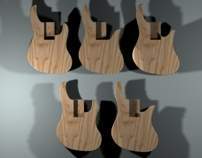
my old Rob Allen exemplified this.
to get the now classic MB2 mwahhhh...the neck had to be fairly straight with low action.
for that upright thump: add some neck relief.
night and day tone in my opinion.
f
to get the now classic MB2 mwahhhh...the neck had to be fairly straight with low action.
for that upright thump: add some neck relief.
night and day tone in my opinion.
f
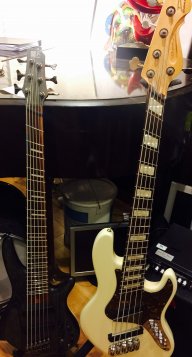
I do my action the other way round to Adrian - I start a little higher than usual, then go down until it starts to buzz, then I back it off a hair. But the idea is the same.
Conventional wisdom would state that with a higher action, you can either play soft or hard to get dynamic range. I find with a lower action, I have to play with a much lighter touch - however playing with a lighter touch has tended to give me more dynamic control than when I was playing hard. Instead of playing hard and soft, I play soft and softer.
There are two other advantages to a lower action for me - better intonation, and also you can use less force to slap, which helps me switch more evenly between fingerstyle and slap.
YMMV!
Johann
Conventional wisdom would state that with a higher action, you can either play soft or hard to get dynamic range. I find with a lower action, I have to play with a much lighter touch - however playing with a lighter touch has tended to give me more dynamic control than when I was playing hard. Instead of playing hard and soft, I play soft and softer.
There are two other advantages to a lower action for me - better intonation, and also you can use less force to slap, which helps me switch more evenly between fingerstyle and slap.
YMMV!
Johann

In my experience, the action has a huge impact on the timbre of the strings. At least that's what I've found on my Hanewinckels. My theory is that when you pluck the string, the string will impact slightly on the upper frets before settling into its vibration. Or, if the action is very high or your touch is light enough, it won't impact at all. By adjusting the action, you are changing where on the fretboard this impact occurs. At the point of impact, you are creating a kind of node in the string vibration. It will dampen some frequencies and enhance others. My observation is that it tends to dampen the fundamental and enhance or give the effect of enhancing the higher-order harmonics.
In college I took a differential equations course where we had to solve the problem of a vibrating string. The solution to the equations was a Fourier series which is the sum of an infinite series of sine functions (if I remember correctly). The coefficients of the terms are what determines the character of the solution. We solved the equations for plucking the string at different points and you could see how plucking near the "bridge" would cause higher-order harmonics to be more prevalent.
- Dave
In college I took a differential equations course where we had to solve the problem of a vibrating string. The solution to the equations was a Fourier series which is the sum of an infinite series of sine functions (if I remember correctly). The coefficients of the terms are what determines the character of the solution. We solved the equations for plucking the string at different points and you could see how plucking near the "bridge" would cause higher-order harmonics to be more prevalent.
- Dave

I play metal in a band and have the action set so that I get tha clanging sound of the strings hitting the fretts. I tone it down with the eq to where I like it...is there anyone else that plays like this. I havn't heard to many people doing this so I'm wondering if it's just kinda unacceptable.
... i have the action fairly low, it could be lower but with my experience with the bass, it doesnt sound the was i would want it to with lower action, it has crazy tone right now and why mess with it just to get a little lower action.

Action & neck relief is EXTREMELY EXTREMELY important. It's a lot more important than whether you've got plain ole ash or grade 4a quartersawn birdseye figured maple blah blah blah as your body wood.
Action should never make or break your style as long as you're aware of what it can do to help or hinder you.
I think Adrian's advice is a good start. Get the neck flat and action low first, and then go from there. Even if you favor fingerstyle over slap/pop, having the lowest action with the tone you want is beneficial because it saves wear & tear on your hands.
Action should never make or break your style as long as you're aware of what it can do to help or hinder you.
I think Adrian's advice is a good start. Get the neck flat and action low first, and then go from there. Even if you favor fingerstyle over slap/pop, having the lowest action with the tone you want is beneficial because it saves wear & tear on your hands.
now THATS a post!Dave Grossman said:In my experience, the action has a huge impact on the timbre of the strings. At least that's what I've found on my Hanewinckels. My theory is that when you pluck the string, the string will impact slightly on the upper frets before settling into its vibration. Or, if the action is very high or your touch is light enough, it won't impact at all. By adjusting the action, you are changing where on the fretboard this impact occurs. At the point of impact, you are creating a kind of node in the string vibration. It will dampen some frequencies and enhance others. My observation is that it tends to dampen the fundamental and enhance or give the effect of enhancing the higher-order harmonics.
In college I took a differential equations course where we had to solve the problem of a vibrating string. The solution to the equations was a Fourier series which is the sum of an infinite series of sine functions (if I remember correctly). The coefficients of the terms are what determines the character of the solution. We solved the equations for plucking the string at different points and you could see how plucking near the "bridge" would cause higher-order harmonics to be more prevalent.
- Dave
Well it might have an ounce of credibility, but I've never tested it. When the string vibrates, it vibrates within the magnetic field of the pickup, which sends the vibrations through your rig and out the speaker.
So maybe where it vibrates within that field could have an effect on the sound....but I don't think it would be of great concern.
So maybe where it vibrates within that field could have an effect on the sound....but I don't think it would be of great concern.
Dave, I have noticed you say all these EXTREMELY detailed post's, then someone comments on them and you reply with somthing like "My Cats breath Smells like Cat food"... I just kinda Find that funny!!
My cat's name is mittens.Funkize you said:Dave, I have noticed you say all these EXTREMELY detailed post's, then someone comments on them and you reply with somthing like "My Cats breath Smells like Cat food"... I just kinda Find that funny!!
- Dave
The location of the pickup has a lot to do with the tone. An oscillating string is really the superposition of the fundamental and higher-order harmonics, or overtones. You know those harmonics you get by touching the string at the 12th, 7th, and 5th frets? Well, all of those harmonics are present in the full vibrating string. Plus, in theory, infinitely more. It's the strength of these harmonics that make the sound. If you have a pickup placed at the node (the point where the string doesn't move for that harmonic. like putting your finger on the string at the 12th fret) then the pickup won't register that sound as strongly as ones that have their nodes outside of the pickup vicinity. Therefore, the placement of the pickup will affect what overtones are present in the signal and at what levels. That's why the bridge pickup sounds so much different than the neck pickup.Garrett Mireles said:Well it might have an ounce of credibility, but I've never tested it. When the string vibrates, it vibrates within the magnetic field of the pickup, which sends the vibrations through your rig and out the speaker.
So maybe where it vibrates within that field could have an effect on the sound....but I don't think it would be of great concern.
- Dave
Dave Grossman said:An oscillating string is really the superposition of the fundamental and higher-order harmonics
....im so confused i forgot who i am...


Rumzini said:I play metal in a band and have the action set so that I get tha clanging sound of the strings hitting the fretts. I tone it down with the eq to where I like it...is there anyone else that plays like this. I havn't heard to many people doing this so I'm wondering if it's just kinda unacceptable.
Fieldy does it, so take that for what it's worth.
Yeah I did rmember that he did...and, er...I'm not that clanky sounding. There is a certain part in the song Getaway Car by Audislave where Tim hits just one note and it sounds more like a wooden clunk to it. that's actually more what I'm loking for.


