
Enjoy the benefits of a premium membership!
Upgrade Account
-
TalkBass has been independent since 1998. Add your voice.
Create a free account to reply to discussions, view embedded media, and browse with fewer display ads.
Join free Log in
Want zero display ads or expanded classifieds tools? Compare plans.
You are using an out of date browser. It may not display this or other websites correctly.
You should upgrade or use an alternative browser.
You should upgrade or use an alternative browser.
Active onboard electronics that sound like passive?
- Thread starter bdplaid
- Start date
-
- Tags
- active electronics onboard sound
More options
Who Replied?

Passinwind
I know nothing.
- Dec 3, 2003
- 23,043
- 45,901
- Disclosures
- Designer/Toaster Tech @ Passinwind Electronics
Heck, maybe if you coiled up a 15' cable, you could route a spot for it under the pickguard and wire it in...sorry, it just seems a little rube goldbergian to rip out a passive system, make it active, then add something to make it sound passive. I'd just buy a pedal or something
I'm just the messenger...
OK, about this cable thing...I'm just the messenger...
In another life I was a video producer and managed a very large production studio. This was in the bad old days of analog video. All the pieces of equipment had to be electronically synced to operate, and this required that each be "timed" with one another. Rather than buy an additional electronic delay unit (they were horribly expensive), one of the tricks that the engineer would do is to use loooong lengths of cable to time the equipment - each foot cable introduces "x" amount of delay to the signal, and he would use whatever length he needed to achieve the proper delay to sync the equipment. And each piece of gear required several cables... We must have had miles of cable under the floor.

Passinwind
I know nothing.
- Dec 3, 2003
- 23,043
- 45,901
- Disclosures
- Designer/Toaster Tech @ Passinwind Electronics
OK, about this cable thing...
In another life I was a video producer and managed a very large production studio. This was in the bad old days of analog video. All the pieces of equipment had to be electronically synced to operate, and this required that each be "timed" with one another. Rather than buy an additional electronic delay unit (they were horribly expensive), one of the tricks that the engineer would do is to use loooong lengths of cable to time the equipment - each foot cable introduces "x" amount of delay to the signal, and he would use whatever length he needed to achieve the proper delay to sync the equipment. And each piece of gear required several cables... We must have had miles of cable under the floor.
Nice! If you want to get really picky you could decide what specific amp and cable combination to emulate. I do stuff like that in modeling software all the time these days, and I just enjoy the design process in its own right. I don't even currently own a passive bass (or a fretted one, for that matter) and most of my amps are optimized just for active ones, but those are just my personal quirks, and subject to change at my next whim.
Yeah, I guess everyone's gotta have sumptin...Nice! If you want to get really picky you could decide what specific amp and cable combination to emulate. I do stuff like that in modeling software all the time these days, and I just enjoy the design process in its own right. I don't even currently own a passive bass (or a fretted one, for that matter) and most of my amps are optimized just for active ones, but those are just my personal quirks, and subject to change at my next whim.
Passinwind
I know nothing.
- Dec 3, 2003
- 23,043
- 45,901
- Disclosures
- Designer/Toaster Tech @ Passinwind Electronics
Yeah, I guess everyone's gotta have sumptin...
As an avid DIY'er, it would be a lot less fun to not take a contrarian approach, I think. I've often been that way as a player too, which sometimes tends to have more serious repercussions. As a sound provider and repair tech I always tried to accommodate other people's wants and needs as much as possible though, and in your case this seems like a perfectly reasonable quest to me.

Thanks, but that would do the opposite of what I want - a buffer lowers the impedance to eliminate the cable loading tone suck... thereby giving one something of a "modern" tone. I wouldn't retain a passive sound, nor would i get the treble/bass controls I am after.
Thanks anyway.
Thanks, but that would do the opposite of what I want - a buffer lowers the impedance to eliminate the cable loading tone suck... thereby giving one something of a "modern" tone. I wouldn't retain a passive sound, nor would i get the treble/bass controls I am after.
Thanks anyway.
You said you wanted lowZ...
Anyway, I can say that the tones I have from this are anything but modern, and my other bass is a Ray...

Why? I thought it was funny and appropriate. And true in oh, so many ways!Sorry about my comment. I enjoy playing with things just for the fun of it too, so I don't know why I said that. Curiosity and messing around is awesome. Have a good one!
Here's an irony: A few months ago I bought a Line6 G10. Very handy and capable wireless. But it has their "cabletone" built in, which models a 10' cable. I sent it back because I didn't want that. Then today, I got a 30' coiled cable which sounds like a blanket over the amp, but am considering keeping it. Duh.
What I want to do is retain the sound of a passive bass without the added crispness of an active system, but have active bass and treble controls. I hope you guy see the diff, it makes sense to me.
Maybe I'll go have a pill.
All good.Thanks, I wasn't trying to be mean, but thought when I looked back it might sound mean. Take care.



Don't bother with expensive preamps from various boutique makers. Get a buffer kit from one of the online guitar circuit sellers or build yourself a little Tilman JFET buffer and be done with it.
Agree - probably the best minimal $$ I ever spent...
Onboard Buffer - Nice one Albert and Don
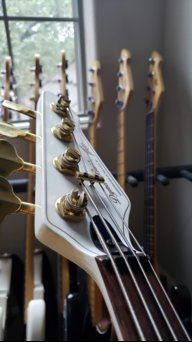
I just received one in the mail today, what you said was exactly my hope. Steve at Audere was really cool and added the Z switch programming switch for free.I'll third (or 4th? 5th?) Audere. The Z switch in their preamps will give you what you're looking for. I'm using a Pro JZ3-4 in one of my Jazz basses and set flat (mid position Z switch with EQ flat), it sounds like it used to when I ran it passive.
Audere Audio Pro JZ3 Preamps
After trying a few different preamps, I think I like the Audere best because (from my understanding) that's how it works, applying the load between the pups and the pre.Yep, load the pickups before the pre. Passive pickups don't just have the cable loading, they usually also have the load of an extra pot or two. A resistor will do the trick to essentially drop the input z of the preamp. I would think that's how the z switch works for Audere's stuff. Try something from 220k to 1M between the input of the pre to earth. If you really want to tweak the active setting to sound like passive, tack in a temporary 1Meg linear pot and adjust it till you can't hear a difference in the treble response when you switch between active and passive. Then remove, measure, and put in a fixed resistor of the same value. Make sure your bypass switch is wired as true bypass. I guess you could also put in a trim pot mounted on the switch.
As others have said, you can also go with a passive tone pot at the input of the pre. Even when fully clockwise, the pot itself will load the pickups to slightly damp the treble.
Be aware that if your pre has a little gain boost (with tone controls centred), you should think about wiring an attenuator at its output so you can also match the levels.
Personally I prefer to have a nice difference in tone when switching from active to passive, so I have only the (unearthed) blend before the pre when in active mode. I rarely use a passive tone playing live, but almost always use it in the studio.


