• TalkBass has been independent since 1998. Add your voice.
    Create a free account to reply to discussions, view embedded media, and browse with fewer display ads.
    Join freeLog in
    Want zero display ads or expanded classifieds tools? Compare plans.

Active preamp, no EQ

As for the rotary switch, Dave posted this in another thread, so I stole it:
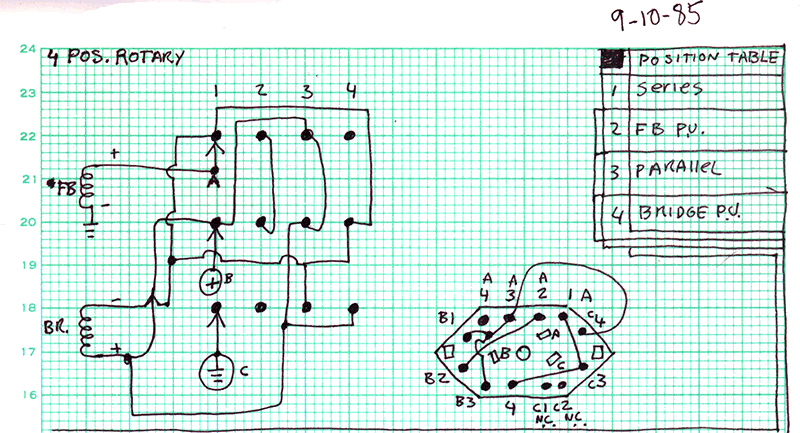
4-pos_series-parallel.gif


The rotary pickup selector would not be necessary for my current bass (although it would still be nice), but it's definitely what I want to do for my future build.

 
I've been using buffered pickups for a long time and still do. The only drawback when going from passive to buffered is that the tone becomes too bright, a bit on sterile side. That's because the natural pickup's resonant peak goes too high. There are two ways to cure this:
1) A capacitor from input to ground. 220pf to 4.7nf, depending on the tone desired. It's a basic cable emulation. The sound would be coloured, but in a pleasing way.
2) Lower volume pot value. 250K or even 100K would make the tone just smoother without adding any character.
 
+1 on the bartolini tc series as suggested at the start of this thread. I've used a tc1 that over time has migrated in 3 basses, everytime in a setup with passive pu's and no tone or eq. In over 15 years I kept the tc1 and changed basses. DIY should be fine too, but if your doubting your soldering skills the bartolini's are a good choice. They're dead quiet and do all those things you want. The battery also lasts for ages, which is a great plus IMO.

Adding a buffer is not tone neutral though. It's not the sound of passive pu's, only louder. There's definetely more low and high end in my case (at the time a nordstrand pj combination in a frettless yamaha bb1200). I would not describe that as sterile as shoewreck does, but the effect might differ from pu to pu. I've got a passive/active switch just in case to be able to go all passive, but I never ever do that.
 
As for the rotary switch, Dave posted this in another thread, so I stole it:

4-pos_series-parallel.gif


The rotary pickup selector would not be necessary for my current bass (although it would still be nice), but it's definitely what I want to do for my future build.


that's about what I thought...a multiple deck rotary switch would be needed.
if you want to move forward with diy and can find this switch then go ahead and buy it.
 
Can you point to some good buffer circuits? I've tried building a JFET one, and had pretty dismal results w/ regard to noise. I just installed a Bart AGDB-918 last night, and it is spectacularly quiet, lots of gain, low distortion, I LOVE it. Have no idea whether it uses op amp or fets...

JFET's are used in low noise applications.
hate to say but I thing something is wrong with the ckt.
 
JFET's are used in low noise applications.
hate to say but I thing something is wrong with the ckt.

Yes, but some JFETs are better than others. I chose the J201 over the radio shack versions for the lower noise and the lower quiessant current (better battery life). Apparently high value resistors (10M and higher) can add noticeable noise as well. With magnetic pups, you can use a much smaller input resistor (500K or 1M) to help with that. Some folks report better results with high quality caps too but I'm not sure if thats actual or perceived noise improvements or something else.

Mouser had all the parts I wanted for a reasonable price although the shipping charge was pretty stiff for a box of inexpensive parts.

Here's a question for you guys - I added a DC jack (with internal switch) to the circuit so I could power the preamp off a 9v pedal power supply. The jack works great off a 9v battery but the plug in power supply adds a lot of high freq noise to the output. I tried using a cap across from the high side to ground to minimize all but the DC but it didn't work. Any suggestions on a small power conditioning circuit to eliminate the power supply noise? The power supply works find with my stereo chorus - no added noise. I don't know what magic Arion added to their box but I wouldn't mind adding it to my buffer.
 
Yes, but some JFETs are better than others. I chose the J201 over the radio shack versions for the lower noise and the lower quiessant current (better battery life). Apparently high value resistors (10M and higher) can add noticeable noise as well. With magnetic pups, you can use a much smaller input resistor (500K or 1M) to help with that. Some folks report better results with high quality caps too but I'm not sure if thats actual or perceived noise improvements or something else.

Mouser had all the parts I wanted for a reasonable price although the shipping charge was pretty stiff for a box of inexpensive parts.

Here's a question for you guys - I added a DC jack (with internal switch) to the circuit so I could power the preamp off a 9v pedal power supply. The jack works great off a 9v battery but the plug in power supply adds a lot of high freq noise to the output. I tried using a cap across from the high side to ground to minimize all but the DC but it didn't work. Any suggestions on a small power conditioning circuit to eliminate the power supply noise? The power supply works find with my stereo chorus - no added noise. I don't know what magic Arion added to their box but I wouldn't mind adding it to my buffer.

power supplies can be tricky. especially switch mode power supplies. I would try to get a schematic of the stereo chorus to see what they are doing.

what kind of cap are you using? physical location of caps is important too.

what kind of noise is it? Hum or hiss?
 
that's about what I thought...a multiple deck rotary switch would be needed.
if you want to move forward with diy and can find this switch then go ahead and buy it.
Well, it's probably something I'll have done in a custom build.

What if I wanted to use the blend and volume pots that are already in my bass and then add a series/parallel switch and an active/passive switch?
 
power supplies can be tricky. especially switch mode power supplies. I would try to get a schematic of the stereo chorus to see what they are doing.

what kind of cap are you using? physical location of caps is important too.

what kind of noise is it? Hum or hiss?

It's a Behringer 9V pedal supply

Orange tantalum cap soldered from ground to 9V at the jack I added to the cavity cover plate.

Noise is neither hum nor hiss, it's a high frequency signal with repeating chirps and constant whistle. Not loud but loud enough to destroy the experience.

I do have the schematic for the Arion pedal courtesy of the internet but I haven't figured out which part provided the signal conditioning.
 
Well, it's probably something I'll have done in a custom build.

What if I wanted to use the blend and volume pots that are already in my bass and then add a series/parallel switch and an active/passive switch?

Mouser sells multi-deck rotary switches. A 4 position 3 deck switch can be had for under three dollars.

The simplest arrangement would be a standard v/v/t setup. I haven't seen a passive v/b but I don't know that it can't be done. You would probably have to wire the pups to the blend pot first, then to the volume pot. I do have a wiring diagram for series/parallel on a dpdt switch from dimarzio but I don't think you can do series/parallel and blend simultaneously. You'd probably need another switch to do one or the other.

An active passive switch would have to go before the jack but after the buffer/tone pot. I used a dpdt switch for this so it switches both the output to the jack and the battery supply to the buffer. In other words, the power to the buffer is turned off when in passive as well.
 
Mouser sells multi-deck rotary switches. A 4 position 3 deck switch can be had for under three dollars.

The simplest arrangement would be a standard v/v/t setup. I haven't seen a passive v/b but I don't know that it can't be done. You would probably have to wire the pups to the blend pot first, then to the volume pot. I do have a wiring diagram for series/parallel on a dpdt switch from dimarzio but I don't think you can do series/parallel and blend simultaneously. You'd probably need another switch to do one or the other.

An active passive switch would have to go before the jack but after the buffer/tone pot. I used a dpdt switch for this so it switches both the output to the jack and the battery supply to the buffer. In other words, the power to the buffer is turned off when in passive as well.
Plenty of people on here have done passive Vol/Blend/Tone setups. I don't see why that wouldn't be possible. I don't want multiple volume knobs.
 
Plenty of people on here have done passive Vol/Blend/Tone setups. I don't see why that wouldn't be possible. I don't want multiple volume knobs.

Never said it wasn't possible, just haven't seen it. Did a quick google and some complained about lower volume when both pups were blended equally since they will load each other down.

I don't see how you would do both a blend pot and parallel/series switch and have it all function across every combination but that doesn't mean it isn't possible either.
 
I don't see how you would do both a blend pot and parallel/series switch and have it all function across every combination but that doesn't mean it isn't possible either.

I don't think it's possible to have a blend control which "works" in both series and parallel mode. However, you could very easily have a switch which selects between "both pickups in full, series mode" and "use the blend pot to set relative pickup volume in parallel mode". You may need a 4PDT switch or something like it. But effectively the blend control could not have any effect in series mode.
 
I don't think it's possible to have a blend control which "works" in both series and parallel mode. However, you could very easily have a switch which selects between "both pickups in full, series mode" and "use the blend pot to set relative pickup volume in parallel mode". You may need a 4PDT switch or something like it. But effectively the blend control could not have any effect in series mode.
Keep in mind I'm not looking for any in-between settings. I either want all neck, all bridge, or both. I don't care if I have that option or series or parallel or whatever, I just want those 3 settings. If you can't switch between pickups in series mode, then I won't. Not a big deal.
 
Keep in mind I'm not looking for any in-between settings. I either want all neck, all bridge, or both. I don't care if I have that option or series or parallel or whatever, I just want those 3 settings. If you can't switch between pickups in series mode, then I won't. Not a big deal.

Then you don't need a blend function so you shouldn't have any issues getting what you want. You need a master volume and the rotary switch. You should be able to wire the rotary to give you bridge, neck, both series, both parallel. I think that hand written diagram you posted previously does that for you. The master volume would go between the switch and the jack.
 
You only need two poles for a 4-way rotary selector. I used the instructions found on this site : [Invalid or Expired Link Removed]

You know, I wrote that Google Base article more than 4 years ago, and I am surprised that it still shows up in searches!

These days, I recommend the Electroswitch C4 series of rotary switches. They are heavier duty and will last longer under repeated use. The downside is that they are expensive and quite large.

KingRazor, you can still use these instructions to switch between either or both. I guess I misunderstood what you really wanted. This should work for you.

It looks like you're not that far from me. (I'm in Hillsboro; you're in Beaverton.) I may have an extra rotary switch of some sort. Let me dig through my parts drawer at home and I'll send you a PM later tonight.
 
Yes, but some JFETs are better than others. I chose the J201 over the radio shack versions for the lower noise and the lower quiessant current (better battery life). Apparently high value resistors (10M and higher) can add noticeable noise as well. With magnetic pups, you can use a much smaller input resistor (500K or 1M) to help with that. Some folks report better results with high quality caps too but I'm not sure if thats actual or perceived noise improvements or something else.

Mouser had all the parts I wanted for a reasonable price although the shipping charge was pretty stiff for a box of inexpensive parts.

Here's a question for you guys - I added a DC jack (with internal switch) to the circuit so I could power the preamp off a 9v pedal power supply. The jack works great off a 9v battery but the plug in power supply adds a lot of high freq noise to the output. I tried using a cap across from the high side to ground to minimize all but the DC but it didn't work. Any suggestions on a small power conditioning circuit to eliminate the power supply noise? The power supply works find with my stereo chorus - no added noise. I don't know what magic Arion added to their box but I wouldn't mind adding it to my buffer.

Op amp circuits tend to be less susceptible to power supply noise than simple discrete preamps. The power supply on something like a common source amplifier circuit actually has to be quite clean.

I suggest looking up the good old LM317L voltage regulator chip, and in the datasheet there should be a circuit for a low noise or "high ripple rejection" circuit that puts a capacitor across the reference voltage. That's one of the quietest regulators that I know of. You'll have to start with a higher DC voltage on the wall wart, if you want to regulate it down to 9 V.

For a buffer that will be onboard an electric bass, I'd probably build a source follower, because I don't think the application requires any gain. Electric bass output signals are pretty hot to begin with. And the power supply rejection is better. For 9-V use I have come to favor the PN5486 JFET because the output bias voltage comes out somewhere around 4 V on typical parts.

I've got some info under my "bare bones" circuits at my web page, on assembling a simple source follower buffer.