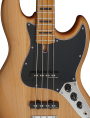
Hi, I wanted to buy this:
Hosa GLT-255 XLR Female to XLR Male Ground Lifter
but in this video it's said it doesn't work and it is a placebo-product only:
My goal is to find some way to add to my Ashdown Bass head DI ground lift feature considering it doesn't have it.
Can you suggest me any working solution or working product?
Thank you very much
The video was all over the map, pro audio, consumer, computer. So I won't address any of that here.
I am (was, now retired) a broadcast technician of nearly 50 years. My duties included the audio broadcast chain from the DJ's microphone all the way through to the transmitter's antenna. This included analog and digital audio, recording and live remote broadcasts. I spend a lot of time interfacing between pro, prosumer, consumer and computers. I will discuss the Hosa device in question, and touch on other aspects to hopefully address ground loop issues and solutions. And BTW, not all hum is caused by ground loops.
The Hosa device is listed as a ground lifter. It should work if Pin 1 is not passed through. If both sides have pin one also tied to the shell then it will pass ground through. But ground also must be carried through on the shells of the other cables it is connected to, which they shouldn't be normally.
I don't recall ever trying one of these for lifting a ground so can't speak to the internal wiring for that purpose. It does have value as a straight thru adapter when you run into the occasional instance where you do need to mate connectors of the same gender. I kept a couple of these in my tool box for that purpose. For ground lifts I usually rolled my own because I know how. Likewise for audio transformer adapters which can also solve hum problems. But I also purchased audio transformer adapters. My go to was usually someone like Whirlwind.
What does a ground lift do? It disconnects pin 1 on an XLR connector, aka the round jobs with three pins used most often in pro audio. Pin 1 carries the shield of a balanced audio cable. No audio signal is carried on the shield, only on pins 2 and 3. You can create a lifted ground cable by disconnecting pin 1 on one of the connectors. I'd make short cables with two XLR connectors (one of each sex) and just not connect pin 1 on one of the connectors. BTW, in pro audio, it is standard practice to NOT connect pin 1 (ground/shield) to the outer metal shell of the XLR, as was claimed in the video that Hosa did. There is a connection tab to do this, but it is not common practice in audio for the very reason raised in question of the Hosa adapter. Which end to lift can also be a consideration. But that's another discussion.
What is a ground loop? If you have two (or more) pieces of equipment powered from an A.C. wall outlet and that equipment uses a three prong A.C. plug (aka grounded plug) and then connect the equipment using XLR cables as is normally done in pro audio, like an amp D.I. output to a mixing console. You can get a ground loop hum, due to multiple grounds at slightly different voltage potentials. (Grounds aren't perfect) To keep the A.C. safety ground on the power cord operating you don't want to break ground there. Rather you employ some method to disconnect the audio shield/ground at one end of the cable. This is safe, effective, and relatively inexpensive. The other method is to use an audio isolation transformer.
This acts by placing an audio transformer on pins 2 and 3 between one device and another. These get relatively expensive and and you definitely get what you pay for here. Again, I like Whirlwind for these if I don't make my own, using a quality transformer. My use for something like this was more to convert unbalanced audio (2 conductor like phono or phone connectors) to the balanced, 3 conductor XLR for most pro use. Many store bought transformers, as well as the all the ones I built into a small box include a ground lift switch. That should be a clue that transformers and switches might be used for different purposes to solve different problems. A non- transformer ground lift switch won't degrade the audio as can happen with lower quality transformers.
All of this like so many other subjects will fill volumes and shelves. I spent a career working with it and only feel like I've scratched the surface. Lot of guys with lots more education and diplomas to prove it can take you on a dive, much deeper than you can ever imagine.
Note several re-edits. FYI.