• TalkBass has been independent since 1998. Add your voice.
    Create a free account to reply to discussions, view embedded media, and browse with fewer display ads.
    Join freeLog in
    Want zero display ads or expanded classifieds tools? Compare plans.

Double Bass adjustable bridge

Crusty, old, young, green, whatever. This place is frequented by people of various levels of experience. I'm just a guy who plays a bit and is blessed to be employed to set up instruments and do some minor repair at a nice shop. The more I learn about what contributes to a good sounding instrument the more I am challenged by the process. Why does it sound better or worse? A certain endpin, tailpiece or whatever improved one bass but not another.??? Forums like this have a lot of value, but there is no substitute for DOING. Iona, I commend your effort. Whether that bridge might work better with aluminum, brass, wood or kryptonite adjusters is of little concern. I would prefer a conventional adjuster to allow finer adjustment. That is all.
 
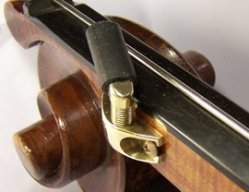
Other benefits I built into the design include getting rid of the wheel ( I know a big name player who carries vice-grips to turn his adjusters) and replacing it with a hex nut design; very easy and positive turning with a standard wrench.

Is it a hex nut design or an actual hex nut? I went to a set-up like is shown on the OP's pic of his bridge some time ago, only with a hex nut on the bolt, adjusted by a wrench. I just got tired of having to use pliers to turn the wheel, plus I have too many basses to plonk down coin for adjusters for all of them. My arrangement works, but looks strictly Gyro Gearloose/Rube Goldberg. A visually-appealing commercially produced version would be enticing.
 
Mass (nit-picking, but weight is the wrong term in this case) seems to be important for brige adjusters. Maybe its psychological, but whenever I take a bow to a bass with brass adjusters, the bridge just feels dead. That is maybe why some luthiers I know prefer aluminium to ebony. I don't know what wood adjusters weigh, but I bet it's somewhat more than Alu. The adjuster I use is about 26 grams per pair. The set screws Iona used are probably steel, and probably weigh in at around 10 grams each. A length of alu (or Ti) threaded rod could be used instead to save weight even further, and it might be worth doing. I've also seen titanium adjusters where the wheel is undercut, so I bet they're super light. There is also the practice of using inserts. Common in Europe, where we don't have a thread which taps into maple as nicely as 1/4-20. This also adds weight.

How important is mass? I'm now bitten. When I get some time I'm going to carve undercuts into the wheels of a pair of aluminium adjusters and drill out the shafts and see if it makes a difference. I bet I could remove ten grams from the pair with a bit of tedious lathe work.

As to Don ruining his bridge, from the photo it seems he knows what he's doing.

Edit: Actually, if there is anything to this it makes an argument for solid bridges. Consider that the amount of wood you remove from the bridge to install adjusters is probably less than five grams.

Rob,

I agree - "it's the mass, stupid".

Here is a source for 1/4-20 Titanium threaded rod. It's about $36.00/ft.(!)
You could drill out the shaft for even less "mass".
http://www.mcmaster.com/#standard-threaded-rods/=ua842a
Is anybody making CF threaded rod? I only found CF bolts.

Also - re: lightening conventional adjusters - you might also consider drilling out a percentage of the "wheel", by strategically placing holes of various sizes around the circumference.
(I might be asking Santa for a Bridgeport Vertical Milling Machine and a Lathe for X-Mas).
Thanks for your interest.
don kasper
 
Can a 3-D Printer tear my fingers off or imbed a length of (expensive) Titanium rod into my skull?
If not, I'm not interested!
don kasper
Luddite! Printing your wheels or nut has got to be easier than drilling out the extra weight! Although I'm still not convinced that the maple wheels aren't the way to go.

I spend most of my weekends working on my, originally derelict, house so I know the joy of stabbing your
yourself with a piece of 16-foot honeysuckle - today - and wrapping your knuckles on a steal cross member freeing a bolt, but, man, use the best tool available, not just the tool you know!

Not everything's a nail. Plllleeeaaaase! ;)
 
  • Like
Reactions: Don Kasper
Is it a hex nut design or an actual hex nut? I went to a set-up like is shown on the OP's pic of his bridge some time ago, only with a hex nut on the bolt, adjusted by a wrench. I just got tired of having to use pliers to turn the wheel, plus I have too many basses to plonk down coin for adjusters for all of them. My arrangement works, but looks strictly Gyro Gearloose/Rube Goldberg. A visually-appealing commercially produced version would be enticing.


It's a nut frozen onto the shaft. I made three sizes: 1/4", 5/16" & 3/8" all in aluminum.

When I last talked with my machinist, it was suggested that we start with hex stock and turn them out rather than rod and add the nut.
 
  • Like
Reactions: Don Kasper
Luddite! Printing your wheels or nut has got to be easier than drilling out the extra weight! Although I'm still not convinced that the maple wheels aren't the way to go.

I spend most of my weekends working on my, originally derelict, house so I know the joy of stabbing your
yourself with a piece of 16-foot honeysuckle - today - and wrapping your knuckles on a steal cross member freeing a bolt, but, man, use the best tool available, not just the tool you know!

Not everything's a nail. Plllleeeaaaase! ;)

Tom,
Is anybody producing Maple adjusters? (I have not been in the market for a new bridge for sometime). I wonder if (1/4-20) threads can withstand the down-force? Maybe soak all the threads with a coat of cyanoacrylate adhesive to strengthen all the mating surfaces? I wish I owned a second (or third) bass for experimenting.

Also - I own a tree branch with horsehair attached. I then dip the horsehair in tree sap - I. AM. A. LUDDITE!
I guess next your going to claim the Earth is "round"?
Thanks.
don kasper
 
Tom,
Is anybody producing Maple adjusters? (I have not been in the market for a new bridge for sometime). I wonder if (1/4-20) threads can withstand the down-force? Maybe soak all the threads with a coat of cyanoacrylate adhesive to strengthen all the mating surfaces? I wish I owned a second (or third) bass for experimenting.

Also - I own a tree branch with horsehair attached. I then dip the horsehair in tree sap - I. AM. A. LUDDITE!
I guess next your going to claim the Earth is "round"?
Thanks.
don kasper
LoLs! Damn right about that round Earth. And damn right about the horsehair in tree sap! Next, you'll be saying that you prefer white hair to dark! Just kidding, I know it makes a significant difference in timbre.

In the last 6 months I asked Lisa Guss's shop to undue my low action, back to 6+ mms on the G-string and they said that the easiest, most cost-effective way, was to make my bridge adjustable and they argued for the maple adjusters they inserted. Sounded good to me. And, after the fact, "sounded good to me". I can't hear any difference on my Chinese hybrid. You've got a much better carved bass than I and I better ear to boot, so, perhaps you can hear the difference, but the luthier's argument for why the maple adjusters were a good choice sounded believable. Again, perhaps you'd notice the difference when I wouldn't.
 
Tom,
Replacing "Maple with Maple" makes so much intuitive sense to me. I would trust Lisa Gass's opinion and expertise on just about any bass-related issue.
Lisa added the adjusters to my current bridge (which was fitted by Jon Peterson - Jon was not a fan of adjusters, as I recall.) - I think they're Ebony, installed about 14 years ago.
I think these (possible) differences need to be evaluated on an individual basis/bassis - that is, I think it's dangerous to draw broad, general conclusions from specific installations.
After all, these are "Basses", fer Chrissakes!
Now, I have to go out and sacrifice a chicken so that the harvest will be bountiful!
don kasper
 
  • Like
Reactions: Tom Lane
Tom,
Replacing "Maple with Maple" makes so much intuitive sense to me. I would trust Lisa Gass's opinion and expertise on just about any bass-related issue.
Lisa added the adjusters to my current bridge (which was fitted by Jon Peterson - Jon was not a fan of adjusters, as I recall.) - I think they're Ebony, installed about 14 years ago.
I think these (possible) differences need to be evaluated on an individual basis/bassis - that is, I think it's dangerous to draw broad, general conclusions from specific installations.
After all, these are "Basses", fer Chrissakes!
Now, I have to go out and sacrifice a chicken so that the harvest will be bountiful!
don kasper

The truth be spoken, so sayith... the experienced bassist? :)
 
  • Like
Reactions: Don Kasper
You Sir, might be a Genius! RH thread/LH thread, with a hex nut in the middle! Damn.
I doff my proverbial cap to you, Sir!
Thanks for your interest and expertise.
don kasper
+1! That's brilliant. I'd considered a hex or square section instead of a wheel to save weight, but the thread thing is especially clever:)
 
Link Removed
Here's something off the shelf from McMaster, but it only comes in steel. How about just drilling a 3/32" hole across the center? Then you can adjust with a small screwdriver, and can have a smaller gap in the bridge leg. If you were to machine it in Ti or Alu, you could make the center section a bit larger for strength. Ideas, ideas, ideas...
 
ImageUploadedByTalkBass1414158627.573955.jpg
 
  • Like
Reactions: james condino
Link Removed
Here's something off the shelf from McMaster, but it only comes in steel. How about just drilling a 3/32" hole across the center? Then you can adjust with a small screwdriver, and can have a smaller gap in the bridge leg. If you were to machine it in Ti or Alu, you could make the center section a bit larger for strength. Ideas, ideas, ideas...

Just run a nut down the right-hand side and braze it into place.