• TalkBass has been independent since 1998. Add your voice.
    Create a free account to reply to discussions, view embedded media, and browse with fewer display ads.
    Join freeLog in
    Want zero display ads or expanded classifieds tools? Compare plans.

Double Bass adjustable bridge

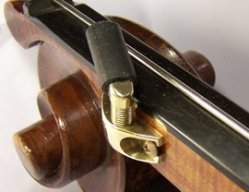
Until they break! The delrin adjusters are incredibly smooth- you can adjust the wheels at full string tension with no effort...but..... This one had a sudden, catastrophic failure just sitting in the rack next to the other basses with nobody touching it for several months! When I called the place that markets and installed them, all I got was a load of BS and backtracking like it was somehow my fault. That's enough to loose all priviledges around here.

I'd like to be able to find a middle ground, something like teflon coated aluminum adjusters.

B43_zps56b0d6e9.gif


www.condino.com
www.kaybassrepair.com

Ouch! Did it ding the top? I'm sticking with metal:)
 
Let me throw some more gas on this fire - (hey, it's down to $3.49/gal. here in Los Angeles).
When drilling metal for a 1/4-20 tap, a #7 drill (.210"), is recommended.
When I've drilled hardwood for a 1/4-20 tap, I've used a slightly undersized drill ( #9, .194", if I remember correctly), which leaves more material/meat for the tap, and results in a slightly tighter fit between the screw and resulting threads. Less Slop! I would experiment and test to see just how much slop could be eliminated without compromising the structural integrity (i.e., "cracking" the surrounding wood while tapping). Finally, powdered graphite is added to all surfaces as a lube. (Insert "lube" joke HERE).
Thanks.
don kasper

I have used a 3/16" (.1875) drill bit for 1/4-20 threads quite often. I'm using different adjusters now which use call for a 13/64" bit, but I never had any trouble with the 3/16" bit.
 
  • Like
Reactions: 360guy
James, thanks for sharing your picture and personal experience with the delrin adjusters. I heard from ehTrain that the some new delrin adjusters ( maybe it's the ones with 5/16" acme threading?) have an aluminum shaft encased in the middle.

Your experience is certainly a cautionary tale. When I make a acetron or delrin adjust-a-bridge (I do really like the "Yin/Yang" adjuster, thank you very much sir!) I'll either try to insert an aluminum shaft or use it just for test purposes.

As far as getting twice the action per turn... Having considered this I think it might also be twice the regular effort. But since my design will use a hex nut I think there will be plenty of leverage with a small wrench. I believe most players would prefer not having to tear up their finger tips on the typical 1 1/4" knurled wheels.

And as my old biology professor from Truman college pointed out: like possums, and several other marsupials with double vaginas and corresponding double penis's " they can 'do it' twice at once".

I'll leave you with that.....
 
Just a note on turning smoothness. Plain alu does corrode in air. It's probably a good idea to rub the threads/shafts/plates with fine steel wool before installation. Anodized adjusters won't corrode. Whatever material you use, you should probably make sure that all pertinant surfaces are nice and smooth.
 
Just another "IED"!!! (Now, where did I put my Kevlar Tux?)
Seriously, Mr. Condino - do they really recommend adjustment while under full tension? That sounds crazy.
Thanks.
don kasper
I adjust bridges under full tension all the time, Don. Its not hard if the adjusters were installed properly.
 
Until they break! The delrin adjusters are incredibly smooth- you can adjust the wheels at full string tension with no effort...but..... This one had a sudden, catastrophic failure just sitting in the rack next to the other basses with nobody touching it for several months! When I called the place that markets and installed them, all I got was a load of BS and backtracking like it was somehow my fault. That's enough to loose all priviledges around here.

I'd like to be able to find a middle ground, something like teflon coated aluminum adjusters.

B43_zps56b0d6e9.gif


www.condino.com
www.kaybassrepair.com

A nice example of what can happen when an adjustable bridge is not precisely vertically aligned - look where it snapped.
Thanks for posting, "James".
don kasper
 
Thank you. The reason for the larger thread sizes is for experimentation. In the near future I hope to cut 5 bridges for the same bass.
1. No adjusters
2. Standard aluminum adjusters
3. 1/4" Adjust-a-bridge*
4. 5/16" Adjust-a-bridge
5. 3/8" Adjust-a-bridge

Then listen and try to record the sound differences. Unfortunately, I don't currently have the time. But I will get to it and report back!

*there....I gave it a name!

Is there an update to this?
Thanks.
 
A nice example of what can happen when an adjustable bridge is not precisely vertically aligned - look where it snapped.
Iownabass, how many adjusters have you fitted?

My comment was NOT criticizing the installation of the adjusters, (necessarily), but rather, the possible misalignment of the whole bridge, as the strings (usually) pull the top part of an adjustable bridge toward the fingerboard, while the feet remain fairly stable and properly aligned.
The break location, at the point where the shaft meets the wheel, suggests to me that the top part of the bridge was not aligned properly, which eventually snapped the shaft.
Just my observation/opinion/$0.02.
Thanks.
 
Yes, perhaps a subject for another thread, but what is the rationale for having this profile?

This is just how my bass is constructed - My setup is very conventional. My bridge is cut this way to facilitate the string height off of the fingerboard.
A bridge profile is cut to place and determine the individual string height across the fingerboard. Mine is at approx. 5mm to 8mm, G to E.
Thanks.