• TalkBass has been independent since 1998. Add your voice.
    Create a free account to reply to discussions, view embedded media, and browse with fewer display ads.
    Join freeLog in
    Want zero display ads or expanded classifieds tools? Compare plans.

Double Bass adjustable bridge

Link Removed
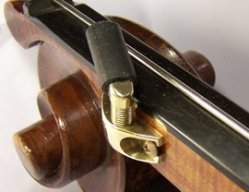
Here's something off the shelf from McMaster, but it only comes in steel. How about just drilling a 3/32" hole across the center? Then you can adjust with a small screwdriver, and can have a smaller gap in the bridge leg. If you were to machine it in Ti or Alu, you could make the center section a bit larger for strength. Ideas, ideas, ideas...

Rob,

Yes - why carry all that mass of a wheel or nut? I like the idea of a slot or hole at the midpoint for adjustment. I'd like to see just how much unnecessary mass could be removed.
Thanks,
don kasper
 

360guy,

I'm curious as to your using the larger screw sizes, (5/16-18; 3/8-16, I assume), in addition to the 1/4-20. I would think that the 1/4-20 has enough thread depth to carry the down force exerted upon the bridge.Maybe you're anticipating repeated cycles of on/off that may lead to unusual wear on the threaded surfaces, and so you're considering the 2 larger sizes? ( I'm becoming OCD regarding "mass"!).
Keep us posted as to the use of threaded hex stock - that seems like a very elegant solution.
Thanks for your interest and expertise.
don kasper
 
Thank you. The reason for the larger thread sizes is for experimentation. In the near future I hope to cut 5 bridges for the same bass.
1. No adjusters
2. Standard aluminum adjusters
3. 1/4" Adjust-a-bridge*
4. 5/16" Adjust-a-bridge
5. 3/8" Adjust-a-bridge

Then listen and try to record the sound differences. Unfortunately, I don't currently have the time. But I will get to it and report back!

*there....I gave it a name!
 
Seems like at the heart of this is whether it's the continuation of the vibration down to the bridge feet and ultimately to the top. That depends on whether you think this material conveys that best or not for that vibration. Has anyone done any scientific experiments to determine the validity of either claim? Until then, we're all just guessing, no? And that suggests that it doesn't make any appreciable difference because it's not obviously detected by luthiers nor bassists. More pissing in the wind on Talkbass. Surprise!
 
I've yet to complete the experiments but I will in the near future. And I'll report the results on TB.

I can I conceive of a pick-up being incorporated into the Adjust-a-bridge somehow, as well!

I may propose doing a study on this over at Michigan State University. They have a great music department.
 
With double-threaded adjusters, are there issues with keeping the tapped sections of the upper and lower parts of the bridge perfectly aligned? With the typical one-side threaded adjusters, there can be a bit of misalignment as the untapped hole can be a little oversize, but if both parts are threaded, this seems like it would be more of an issue. Also, does one assume that transmission of vibration through the threads in a double-threaded adjuster is superior to the transmission through the plate (for lack of a better word) of the typical adjuster as it sits flat on the bridge end-grain surface?
 
With double-threaded adjusters, are there issues with keeping the tapped sections of the upper and lower parts of the bridge perfectly aligned? With the typical one-side threaded adjusters, there can be a bit of misalignment as the untapped hole can be a little oversize, but if both parts are threaded, this seems like it would be more of an issue. Also, does one assume that transmission of vibration through the threads in a double-threaded adjuster is superior to the transmission through the plate (for lack of a better word) of the typical adjuster as it sits flat on the bridge end-grain surface?

misterbadger,

By design, all adjustable bridges should be aligned symmetrically - that is, each side (G/E) should always be either lowered or raised exactly as the other, (assuming the original geometry was done correctly). An adjustable bridge should never be used to compensate for the curve of the bridge in relation to the curve of the fingerboard ("G string height", for example). I've seen students bring in basses with bridges that have been misused in this way - most of them are so out of symmetrical alignment as to qualify as a IED!
Yes, 360guy's "Yin/Yang" design, (you're welcome!), will need to be carefully maintained and adjusted, (WRT symmetry), just like any conventional adj. bridge.

Regarding the "transmission of vibration" question - I believe that this is a significant issue, although I have no Scientific Data whatsoever to substantiate that claim. My instinct tells me that an adjustable bridge that is "bent", (not rigid and straight), due to the "slop" in the non-threaded hole, might not be coupling acoustically to the top plate, as well as a more stable/rigid (or 1 piece/solid/non-adj.) bridge.

Thanks for your time and interest.
don kasper
 
  • Like
Reactions: 360guy
Properly fitted adjusters should always be easy to adjust.
+1.

Also, all this stuff about vibration transmission / material / alignment / etc. is sort of sidetracking. 360 Guy seems to be focused on reducing mass as much as possible. I think the effects of the extraordinary reduction he's achieving will vastly outweigh any other parameters.

One thing, though. Using this "opposed thread" techique will mean that the height change from a given rotation amount will be double that of turning a normal adjuster. This shouldn't be a big deal, but one must take it into consideration when adjusting.
 
Last edited:
Rob,
Re: ...all this stuff about vibration transmission / material / alignment / etc. is sort of sidetracking. 360 Guy seems to be focused on reducing mass as much as possible."

If I'm not mistaken, 360's primary concern was keeping the feet from falling off on a removable neck bass bridge when dissembling, hence his use of yin/yang threads.
An additional benefit will be - more accurate "alignment", as threaded couplings will be less susceptible to misalignment, and will introduce less "slop" into the system.
I believe the 3 factors (transmission/material/alignment) are interrelated and are worthwhile considering in the discussion, though I agree that the "low-mass" issue might be the most significant (and interesting).
Thanks for your time, interest and expertise.
don kasper
 
Last edited:
If I'm not mistaken, 360's primary concern was keeping the feet from falling off on a removable neck bass bridge when dissembling, hence his use of yin/yang threads.
An additional benefit will be - more accurate "alignment", as threaded couplings will be less susceptible to misalignment, and will introduce less "slop" into the system.
I believe the 3 factors (transmission/material/alignment) are interrelated and are worthwhile considering in the discussion, though I agree that the "low-mass" issue might be the most significant (and interesting).
Thanks for your time, interest and expertise.
don kasper

Don,

You're right. 360Guy said "I've invented this design initially for removable neck basses. I didn't want the feet to separate when the bridge was taken down." But he's certainly on to something in terms of weight. I don't know about "slop and alignment" though. If you're luthier does a sloppy job with standard adjusters, I don't see him doing better with "double-threaded".
 
Last edited:
Don,

You're right. 360Guy said "I've invented this design initially for removable neck basses. I didn't want the feet to separate when the bridge was taken down." But he's certainly on to something in terms of weight. I don't know about "slop and alignment" though. If you're luthier does a sloppy job with standard adjusters, I don't see him doing better with "double-threaded".

Personally, I like my adjusters to have minimal space in the leg. These adjusters we're talking about seem rather ugly to me. A large gap with a hex nut in between... The Italian masters would not approve:)

I'm referring to the "slop and alignment" as a result of inattention to the vertical integrity/straightness, usually due to the pull of the strings, over time. That non-threaded hole (usually) in the top part of the bridge, can become enlarged and "sloppy", if the bridge is not kept absolutely straight/perpendicular. A threaded hole will be less susceptible to misalignment, but not immune, of course.
Also - I'm not sure the Eyetalians would approve of ANY adjustable bridge of any kind, whatsoever. As you well know - "...it's not personal, Sonny. It's strictly business."(!)
Thanks.
don kasper
 
Let me throw some more gas on this fire - (hey, it's down to $3.49/gal. here in Los Angeles).
When drilling metal for a 1/4-20 tap, a #7 drill (.210"), is recommended.
When I've drilled hardwood for a 1/4-20 tap, I've used a slightly undersized drill ( #9, .194", if I remember correctly), which leaves more material/meat for the tap, and results in a slightly tighter fit between the screw and resulting threads. Less Slop! I would experiment and test to see just how much slop could be eliminated without compromising the structural integrity (i.e., "cracking" the surrounding wood while tapping). Finally, powdered graphite is added to all surfaces as a lube. (Insert "lube" joke HERE).
Thanks.
don kasper
 
Last edited:
I have Delrin adjusters, very easy to adjust

Until they break! The delrin adjusters are incredibly smooth- you can adjust the wheels at full string tension with no effort...but..... This one had a sudden, catastrophic failure just sitting in the rack next to the other basses with nobody touching it for several months! When I called the place that markets and installed them, all I got was a load of BS and backtracking like it was somehow my fault. That's enough to loose all priviledges around here.

I'd like to be able to find a middle ground, something like teflon coated aluminum adjusters.

B43_zps56b0d6e9.gif


www.condino.com
www.kaybassrepair.com
 
Last edited:
  • Like
Reactions: Don Kasper