• TalkBass has been independent since 1998. Add your voice.
    Create a free account to reply to discussions, view embedded media, and browse with fewer display ads.
    Join freeLog in
    Want zero display ads or expanded classifieds tools? Compare plans.

Adjusted pickup height. Life changed.

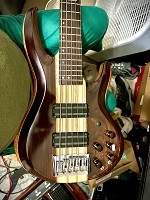
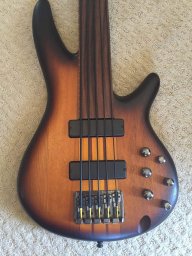
I recently acquired two very nice custom basses. Both were great right out of the box, but something was always missing. Neither felt as "alive" or kinetic as other basses I've played over the years, even though on paper they should have been killer.

Before throwing in the towel and continuing the GAS cycle, I tried one last thing. I brought the pickups MUCH closer to the strings. That did it. All of a sudden I felt like I had completely new basses. They were so much more present in the mix and responsive to my playing.

Has anyone else had a similar experience? And is closer (to the strings) always better? I'm inclined to believe that at this point, although I'm curious to hear what works for others.
 
Congratulations! Yes, pickup "height" — the distance between the pickup and the string, actually — is crucial. This is true for individual pickups and for sets. Some pickups are more forgiving of variations in distance than others, but I think the principle applies to all. Fingerboard radius can be a contributor, especially in bass guitars made in the old Fender style (7.25" radius, for a pronounced curve).

Lately I have been trying out sets of J pickups and paired P and J pickups. I discovered that when the J pickups are brought into proper adjustment as a set, and both pickups are at full volume together, the sensation is of the sound "coming into focus". There is a small range of variance for this, wherein the balance you choose is a matter of taste. But on entering that range, that sweet spot, it's like finding a magic garden; as if something that was hidden suddenly is revealed. Unicorns and such. :)

You will hear people discuss the perils of excessive string pull, when a relatively strong pickup is too close to the strings and exerts too much pull, causing audible oscillation. Once, several years ago, Carey Nordstrand was talking me through adjusting the height of a custom pickup he made for another builder's bass I had just acquired. Oscillation was one problem in that setup. My recollection is that Carey said that sometimes they saw oscillation not only when a pickup was too close, but also when it was too far from the strings. I can't remember why, but it was a different principle of physics.

Anyway, yeah: whenever I struggle to get (a) pickup(s) adjusted, and it's taking... so... long; after I find that magic sound, and I am riding that sonic unicorn, I remind myself that there are few better investments a bass guitarist can make in their sound.
 
is closer (to the strings) always better?

No. every instrument and pickup behaves differently, and everyone's ears are different. There is no hard and fast rule for setting pickup height. Sometimes pickups will end up close to the strings, and other times they will sound better farther away. There are some published specs that serve as starting points, but beyond that, you tweak until it sounds good.
 
No. every instrument and pickup behaves differently, and everyone's ears are different. There is no hard and fast rule for setting pickup height. Sometimes pickups will end up close to the strings, and other times they will sound better farther away. There are some published specs that serve as starting points, but beyond that, you tweak until it sounds good.
I agree. Also type of string and what it is made of comes into the equation
 
So could one generalize that it is better to err either too close OR too far from the strings?

I guess. But personally, after hearing the difference, closer to the strings gives a much stronger signal with "more" tone. Obviously the signal will be weaker further away, but I can't help but feel you're missing out in that scenario. If hot signals aren't your thing, turn the volume down. You lose out on a lot of harmonic content (to my ears) with a wider gap between pickup and strings.
 
On the '78 P bass I had, the previous owner had the pickup fairly low and it wasn't adjusted to match the curvature of the neck's radius, it was pretty much parallel to the plane of the pickguard. After reading about adjusting the pickup's height on the Fender website, I thought I would try adjusting it to Fender's specs, and it was a huge and very noticeable improvement, making a good sounding bass sound terrific. Since then, I make sure to at least check the height of the pickup(s), and, if necessary, move them a little closer to the strings.
 
I guess. But personally, after hearing the difference, closer to the strings gives a much stronger signal with "more" tone. Obviously the signal will be weaker further away, but I can't help but feel you're missing out in that scenario. If hot signals aren't your thing, turn the volume down. You lose out on a lot of harmonic content (to my ears) with a wider gap between pickup and strings.

You are trying to generalize based on your limited experience with one bass. There are many factors that you are not accounting for. Firstly, players with more aggressive techniques will often have problems with the strings clanking on the pole pieces or covers, if the pickups are too close to the strings. Second, when you have strong magnets, you will often end up with warbling out of tune notes when the pickups are close to the strings.
 
You are trying to generalize based on your limited experience with one bass. There are many factors that you are not accounting for. Firstly, players with more aggressive techniques will often have problems with the strings clanking on the pole pieces or covers, if the pickups are too close to the strings. Second, when you have strong magnets, you will often end up with warbling out of tune notes when the pickups are close to the strings.

Well, it was two basses, with completely different pickups and strings (weak single coil + flats, strong humbuckers + rounds), but I see your point. I guess the generalization is with the caveat of "is still playable without any interference", closer yields more tone than further away.
 
You are trying to generalize based on your limited experience with one bass. There are many factors that you are not accounting for. Firstly, players with more aggressive techniques will often have problems with the strings clanking on the pole pieces or covers, if the pickups are too close to the strings. Second, when you have strong magnets, you will often end up with warbling out of tune notes when the pickups are close to the strings.
Especially if the strings have a lot of ferris material
 

Latest posts