• TalkBass has been independent since 1998. Add your voice.
    Create a free account to reply to discussions, view embedded media, and browse with fewer display ads.
    Join freeLog in
    Want zero display ads or expanded classifieds tools? Compare plans.

Double Bass Adjuster Question

Aug 1, 2005
3,546
1,421
Cologne, Germany
www.basscapos.com
Disclosures
Private Inventor - Bass Capos
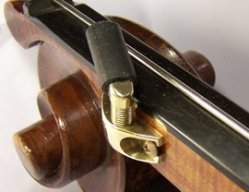
I recently got some one-piece aluminum adjusters with the normal knurled wheel and 1/4-20 thread, but the unthreaded side was not 1/4", but 0.199". I called the seller, and he said that this just saves a drill cycle, since the smaller stud fits into the pilot hole, and therefore you only drill once. I found this to be totally logical, but one luthier I talked to said he'd used them, but didn't like them. He said they were "bendy" and unstable. It seems to me that if the surface on that side is properly flat and perpendicular to the hole then this shouldn't be an issue. Any opinions on this?
 
I dunno about being 'bendy' but I don't like the extra step of putting the bridge in the jig after drilling through the feet. There's always the risk of splitting or misalignment when doing that extra step. Curious to hear how these work long term.
 
I dunno about being 'bendy' but I don't like the extra step of putting the bridge in the jig after drilling through the feet. There's always the risk of splitting or misalignment when doing that extra step. Curious to hear how these work long term.

Yes. I agree totally. I confess that I'm in the process of having a machining job done off-shore. With this kind of transaction, you naturally commit yourself to a large part count, so I want to be sure. It's still early enough that I can make changes, but I am leaning toward sticking with the thinner top stud. One installer in Ireland by the name of Kevin Harrington wrote:

In fact the installation is so much easier with these adjusters that you would be less likely to have inaccuracies that could lead to stability issues. The way I was taught to install adjusters involved fixing the bridge to a jig and drilling the first hole. Then you removed the bridge from the jig to carefully cut off the feet and you have to reinstall it in the jig to drill the larger hole for the shaft. You had to be so so careful when replacing the bridge in the jig cos any inaccuracies in your angles here could throw out the alignment after reassembly. The new adjusters just need one hole so you're removing a major cause of imprecision. Makes my day a whole lot easier! I'm sure different luthiers have their own way of doing things but this is how I was shown to do it in two different double bass-specialist workshops in London when I was training.

I cannot agree more, and don't see a downside..
 
I'm not a luthier, but am about to try this on some student basses. My own professionally done bridge has the threads in the upper part, so I just assumed you'd drill the pilot hole all the way through, chuck the bigger bit in and just drill as deep as you need to, cut, thread by hand. I see that the adjuster with the smaller size shaft would be potentially more accurate. Can anyone suggest a source for these adjusters?
 
Just something to think about...customers who have these new adjusters will have problems installing a Full Circle pickup. I doubt Fishman will offer yet another variety. Sure you can drill it out so it can be installed...but as someone who ships lots of product to people all over the world...I'm imagining the calls/eMails now.

The easy answer is they just buy a wing mounted pickup, of course, and then they can have any adjuster they want. ;)
 
  • Like
Reactions: neilG