• TalkBass has been independent since 1998. Add your voice.
    Create a free account to reply to discussions, view embedded media, and browse with fewer display ads.
    Join freeLog in
    Want zero display ads or expanded classifieds tools? Compare plans.

Double Bass Advice Needed Re: Height/Shape of EUB Bridge

GKon

Supporting Member, Boom-Chicka-Boom
Supporting Member
Feb 17, 2013
4,714
3,821
Los Lunas, NM
Hi folks,

I'm relatively new to the UB world, my main hands-on experience being my Harley Benton (aka Palatino) EUB-500 (Let me say up front, please no negative comments about your opinions on Harley Benton/Palatino). Other than that, I've done a lot of reading on this forum, as well as various sites online in regards to upright bass setup, and do most of the work on my EB's (30+ years experience), but I don't have much real life experience modifying UB's.

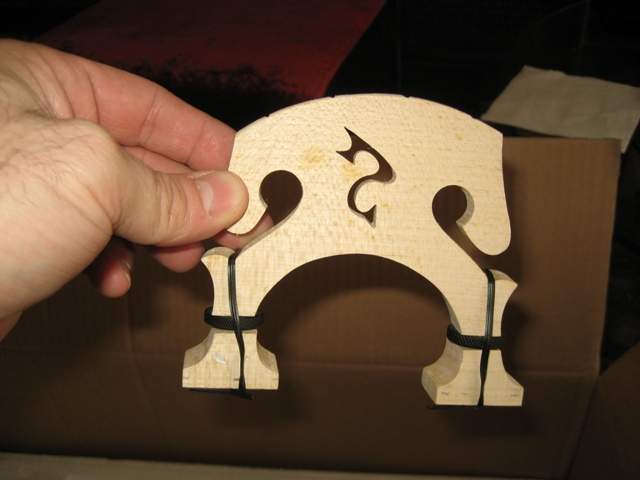
My questions have to do with the height and shape of the stock, adjustable bridge that came with my HB EUB. I understand that the curve of the top of the bridge has to follow the contour of the fingerboard. The way this bridge is cut, however, the top of the bass side of the bridge at the bottom of the E string groove is ~6mm higher than the top of the treble side at the bottom of the G string groove. This is much different than the profile of the fingerboard (see pics below).

I understand that string height has to do with preference, strings being used, fingerboard profile, angle that the fingerboard is set into the bass, whether you are playing pizz or arco, etc. However, in "general" all the reading I have done here on TB and elsewhere point to an average of about 3mm difference of height from the G string to the E string measured from the end of the fingerboard to the bottom of the string. For example, 7mm G string height - 10mm E string height, 8mm G string height - 11mm E string height, 9mm G string height - 12mm E string height, and so on.

Because my bridge's unadjusted height difference is at 6mm, there is no way for me to achieve anything under a 6mm difference between the G string height and E string height without seriously skewing the angle of the bridge, which then creates other problems like too much string tension, unsteady bridge, etc.

My current setup, using Slap Happy's Light Gauge, Low Tension, Weed Wacker strings is 8mm G string height - 14mm E string height. Although playable, and there is PLENTY of room for the low tension Weed Wacker E string to vibrate without any buzzing from it hitting the fingerboard, I still feel that 14mm is a bit too high for the E string. I would like to lower it.

My first question is, I'm wondering if my bridge cut and shaped correctly? I've asked other Palation/HB owner's to provide their bridge's measurement but have had no responses, so I have nothing to compare it to.

Here is a photo of my bridge brand new as it came out of the box.
IMG_8346e.jpg


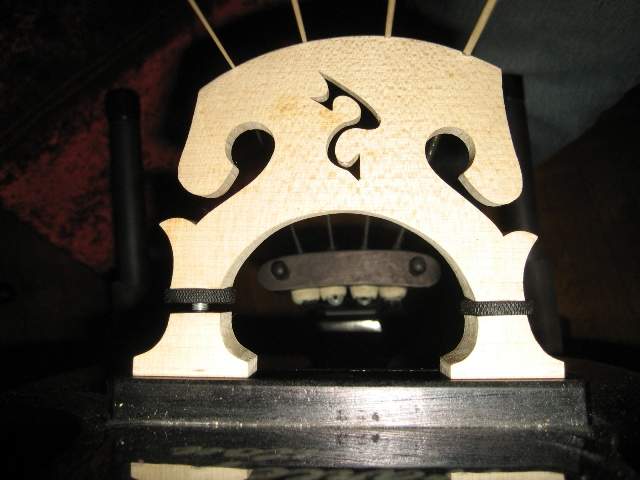
Here is a photo of it on the bass (Please disregard the height of the adjusters. It is not set up that way now):
IMG_9185e.jpg


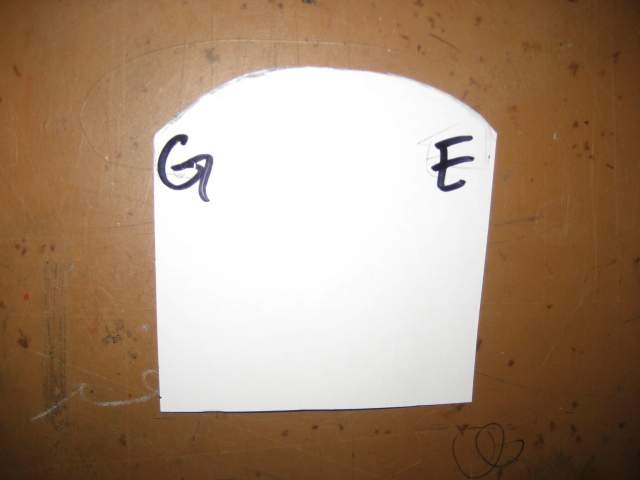
Here is a picture of a piece of cardboard the top of which I traced the curve of the fingerboard (don't mind the non-perpendicular sides of the cardboard. The bottom is cut flush with the body of the bass and the top is in line with the bottom). You can see that the E side is a bit higher than the G side, but NOT 6mm:
IMG_0797.JPG


And here is a pic of that same cardboard sitting on top of the bridge. You can see the big discrepancy of the profile of the fingerboard (top of the cardboard) and the profile of the bridge:
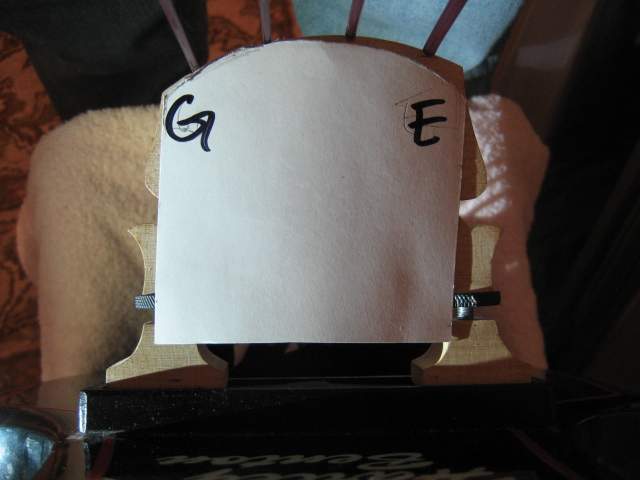
IMG_0803.JPG


One more picture for the sake of comparison is an Eminence EUB bridge that has been reshaped to install on to a Palatino/HB EUB-500 that is for sale on ebay. According to the seller, the height difference between the E string groove to the bottom of the bass foot and the G string groove to the bottom of the G string is 3mm. You can clearly see a much more gradual curve as compared to my stock bridge:
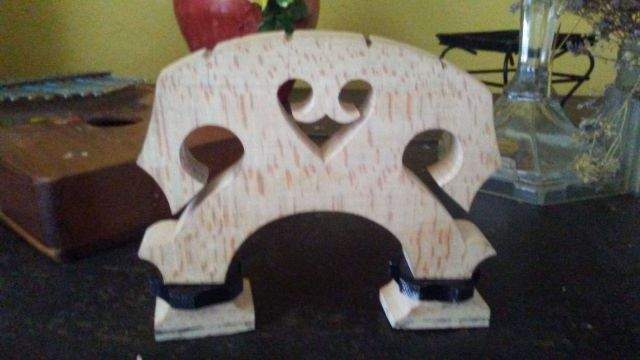
Eminence.jpg


What I would like to do is (as suggested to me on a different thread) to lower the E string groove 3mm, the A 2mm, the D 1mm, and leave the G alone, and then sand or file down the top of the bridge to the correct dimensions and thickness so that the strings are sitting in their grooves properly, with 1/2 to 1/3 of the string exposed above the new grooves.

Actually, at first, I would lower the E string groove by 2mm, the A by 1mm, and the D by .5mm, and try that out to see how I like it and how it sounds. If I want to do more, then I can.

My question is, for those that have more experience doing mods than I do, does this sound realistic and feasible to do without making the bridge unusable?

Keep in mind that, although I'm no luthier, I am handy, have already successfully opened up the nut and bridge slots on this EUB already to accommodate the thicker gauge Weed Wackers which I just recently installed, replacing the stock, steel strings (I had the same height issues with the steel strings, so that has nothing to do with this issue). I've set up the height of each string to the thickness of a business card where the strings come off of the nut.

I also do all of my own set-ups on my EB's.

Also, at this point, although I've done some arco playing, I am mainly playing pizz. That's not to say I won't focus more on arco in the future, though, so I'm concerned about my bridge reshaping and string height adjustment affecting that in the future.

Any info, advice, and words of encouragement would be much appreciated. I apologize if this is a long thread, but I wanted to be as detailed and thorough as possible.

Thanks in advance,
Konstantine
 
Congrats for the detailed post.
It's quite common to need to redo the setup on an instrument when you buy it.
That said your analysis seems very good, and I think you could go ahead and modify the bridge, or get a new one and modify it.
But what about the fingerboard?
Why is the E string higher than usual?
If it doesn't have the proper camber, lowering the strings may yield to buzzes.
My best advice would be to bring the instrument to a qualified DB luthier to do the setup.

Good luck!
 
  • Like
Reactions: GKon
Congrats for the detailed post.
It's quite common to need to redo the setup on an instrument when you buy it.
That said your analysis seems very good, and I think you could go ahead and modify the bridge, or get a new one and modify it.
But what about the fingerboard?
Why is the E string higher than usual?
If it doesn't have the proper camber, lowering the strings may yield to buzzes.
My best advice would be to bring the instrument to a qualified DB luthier to do the setup.

Good luck!
Thank you for your reply and input. I'm glad to know I'm on the right track.

I figure that the E is that high because of the extra height of the bridge, meaning 6mm higher than the G when unadjusted.

The E is at its current height of 14mm because I wanted the G set at 8mm, so I adjusted the bridge, thus raising the E to 14mm (8mm +6mm= 14mm).

Till now, I've had no issue with the fingerboard either with the steel strings installed or with the weedwackers.

Since it appears that my diagnosis is on the right track, I'm willing to work on the bridge to get the strings lower and see how it goes from there.

Thanks, again.
 
I would put the bridge as low as possible and check with steel strings that the height of the individual strings is good in comparison to each other, no rattling of a string (specially the E) and no buzzing for any fingered note.
Also check with a bow that the bowing angle (angle until you touch a neighbor string) is equally distributed (specially for the inner strings) and not too small.
You don't need to be able to bow well, just check that angles on D and A are more or less equal and not too small.

Usually putting the strings higher won't get buzzes with other strings. Except maybe the E. That's the reason why I warned about the 1 mm difference from string to string, something in between 1 to 1.5 mm from string to string might be better to avoid a rattling E but will reduce the bowing angle a bit.

Also using thick lower and thin upper strings can reduce the bowing angle. You might want to consider the string diameters in your calculation, since you measure the clearance to the fingerboard below the string, but bowing happens above the string.

Since you have adjusters you can screw the bridge a bit higher and reshape it if you find out after a while that you took off too much from the E, but don't do that too often or you might need a new bridge.

Take it slow and play for a while after you made your initial adjustment.
 
  • Like
Reactions: GKon
I would put the bridge as low as possible and check with steel strings that the height of the individual strings is good in comparison to each other, no rattling of a string (specially the E) and no buzzing for any fingered note.
Also check with a bow that the bowing angle (angle until you touch a neighbor string) is equally distributed (specially for the inner strings) and not too small.
You don't need to be able to bow well, just check that angles on D and A are more or less equal and not too small.

Usually putting the strings higher won't get buzzes with other strings. Except maybe the E. That's the reason why I warned about the 1 mm difference from string to string, something in between 1 to 1.5 mm from string to string might be better to avoid a rattling E but will reduce the bowing angle a bit.

Also using thick lower and thin upper strings can reduce the bowing angle. You might want to consider the string diameters in your calculation, since you measure the clearance to the fingerboard below the string, but bowing happens above the string.

Since you have adjusters you can screw the bridge a bit higher and reshape it if you find out after a while that you took off too much from the E, but don't do that too often or you might need a new bridge.

Take it slow and play for a while after you made your initial adjustment.

Thanks for all of the info DoubleMIDI. You were one of the people I was referring to when I mentioned getting advice from others. I decided to start a new thread rather than keep posting in the Palatino EUB Modifications thread.

Since I had to open up the nut and bridge grooves to accept the weedwackers, I don't think I can reinstall the steel strings and get an accurate idea of how the strings will react regarding buzzing and the like.

I have played it in the past with the steel strings and the bridge at the lowest setting with no buzzing so I figure all is well in that regard. I have also bowed it with the steel strings and the bridge at various height. It is bowable but I did feel the angle from the A to the D was a little small as compared from the E to the A and the D to the G. However, there is a good that that has more to do with my inexperience with bowing.

I would like to lower the E some. When I do finally get around to it, I plan on measuring the current heights between the strings and will make small adjustments each time so as to avoid messing anything up.

For curiosity's sake I would still love to have someone with a stock Palatino/HB bridge give me their measurements for comparison.
 
You can reinstall the steel strings, at least for some testing. But you probably don't need to do that.
It seems that the A string is a bit low or the D a bit high. Your description is a bit unclear, since the angle on the D is from not touching the A to not touching the G. The angle at the A is from not touching the E to not touching the D. The Angle at the G is from not touching the D to not touching the bout at the G side, but you might want a bit more to avoid touching the bout at all (more of a problem with an acoustic double bass and a five string, that usually is no problem with an EUB).

I don't have a Palatino, only a Stagg EUB, but with these cheap instruments (I tried some EUBs at a big music store, cheaper and more expensive ones), their setup is often bad. Mainly because there is no double bass player in the production chain, at least none that has any influence on the final design.
The Stagg often has no to a negative camber (I have three of them that I got cheap because they had some small damage) and the bridge has equal height on every string. The bridge is painted or covered with black epoxy, so changing the bridge damages the finish. But the bridge is bad anyway because the adjusters have too much mass etc.
And there might be tolerances specially with the fingerboard to body angle and the fingerboard shaping that might make measurements from other Palatinos useless. So you might ask, but don't take for granted that this would work the same way on your instrument.

Try to adjust the bridge string height first before you lower the action. That gives you some experience and you would lower that one string anyway later. It's also easier to lower the action after you adjusted the bowing action because you can do a third on D two thirds in A and full difference on E. And do the bowing angle adjustment with steel strings or metal wound strings since the Weedwackers are not bowable and rather thick.
The string with the low bowing angle is too low, but since you cannot raise it, you need to lower the other inner string and maybe also the outer two strings.
 
You can reinstall the steel strings, at least for some testing. But you probably don't need to do that.
It seems that the A string is a bit low or the D a bit high. Your description is a bit unclear, since the angle on the D is from not touching the A to not touching the G. The angle at the A is from not touching the E to not touching the D. The Angle at the G is from not touching the D to not touching the bout at the G side, but you might want a bit more to avoid touching the bout at all (more of a problem with an acoustic double bass and a five string, that usually is no problem with an EUB).

I don't have a Palatino, only a Stagg EUB, but with these cheap instruments (I tried some EUBs at a big music store, cheaper and more expensive ones), their setup is often bad. Mainly because there is no double bass player in the production chain, at least none that has any influence on the final design.
The Stagg often has no to a negative camber (I have three of them that I got cheap because they had some small damage) and the bridge has equal height on every string. The bridge is painted or covered with black epoxy, so changing the bridge damages the finish. But the bridge is bad anyway because the adjusters have too much mass etc.
And there might be tolerances specially with the fingerboard to body angle and the fingerboard shaping that might make measurements from other Palatinos useless. So you might ask, but don't take for granted that this would work the same way on your instrument.

Try to adjust the bridge string height first before you lower the action. That gives you some experience and you would lower that one string anyway later. It's also easier to lower the action after you adjusted the bowing action because you can do a third on D two thirds in A and full difference on E. And do the bowing angle adjustment with steel strings or metal wound strings since the Weedwackers are not bowable and rather thick.
The string with the low bowing angle is too low, but since you cannot raise it, you need to lower the other inner string and maybe also the outer two strings.

Sorry for the confusion. What I was trying to explain was, when bowing the E there is plenty of room between the bout and the A, when bowing the A there is plenty of room on the E side and on the A side, when bowing the D there is less room on the A and G side as compared with the other strings being bowed, and when bowing the G there is plenty of room between the D and the bout.

I actually just came back from bowing the weedwackers and I saw that all strings are bowable as I mention above. There is room to bow the D string, with a smaller amount of room on the A and G side but it seems enough to bow if I was more experienced with bowing. (You mentioned the WW's not being bowable but I remember reading that they are and I was just able to, but that's not to say I'm right given my lack of experience).

Something else I did was measure the height difference between strings and they are all 2mm apart from each other in height meaning G is 8mm, D is 10mm, A is 12mm and E is 14mm. Although they get progressively higher, from G to E, there is a nice curve to them as you can see in the pics, so they are playable both pizz and arco. My idea of wanting to lower the height of the E is due to the reading I've done where the E is on average only 3mm higher than the G as opposed to the 6mm it is now.

I've done a lot of adjustment to the bridge height over the last few years that I've had this EUB. Although I can alter the height of the strings, they still have the overall difference of 2mm from string to string and 6mm difference between the G and E. For example, if I lower the G to 7mm, that will put the E at 13mm. G at 9mm = E at 15mm.

In the past I have set the bridge height where the bass side is 1/2 to 1 turn less (lower) than the treble side which puts the E at 5mm higher than the G, but as mentioned before, that puts undue stress on the G string and makes the bridge seem less stable and skewed too much. For that reason I've stuck to raising/lowering the bridge an even amount of turns, as I have it now.

Sorry for being so wordy.

My question now is, if I lower the E 2mm right now, that will put the G at 8mm, D at 10mm, A at 12mm and E at 12mm. However, because of the curve of the bridge, the E should still be lower than the A in regards to bowing, correct?
I don't necessarily want to also lower the A and D strings because I don't want to make them more difficult to bow or completely unbowable.

I appreciate your responses. I like learning new things and how to fix and modify my instruments, hence my asking so many questions.
 
If you take only the E lower, the bridge angle for the A rises (and if you have a bout like on an acoustic double bass the bowing angle of the E gets less, but usually still enough).

But then you have a larger angle for the A which was bigger than the one for the D even before, so it would make sense to lower the A string a bit too, maybe up to half of the E string height difference.

Try it bit by bit, put on the string after you changed a bit and try and feel what happens. Start with the E and if you are happy with it check the A. Be slow with the A and check often as the only way to correct going too low is lowering all other strings and raise th adjuster. The E is the least problematic string to change unless it starts to rattle. And even less problematic on an EUB.

If you make the bridge slots as wide as the strings, you can start file them down, put the strings on and check, then correct if needed, maybe several times. If you are finished you can file down the crown until the string slots are 1/3 string diameter deep (a bit more for the , at least at the inner side of he slot or your E string might jump out of the groove). That way you can file and test quickly and reshape the bridge when you have finished. Just make sure that the strings glide easily into he slots and are not getting cramped each time you check your setup by putting the string in and tuning up.
 
Last edited:
  • Like
Reactions: GKon
If you take only the E lower, the bridge angle for the A rises (and if you have a bout like on an acoustic double bass the bowing angle of the E gets less, but usually still enough).

But then you have a larger angle for the A which was bigger than the one for the D even before, so it would make sense to lower the A string a bit too, maybe up to half of the E string height difference.

Try it bit by bit, put on the string after you changed a bit and try and feel what happens. Start with the E and if you are happy with it check the A. Be slow with the A and check often as the only way to correct going too low is lowering all other strings and raise th adjuster. The E is the least problematic string to change unless it starts to rattle. And even less problematic on an EUB.

If you make the bridge slots as wide as the strings, you can start file them down, put the strings on and check, then correct if needed, maybe several times. If you are finished you can file down the crown until the string slots are 1/3 string diameter deep (a bit more for the , at least at the inner side of he slot or your E string might jump out of the groove). That way you can file and test quickly and reshape the bridge when you have finished. Just make sure that the strings glide easily into he slots and are not getting cramped each time you check your setup by putting the string in and tuning up.

I was worried about just lowering the E and how that would affect the bridge and bowing angle of the A, but I was also concerned about if I also lower the A, that might worsen the bowing angle between the A and the D.

I am planning on doing exactly what you suggest, bit by bit, slowly, and constantly test the results. I can do the work with the bridge still on the bass, loosen the E string, work on the E string slot, restring it, test it, repeat as necessary. I can then get a feel for what I need to do with the A string and use the same process.

Once that's done I can file down the bridge crown.

The good thing is, we're only talking about 2mm or so, which won't be so hard to file down.
 
  • Like
Reactions: DoubleMIDI
I've been doing some more research and have come across something called a fingerboard template which basically seems to be a template of the curve of the end of the fingerboard, (Most I saw were for cellos, but I did run across a couple for UB, including a thread on Talkbass) similar to my cardboard template in the pics above.

This info coupled with it being pointed out that the curve of the bridge follows the curve of the fingerboard leads me to ask the question, is it literal that the curve of top of the bridge simply follows the curve of the end of the fingerboard? Can I make a more substantial template of the fingerboard curve and transfer that to the bridge to assist me in resetting the string heights and reshaping the bridge?
 
GKon, you're going quite deep & detailed into all this, but to answer your question:
is it literal that the curve of top of the bridge simply follows the curve of the end of the fingerboard?
No, not precisely. Compared to the fingerboard, the bridge should have a slightly larger radius of curvature R, and the centre (mid-point of the circle) should be a little bit towards the E-side, both in order to achieve a little bit more string height on the low side.

In the design stage, the bridge R is selected aligned with the intended focus of the instrument. Typically below 85mm for an arco focus, and larger for more pizz focus, but the actual number is a personal preference (but arco gets difficult for R > 100mm), and also depends on the number of strings. Then the FB is made with a slightly lower R (say 10mm less), and a slightly offset centre, to create said increasing string heights (you can do the math). Well, this is what I do, others will doubtlessly do differently.

But in your case, I don't think you are going to re-shape your FB. Best take that as a given, put the strings properly centred over it, with the adjusters at their lowest setting (or at a setting equal on both sides that gives the lowest acceptable height for the G-string, say 6mm), and then just file down the grooves for the other strings till they reach their desired heights (so say 7, 8, 9; or 6.8, 7.7, 8.7). File carefully & measure frequently: going down is easy, coming up not so. When done, round-off the crest, round the string notches, lubricate w/ pencil lead (also in nut), crank-up the adjusters to a more normal height & start playing.
 
  • Like
Reactions: GKon and DoubleMIDI
Even if you want to curve your fingerboard later to a smaller radius, it would be no problem to change the bridge to that too then.

I tried to deepen the camber on one of my Stagg EUBs with a rosewood fingerboard (all were slightly damaged in some way and therefor cheap), done that successfully (but still not deep enough), but I don't think I would reshape the fingerboard curvature in the near future. One reason is there is not much wood left at the edges of the fingerboard, but the second that I'm not sure I can do this successfully. At least not currently.

Reshaping the camber helped to prepare for that, since I needed to find and eliminate high spots on the fingerboard. Reshaping the curvature of the fingerboard is almost as hard as shaping a fingerboard out of a block of wood. You need to be able to eliminate all buzzes due to high spots below the strings and successfully shape the curvature change from the nut end (low curvature) to the bridge facing end (high curvature). At least it looks like the curvature changes, maybe someone else can correct me if needed. Maybe the nut end is just a smaller segment of the bridge side curvature.

I would have liked a higher fingerboard curvature on the Stagg fingerboard for bowing, but since the solid body Stagg doesn't bow as well as an acoustic double bass, it is possible to live with it as it is. And I'm used to a smaller bowing angle, since my acoustic double bass is a 5-string.

The Palatino might be a bit better for bowing due to the moving top, but since the top is so narrow and the bridge feet almost touching the ribs, I think it's still far away from the bowing experience of a double bass. So, unless you want to bow the crap out of the Palatino, which you can try first with the current fingerboard shaping, you don't need to reshape the fingerboard curvature.
 
  • Like
Reactions: GKon
GKon, you're going quite deep & detailed into all this, but to answer your question:

No, not precisely. Compared to the fingerboard, the bridge should have a slightly larger radius of curvature R, and the centre (mid-point of the circle) should be a little bit towards the E-side, both in order to achieve a little bit more string height on the low side.

In the design stage, the bridge R is selected aligned with the intended focus of the instrument. Typically below 85mm for an arco focus, and larger for more pizz focus, but the actual number is a personal preference (but arco gets difficult for R > 100mm), and also depends on the number of strings. Then the FB is made with a slightly lower R (say 10mm less), and a slightly offset centre, to create said increasing string heights (you can do the math). Well, this is what I do, others will doubtlessly do differently.

But in your case, I don't think you are going to re-shape your FB. Best take that as a given, put the strings properly centred over it, with the adjusters at their lowest setting (or at a setting equal on both sides that gives the lowest acceptable height for the G-string, say 6mm), and then just file down the grooves for the other strings till they reach their desired heights (so say 7, 8, 9; or 6.8, 7.7, 8.7). File carefully & measure frequently: going down is easy, coming up not so. When done, round-off the crest, round the string notches, lubricate w/ pencil lead (also in nut), crank-up the adjusters to a more normal height & start playing.

Thank you, @Ortsom , for your detailed post. I'm enjoying learning more about the construction of UB's, especially by reading information from people with experience.

No, I'm not planning on re-shaping the FB. I basically want to lower the string heights some, mainly the E, which will also require the other strings to come down some, too.

I will go slowly, until I reach a desired height. Having no hands-on experience with UB's till now, EUB or otherwise, I have nothing to compare my results to.
That being the case, I'll make small adjustments at one time, then try that for a while and then decide if I want to make further adjustments (as recommended by @DoubleMIDI in an earlier post).

I have already used the pencil lead method in the nut and bridge after reshaping the notches on both to fit the weedwacker strings. I will make sure to continue to do so.

Thanks again,

- Konstantine
 
Even if you want to curve your fingerboard later to a smaller radius, it would be no problem to change the bridge to that too then.

I tried to deepen the camber on one of my Stagg EUBs with a rosewood fingerboard (all were slightly damaged in some way and therefor cheap), done that successfully (but still not deep enough), but I don't think I would reshape the fingerboard curvature in the near future. One reason is there is not much wood left at the edges of the fingerboard, but the second that I'm not sure I can do this successfully. At least not currently.

Reshaping the camber helped to prepare for that, since I needed to find and eliminate high spots on the fingerboard. Reshaping the curvature of the fingerboard is almost as hard as shaping a fingerboard out of a block of wood. You need to be able to eliminate all buzzes due to high spots below the strings and successfully shape the curvature change from the nut end (low curvature) to the bridge facing end (high curvature). At least it looks like the curvature changes, maybe someone else can correct me if needed. Maybe the nut end is just a smaller segment of the bridge side curvature.

I would have liked a higher fingerboard curvature on the Stagg fingerboard for bowing, but since the solid body Stagg doesn't bow as well as an acoustic double bass, it is possible to live with it as it is. And I'm used to a smaller bowing angle, since my acoustic double bass is a 5-string.

The Palatino might be a bit better for bowing due to the moving top, but since the top is so narrow and the bridge feet almost touching the ribs, I think it's still far away from the bowing experience of a double bass. So, unless you want to bow the crap out of the Palatino, which you can try first with the current fingerboard shaping, you don't need to reshape the fingerboard curvature.

As mentioned, I have bowed my Palatino successfully, but I have no idea what it's like to bow a proper AUB, so I can't say one way or another if they are similar.
I have seen them bowed on various YouTube videos, too, but again, have no idea how it compares.

I get the feeling that lowering my string heights a bit, keeping the overall curve that they have now by matching the amount I take each string down, should retain the current bowing aspect just fine without me having to do any major surgery to the shape of the bridge or the FB. At this point, I'm asking as many questions as I can so that I am as well informed as possible prior to starting the string height adjustment. I may be over-thinking or asking questions that are far beyond what I may end up needing to do, but I prefer to be as knowledgeable as possible prior to jumping in (and that's because I DO have experience of jumping in way too soon in the past, and paying the price for that, ;) ).
 
The string on an AUB starts quicker and smoother than on a (solid body) EUB and the sound is also less raspy.

I just wanted to explain why changing the fingerboard curvature is a rather big thing and you don't need to do that if you can bow the way it is now.
With your modification your bowing angle will become greater (for the A) and so you can lower the A a bit too to give some of the increased bowing angle to the D.
The outer strings always have a large bowing angle since the are only limited to one side, not two as the inner strings.
 
  • Like
Reactions: GKon
At the moment, all strings have a 2mm height difference from each other.
G is 8mm, D is 10mm, A is 12mm and E is 14mm. The curve of the bridge and fb allow me to bow.

When I start lowering the E string, I plan to lower the A and D the amount needed to keep the same heights relative to each other, thus keeping the same curve. This is what you recommended in the other thread. Good advice!

I'll likely start with .25mm for D, .5 for A and .75 for E, although that seems like very little so I may start with .5mm for D, 1mm for A and 1.5mm for E. This will lower the height relative to each other to 1.5mm and the E down to 12.5mm from 14mm. This is a 4.5mm difference from the G at 8mm, down from 6mm.

This should still allow plenty of room for allowing the strings to vibrate without hitting the fingerboard, and retain the original curve to allow for bowing.

I'm looking forward to finding the time to do this.
 
Today I had the time to work on my bridge and lower the string heights. With all of the information you all provided, and with the research I have done, I felt that I was well prepared to tackle this, being that it's the first time I've done any work like this.

I used drill bits wrapped in sandpaper to get the right size for each string. I started with 220, then 320, then finished with 400 grit.

I took my time with each string, sanding some, then restringing to pitch to check the height. I did this MANY times till I got the height
I felt was best. After some experimentation, I lowered the heights so that instead of a 2mm difference between the neighboring string,
there is now a 1.0mm - 1.25mm difference between them. This has made a huge improvement in the feel and ease of fingering each note, as well as
with playing quick pizz between strings.

As well, I have retained the curve of the strings to follow the fingerboard, so playing with a bow
is still easily possible. I actually tweaked the heights a tiny bit (that's why I say 1.0mm - 1.25mm above) so that the bowing space for the D, and for the A string are improved over what it was
before, so I can bow those two strings much more easily than before.

After setting the depths of the notches on the bridge to achieve the string height I wanted, I then filed down the top of the bridge, to allow for 1/3 of the
D and A string to be sitting in the notch and the remaining 2/3 above, and just about 1/2 of the E string in the notch and 1/2 exposed above.


Thank you to everyone for their input, advice and information. You helped me to accomplish this successfully.

- Konstantine
 
Last edited:
Congratulation! You made yourself a nice Christmas present.
I assume you would like to play this instrument now at least twice as much as before.
Funny you should put it that was, as I promised myself to do this for myself for Christmas

You are correct, too, about it being even more enjoyable. It's amazing how much difference 1.25mm in height can make. I also like the more pronounced curved feel the strings now have.
 
Quick update: I notice, because of the low tension of the strings and likely because they are a bit more slippery than steel strings, the bridge leans slightly towards the fingerboard. I push it towards the tailpiece but it slips right back into a slight backward tilt. It's minute, but worries me because at one point, I lifted up the E string off of its groove on the bridge while everything was under tension to stretch it a bit (the E has such low tension when at pitch that I can lift it off of the bridge), the bridge came flying off of the body and across the room. It left a nasty ding in the finish of the bass. Thankfully the bridge didn't break.

I think a part of the problem, too is the adjuster on the bass side fits loosely into the top of the bridge, allowing it the slightest amount of wiggle.

This happened once before, just after installing the low tension weed wacker strings, but prior to my adjusting the string heights, so I don't think that has anything to do with it.

Are there any suggestions as to what I can do?

An online friend not on this forum who has the same EUB as I have with weed wacker strings on it mentioned having some sort of cord or something that's somehow attached (possibly looped around?) the bridge and to the tailpiece which helps to,keep his bridge stable.