
Enjoy the benefits of a premium membership!
Upgrade Account
-
TalkBass has been independent since 1998. Add your voice.
Create a free account to reply to discussions, view embedded media, and browse with fewer display ads.
Join free Log in
Want zero display ads or expanded classifieds tools? Compare plans.
You are using an out of date browser. It may not display this or other websites correctly.
You should upgrade or use an alternative browser.
You should upgrade or use an alternative browser.
Double Bass Advise On Upright Bass Repair
- Thread starter KC2020
- Start date
More options
Who Replied?
The bridge you can carefully fix yourself - I can't describe how right now but I'm sure others can or you can find a video about how to do it. The scroll is concerning. I think we can't see the whole picture - it could be a failing scroll graft, or the bass has sustained major damage that's not pictured. I don't see how you'd get that any other way.

Thank you for the input. The scroll seems stable at the moment, but yeah it needs to be fixed eventually.The bridge you can carefully fix yourself - I can't describe how right now but I'm sure others can or you can find a video about how to do it. The scroll is concerning. I think we can't see the whole picture - it could be a failing scroll graft, or the bass has sustained major damage that's not pictured. I don't see how you'd get that any other way.

I agree, the scroll needs to be at least evaluated soon. Can you see any other evidence of previous repairs or growing cracks? I don't know how the scroll could end up like this unless it was repaired badly (ie, off-kilter) in the past, or unless it was failing - again, either a previous repair or a new break somewhere.

Wondering about the scroll, has this double bass been exposed to high temperatures? Most wood adhesives begin to let loose at somewhere between 120F and 130F, which btw, is easily reachable within an hour inside a closed car on an 85F day. Unless there is evidence of trauma, I'd suspect heat is what happened there.
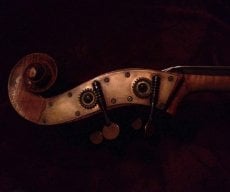
The scroll was busted off the neck at some point and repaired with a wooden pin through the cheeks, which used to be considered best practices. That pin is failing. Ask me how I know.
You have three basic options: Pull everything back into true, drill out the failed pin, replicate the original repair and wait for it to fail a second time.
Alternately, you can spend a little more to have a shelf graft done, a Robbie McIntosh innovation that is considered current best practices.
Finally, a scroll graft, which will last forever and cost you $3k in Manhattan.
Your bridge can be boiled to saturation and clamped flat for a week or until fully dry. Sometimes they stay straight forever, sometimes they banana again.
You have three basic options: Pull everything back into true, drill out the failed pin, replicate the original repair and wait for it to fail a second time.
Alternately, you can spend a little more to have a shelf graft done, a Robbie McIntosh innovation that is considered current best practices.
Finally, a scroll graft, which will last forever and cost you $3k in Manhattan.
Your bridge can be boiled to saturation and clamped flat for a week or until fully dry. Sometimes they stay straight forever, sometimes they banana again.

It should be possible to see if there has been an old scroll graft because the joint lines will be visible in the front of the peg box, also in the top of the neck below the peg box. From your picture it looks more likely that the scroll has had a big knock and the peg box cheeks have sheered at their weakest point. This could have had some previous repair and the machine plate may cover some evidence of this. No matter what has happened the area has been significantly weakened IMO and should be attended to sooner than later by a luthier before more damage is done.
Thanks for the info, yeah alot needs to be doneRe the scroll, I would think immediately rather than eventually. And while many of us here can correct a warped bridge, yours is about the most extreme example I've seen. In fact, it looks like extreme tension from someplace is having its effect at both ends of the bass.
Yeah, I've sent the picture to a luthier and he asked the same thing bout previous repair. Guess i really need to bring the bass in.I agree, the scroll needs to be at least evaluated soon. Can you see any other evidence of previous repairs or growing cracks? I don't know how the scroll could end up like this unless it was repaired badly (ie, off-kilter) in the past, or unless it was failing - again, either a previous repair or a new break somewhere.
Hmm.. Im gonna try the bridge technique. And the pin is failing??? Oh no.The scroll was busted off the neck at some point and repaired with a wooden pin through the cheeks, which used to be considered best practices. That pin is failing. Ask me how I know.
You have three basic options: Pull everything back into true, drill out the failed pin, replicate the original repair and wait for it to fail a second time.
Alternately, you can spend a little more to have a shelf graft done, a Robbie McIntosh innovation that is considered current best practices.
Finally, a scroll graft, which will last forever and cost you $3k in Manhattan.
Your bridge can be boiled to saturation and clamped flat for a week or until fully dry. Sometimes they stay straight forever, sometimes they banana again.
End pin assemblies need not be expensive to work well but generally need some fitting. An emergency procedure (or short term fix) depends on which set of threads is most worn, the female of the ferrule or the male of the thumbscrew. A new hole can be drilled and tapped with the same thread (or different thread with matching new thumbscrew) on the other side of the ferrule. Or, if that female thread will hold, then shortening the old thumbscrew by a few threads with a hacksaw will engage the same length of unworn male thread. If both are worn out then aim for a new end pin. Steel screw into brass ferrule is best. Steel into steel is OK. Brass into brass wears the fastest. Look for some thickness in the ferrule as an indicator of quality IMO.
Great input, thanks!End pin assemblies need not be expensive to work well but generally need some fitting. An emergency procedure (or short term fix) depends on which set of threads is most worn, the female of the ferrule or the male of the thumbscrew. A new hole can be drilled and tapped with the same thread (or different thread with matching new thumbscrew) on the other side of the ferrule. Or, if that female thread will hold, then shortening the old thumbscrew by a few threads with a hacksaw will engage the same length of unworn male thread. If both are worn out then aim for a new end pin. Steel screw into brass ferrule is best. Steel into steel is OK. Brass into brass wears the fastest. Look for some thickness in the ferrule as an indicator of quality IMO.

- Mar 19, 2002
- 800
- 130
- 53
- Disclosures
- President: Upton Bass String Instrument Co.
A lot of scrolls break there...its kind of a design flaw with the pegbox walls falling outside the neck...the load is unsupported and on a very small amount of grain.
I'm not sure what Robbie is doing, haven't seen one, but if you can pull and train the scroll back to zero, an inlaid nut can support the load if the cracks aren't deep.
Steaming the bridge will last for a hot minute...it'll go back. Best to get a new bridge, and have the saddle looked at if it's too low and the angle of the strings off the tailpiece side of the bridge is too acute (and out of balance with the playing side of the strings) it will push the bridge forward abnormally.
I'm not sure what Robbie is doing, haven't seen one, but if you can pull and train the scroll back to zero, an inlaid nut can support the load if the cracks aren't deep.
Steaming the bridge will last for a hot minute...it'll go back. Best to get a new bridge, and have the saddle looked at if it's too low and the angle of the strings off the tailpiece side of the bridge is too acute (and out of balance with the playing side of the strings) it will push the bridge forward abnormally.
Thanks for the advise, ill look into those things you've said.A lot of scrolls break there...its kind of a design flaw with the pegbox walls falling outside the neck...the load is unsupported and on a very small amount of grain.
I'm not sure what Robbie is doing, haven't seen one, but if you can pull and train the scroll back to zero, an inlaid nut can support the load if the cracks aren't deep.
Steaming the bridge will last for a hot minute...it'll go back. Best to get a new bridge, and have the saddle looked at if it's too low and the angle of the strings off the tailpiece side of the bridge is too acute (and out of balance with the playing side of the strings) it will push the bridge forward abnormally.


