• TalkBass has been independent since 1998. Add your voice.
    Create a free account to reply to discussions, view embedded media, and browse with fewer display ads.
    Join freeLog in
    Want zero display ads or expanded classifieds tools? Compare plans.

Double Bass aircraft cable and knot tying

I dont have any with me but i remember the eighth inch cable being quite flexible, tying knots is another matter though. I think the kind you mention that would allow adjustment sound awesome.

Its either that or put a comealong in there somewhere.
Thx
 
clamp72.jpg

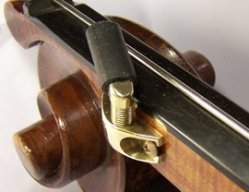
Many luthiers use something like this. They are available through industrial suppliers, but many shops have them made up by their local machinist. Also, some argue about this, but 1/16" SS aircraft cable is all you actually need.
 
clamp72.jpg

Many luthiers use something like this. They are available through industrial suppliers, but many shops have them made up by their local machinist. Also, some argue about this, but 1/16" SS aircraft cable is all you actually need.

The 7 x 7 1/16" SS cable has a working strength of 450 lbs. and a breaking strength of 900 lbs., so no problem there! ;)

I have small aluminium sleeves made for me by a local machinist and they are perfect for getting the after-lengths adjusted and tuned properly.
 
Perfect, thanks everyone. I got some 1\8 inch aircraft cable which is poly covered and some cute little adaptors, not as pretty but ultimately usable. I went to peavey mart.

Maybe this would be a good time to ask about the precedure. Bass on back...soundpost held .........release tension on strings and replace coat hanger
with cable and reverse. Sound good.

Thx for everyones input.
B
 
What I do is:

Lay bass down on G side so soundpost can't fall.

Drape towel over lower bout so tailpiece can't scratch varnish.

Measure old tailgut.

Slack strings.

Drop bridge.

Cut and remove old tailgut.

Loosely fit new tailgut.

When new tailgut is in the ballpark, cinch it down.

Re-mount tailpiece and tailgut, making sure tailgut is centered on the nut.

Stand bridge up and tune up.

If everything lines up and the afterlengths are correct, cut off extra cable from new tailgut.

Some folks put heat-shrink wrap over the cable so you don't impale your fingers on errant steel filaments or shred your cover.
 
With the bass laying on the G side, the post has nowhere to fall, unless it's very loose and you really jostle the bass. I've never had a post fall that way without me doing something dumb.

Heat from a soldering iron should be enough to make the heat-shrink tubing contract. To be extra careful, you could pull the endpin and move the tailpiece a few feet away from the bass.
 
Thx everyone,
i decided after getting home from my nightshift it would be a good idea to fit the cable and adjust the bridge and soundpost. With your advice it all worked out very well and has certainly improved the sound of the bass. It also raised the action quite an bit on the e string so ill have to deal with that next next, but all in all a productive day.
Now to bed.
Thx Again
 
With the bass laying on the G side, the post has nowhere to fall, unless it's very loose and you really jostle the bass. I've never had a post fall that way without me doing something dumb.

Heat from a soldering iron should be enough to make the heat-shrink tubing contract. To be extra careful, you could pull the endpin and move the tailpiece a few feet away from the bass.

Thanks, now that I liik at the geography of the top that makes sense.
 
I dont have any with me but i remember the eighth inch cable being quite flexible, tying knots is another matter though. I think the kind you mention that would allow adjustment sound awesome.

Its either that or put a comealong in there somewhere.

The thought of teeny a comealong tickled my funnybone.

A note to anyone searching this topic in the future that tying knots in wire rope of any sort is a very bad idea. You always need to splice it (a bit of a lost art) or use a mechanical nut devise like Jake's elegant little sleeves or Crosby type wire rope clips or a crimped Nicopress type sleeve.

Also I would much prefer soldering the ends of the cables to slapping on heat shrink. Heat shrink is a relatively quick fix not appropriate to the longevity of a wire tailgut.
 
Having got some wire in my hands now i would second jeff and never try to tie this wire unless your in the desert and its an emergency.

Kungfu i believe everything is lined up now, certainly better than it was before. Everything was out before i began, the bridge was not centered and to far back
soundpost was ok relative to bridge, nut needed filing a little as did the top of the
bridge.

Now it certainly sounds better and ill play it some more today and see.

One thing about the top of the bridge is that now its a quater inch across and i beleive it needs to be around the eigth inch mark. Is it as simple as removing wood from the back edge? I know there is some info hidden in the stickys i found yesterday but damn if i didnt bookmark it.

Th again all
 
...

Also I would much prefer soldering the ends of the cables to slapping on heat shrink. Heat shrink is a relatively quick fix not appropriate to the longevity of a wire tailgut.

Another solution for the wire ends is hot melt glue. It is a good idea to do something effective to bind those ends. Once they fray they will at least tear your case to hell, if not wear a hole in the bottom of your rib.
 
Another solution for the wire ends is hot melt glue. It is a good idea to do something effective to bind those ends. Once they fray they will at least tear your case to hell, if not wear a hole in the bottom of your rib.

Hmm...I haven't tried finishing wire with any kind of glue hot or otherwise but I'd bet epoxy would work too. If you were a real traditionalist and handy with cordage you could do an old school whipping with some #2 or #4 whipping twine.
 
A few notes on bowden cables, aka aircraft cables.

Cycle brake cables (inners) spring to mind as a suitable source, come in both steel and stainless steel and are about 1/16" diameter. They are cheap and any cycle shop will have them. They come in pre cut lengths for front and back brakes, not sure which one you would need for a DB tailpeice.

Cutting bowden cable can be difficult as it is quite springy and tends to fray out when cut. Cycle shops have a tool that shears it with a nice clean cut and would probably cut it to length for you. They also stock aluminium sleeves that you crimp on the cut ends of cables to stop you puncturing yourself on errant strands of wire. (Available in a variety of anodised finishes if you want to get flashy.)

You can solder the steel cable ends with a regular soldering iron but not stainless steel ones. You will no doubt want to wash the oil/grease off them before you get them anywhere near your DB. It will make soldering easier too.

Heat shrink sleeving will last for years as long as you use the correct size and it is tightly shrunk onto the cable. If you thread both the cut end and the main cable through it (you have to put the pieces of sleeving on at the same time as the clamp) it will make a very tidy job and hold the cut end tight to the main cable and stop it from both fraying and getting bent and sticking out.

(I'm not a DB player but am a retired engineer)