• TalkBass has been independent since 1998. Add your voice.
    Create a free account to reply to discussions, view embedded media, and browse with fewer display ads.
    Join freeLog in
    Want zero display ads or expanded classifieds tools? Compare plans.

Alembic bridge disassembly - Flitz polish on brass

UpperBout

Supporting Member
May 15, 2008
824
836
Near Chicago Illinois USA
I only took a few pictures - I was sort of racing against sun-down, since I was working outside in natural light.

Before: 2014-07-29 18.08.10.jpg 2014-07-29 18.08.25.jpg

I marked the order of disassembly and orientation on a shop-towel
2014-07-29 18.52.00.jpg

That Flitz is miraculous stuff, but you do need to add elbow grease.
2014-07-29 19.08.49.jpg
The tail-piece after:
2014-07-29 18.29.44.jpg

The "After" picture:
2014-07-30 12.51.59.jpg

I also conditioned the ebony board with pure lemon oil:

2014-07-29 18.16.09.jpg

Did a rough set-up and intonation last night as well.

BTW, there are lots of tips and guidance on the Alembic Club on bridge disassembly/polishing, so google on over there for more details.
 
  • Like
Reactions: wvbass
I thought Alembic put a light coat of lacquer on the bridge to keep things clean.

Depends on the model, I think. Even the models that have it eventually wear off. Except the ultra-fancy Series II's which are gold-plated. Series I's are chrome. My old Series I (1977) has the lacquer, but it's wearing off a bit. With Alembics, everythings so customized, there are probably as many exceptions as there are standard.

The good news is that regardless, the brass cleans up pretty nice with a bit of elbow grease. I think if I were to do this again, I'd get a little dremel and some of those conical foam buffing bits.
 
Looks good. For future reference, get a can of Never Dull. It's a wadding polish so it gets down in the little nooks and such much better than a rag wetted with cleaner/polish so it makes for a quicker job.

If you want the best, Semichrome is the only way to go. It brings back the blue luster of chrome like nothing else, although it can be tedious on small parts as it takes a lot to get it all rubbed off. It also does a bang up job on other metals, it's just more work.
 
That's a sweet bass. How do you control string height with that bridge?
The body has threaded metal sleeves embedded, and the bridge has allen wrench height adjustments on each side. You can't adjust an individual string height independently from the other strings, but the radius of the neck is cut into the slots in the brass saddles, so I've never needed to vary the height individually on any of my Alembics.
2014-07-29 18.08.10 copy.jpg
 
  • Like
Reactions: carsbybigd
Looking at the style of that bridge, the massive yellow metal parts, the nylock nuts for intonation, the carrier rods for the saddles, it's like Alembic anticipated the steampunk look and built accordingly.

Or maybe their style helped inspire steampunk?
 
Looking at the style of that bridge, the massive yellow metal parts, the nylock nuts for intonation, the carrier rods for the saddles, it's like Alembic anticipated the steampunk look and built accordingly.

Or maybe their style helped inspire steampunk?

Some of their early creations are [Invalid or Expired Link Removed],
70710.jpg

although I think that's an unintentional coincidence. But the very early incarnations were extensively hand-wrought wood and metal creations, and fairly ornate.

Alembic as a separate company was largely spawned out of the Grateful Dead's desire to push sonic boundaries ([Invalid or Expired Link Removed]), and Alembic, for all intents and purposes, invented the "boutique bass". A lot of what went into the Early Alembics was due to the fact that there were no parts to source from - everything had to be hand-crafted. (another steam-punk-ish aesthetic)
 
I did some more work on this bass, and it's really come back to life.

Thorough cleaning and readjustment of the headstock and machine heads:
2014-08-02 16.13.04.jpg 2014-08-02 16.13.14.jpg

Flitz polish on the headstock logos:
2014-08-02 19.15.27.jpg
The machine heads are still somewhat pitted and losing plating, but I don't mind - they work fine and now they don't have any looseness or "play" in them.

BTW - to be clear, I didn't use Flitz on the machine heads, just the brass logos. The machine heads got a mild cleaner and tooth-brush to remove gunk.

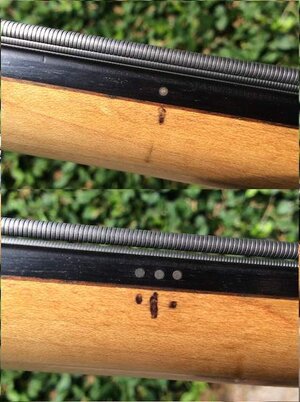
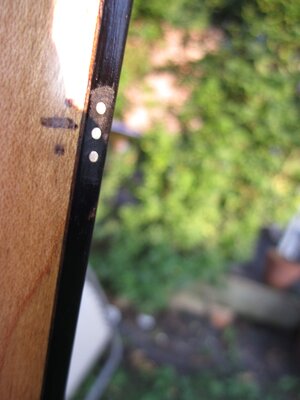
The side dots were nearly invisible:
2014-07-29 13.11.00 copy.jpg

Flitz did not seem to be punching through the layer of varnish obscuring the dots, so I masked off the dots with tape (couldn't find my real masking tape...)
2014-08-02 18.33.01.jpg
And used a super-thin strip of fine-gauged sandpaper to get to the shiny metal.
2014-08-02 19.16.24.jpg 2014-08-02 19.16.33.jpg
Result - totally visible dots. This technique is one of the recommendations from Alembic. It might have been a scosche more aggressive than I intended, but I definitely need the dots. Add a bit of hand-wear from playing and the abraded ebony should revert to the same appearance as the rest of the the neck.

I'm still looking for the definitive "setup and intonation for fretless" guide. I'm happy with the way it's set up now, but I was just guessing based on the usual setup guidelines for fretted.
 

Latest posts