• TalkBass has been independent since 1998. Add your voice.
    Create a free account to reply to discussions, view embedded media, and browse with fewer display ads.
    Join freeLog in
    Want zero display ads or expanded classifieds tools? Compare plans.

All of Me (the tune) help

conttador

Supporting Member
Jun 10, 2010
1,639
2,228
San Antonio, TX
Good evening bottom feeders!

Im working on All of Me (Standard) and I need some help with a few bars.

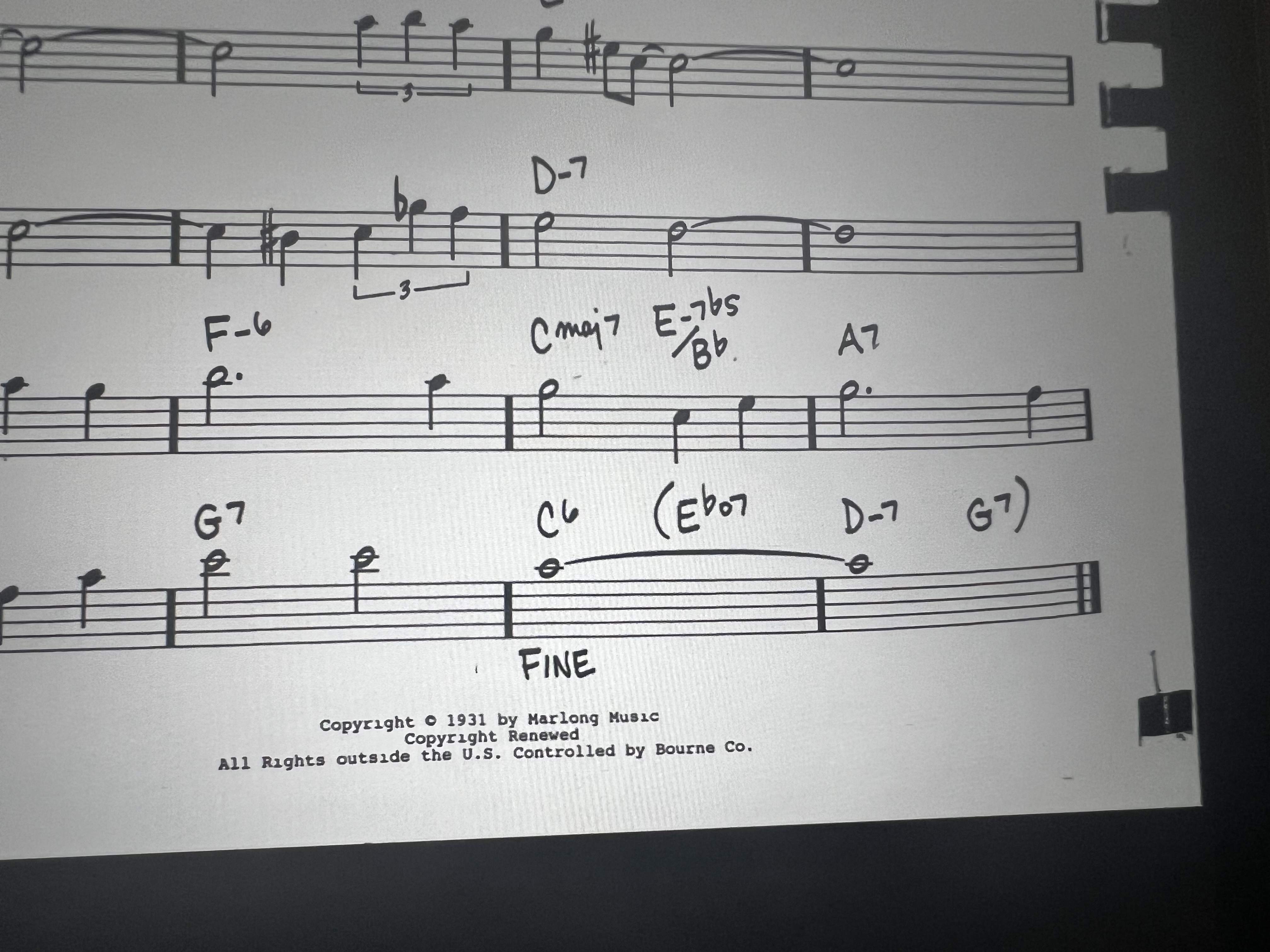
In the B part of the form there's a change that goes from F-6 to CMaj7 & E-7b5/Bb. What should I focus on in all of that? I figure a C on beat 1 & Bb on beat three?

Then there's the last two bars. Those two bars have C6 but then there's (Ebo7 D-7 G7). I believe that a turnaround would be in order but how?

Thanks in advance for your insight and sharing your knowledge!
5B91A6F9-1EFE-460D-91B1-07E80EB3339B.jpeg
 
  • Like
Reactions: StayLow
You'd probably get more responses to your questions if you ask over on the double bass side. As for those questions, that Bb is in the bass because that's what the arranger wants the bass movement to be. If you want to drive that movement home you could play two beats on C and two on Bb - but you're free to be more adventurous if you'd like (and it suits the context). The last two bars should involve the turnaround (consisting of all the chords in those final two bars including those in parentheses) every time you want to go back to the top of the form. Only when you want to end the song would you stay on the C6 for the full two bars.
 
Here is a clarification about the turnaround that seems to puzzle you.

The Dm7 G7 part in bar 32 is just the familiar ii V7 bringing back to C6 (chord I) at the top of the form. So the only piece that may need some clarification is the Ebo7 found between C6 and Dm7. If you examine the chord tones of both chords, you have:
C6: C E G A
Ebo7: Eb Gb A C
Dm7: D F A C
So 2 notes (C and A) are common to all 3 chords, whereas the remaining chord tones moves chromatically from C6 to Ebo7 to Dm7 (E -> Eb - D; G -> Gb -> F). So the Ebo7 enables to voice-lead very smoothly from C6 to Dm7.

If the context of your question is in walking bass line, then you may walk over the turnaround C6 Ebo7 / Dm G7 / C6 (top of the form) like this (using chord tones, yet with good voice leading): C E Eb A / D A G B / C.
 
Last edited:
Concerning the chords in bar 27 (Cmaj7 Em7b5/Bb), what you have in this chart is a reharmonization that I find questionable, because the Bb prominently present there (Em7b5/Bb) conflicts (to my ears) with the B played in the melody just before and just after that chord.

In other charts, you find this bar either as CMaj7 Em7, or as Em7 for the entire bar, which are essentially equivalent since Em7 is a common substitute for the I chord CMaj7 (both chords share 3 chord tones).
If you take bar 27 as Em7, then you can walk like this (starting with Fm6 in bar 26 ): F G Ab F / E D B Bb / A B C# E / D F A A# / B A G D / C (bar 31).

If your band mates insist in playing CMaj7 Em7b5/Bb in bar 27, then you could walk it like this (from bar 26): F Ab F D / C B Bb Bb / A B C# E / D F A Ab / G Gb F D / C.
 
Last edited:
Concerning the chords in bar 27 (Cmaj7 Em7b5/Bb), what you have in this chart is a reharmonization that I find questionable, because the Bb prominently present there (Em7b5/Bb) conflicts (to my ears) with the B played in the melody just before and just after that chord.

In other charts, you find this bar either as CMaj7 Em7, or as Em7 for the entire bar, which are essentially equivalent since Em7 is a common substitute for the I chord CMaj7 (both chords share 3 chord tones).
If you take bar 27 as Em7, then you can walk like this (starting with Fm6 in bar 26 ): F G Ab F / E D B Bb / A B C# E / D F A A# / B A G D / C (bar 31).

If your band mates insist in playing CMaj7 Em7b5/Bb in bar 27, then you could walk it like this (from bar 26): F Ab F D / C B Bb Bb / A B C# E / D F A Ab / G Gb F D / C.
Thank you for the responses! Gives me something to experiment with!
 
I suggest taking it fairly literally...by this I mean play chord tones.

It would be different if the changes were spread out, so that each chord gets four beats instead of two...then you would want to work in some non-chord tones.

I agree that the Ebdim7 seems a somewhat weak sub. To my ears Gb is the weakest chord tone in this context. IMHO it's a sub for an A chord, where the Gb would be the 7th rather than the 3rd.

I would also probably be tempted to interpret Ebdim7 as Adim7. I might also sub in Amin7 or even A7. Depends on who I am playing with and what is going on around me.

To my ears the Ebdim7 sort of sets up E,Eb,D,Db in the bass line. So, I would be tempted to occasionally throw in a tritone sub for the G7.
 
I suggest taking it fairly literally...by this I mean play chord tones.

It would be different if the changes were spread out, so that each chord gets four beats instead of two...then you would want to work in some non-chord tones.

I agree that the Ebdim7 seems a somewhat weak sub. To my ears Gb is the weakest chord tone in this context. IMHO it's a sub for an A chord, where the Gb would be the 7th rather than the 3rd.

I would also probably be tempted to interpret Ebdim7 as Adim7. I might also sub in Amin7 or even A7. Depends on who I am playing with and what is going on around me.

To my ears the Ebdim7 sort of sets up E,Eb,D,Db in the bass line. So, I would be tempted to occasionally throw in a tritone sub for the G7.
I think my dilemma is that, in my limited knowledge, I try to connect everything w passing tones that are a tone or semitone away from my next root. I'm finding out that at least for now, with my limited knowledge, with turnarounds, that may not always be possible.

That said, when I'm limited to two notes for each chord, if the first note is the root and I want to use chord tones, what would be the better choice the 3rd or 5th? I suppose I don't necessarily have to star on the root, so I'll guess I'll explore other possibilities and see what that yields.
 
  • Like
Reactions: Wasnex
I think my dilemma is that, in my limited knowledge, I try to connect everything w passing tones that are a tone or semitone away from my next root. I'm finding out that at least for now, with my limited knowledge, with turnarounds, that may not always be possible.

That said, when I'm limited to two notes for each chord, if the first note is the root and I want to use chord tones, what would be the better choice the 3rd or 5th? I suppose I don't necessarily have to star on the root, so I'll guess I'll explore other possibilities and see what that yields.

The first part is to study and try to figure out what sounds good. This is done slowly and methodically. Then you play in the various options and develop your ear. Think of this as building a mental library of licks you can pull out without conscious effort. During the gig it should all happen pretty much automatically/instinctually.

Keep in mind, developing the ability to pull this off doesn't happen overnight. Even after you have mastered a bunch of songs, you will occasionally be presented with changes that you have to slow down, analyze, and study. Also, a big part of building your mental library should involve listening to great players and copying their lines.
 
  • Like
Reactions: bassGtar
I think my dilemma is that, in my limited knowledge, I try to connect everything w passing tones that are a tone or semitone away from my next root. I'm finding out that at least for now, with my limited knowledge, with turnarounds, that may not always be possible.

That said, when I'm limited to two notes for each chord, if the first note is the root and I want to use chord tones, what would be the better choice the 3rd or 5th? I suppose I don't necessarily have to star on the root, so I'll guess I'll explore other possibilities and see what that yields.
All Of Me isn't bebop ;). I'm not saying not to try to be creative, but some tunes lend themselves to it more than others. So listen hard and realize what works and what doesn't.
 
  • Like
Reactions: Nashrakh
The first part is to study and try to figure out what sounds good. This is done slowly and methodically. Then you play in the various options and develop your ear. Think of this as building a mental library of licks you can pull out without conscious effort. During the gig it should all happen pretty much automatically/instinctually.

Keep in mind, developing the ability to pull this off doesn't happen overnight. Even after you have mastered a bunch of songs, you will occasionally be presented with changes that you have to slow down, analyze, and study. Also, a big part of building your mental library should involve listening to great players and copying their lines.
You're hitting on a lot of the stuff I'm working through. I'm starting to dig into the book Patterns for Jazz & that's helping me build that mental library. I think my biggest obstacle is my mind in the sense that I'm thinking about what I'm playing and where I'm going and I need to get to a level where I can just play without thinking.

One of the things that has started helping me is writing out the lines I put together but that too can be a crutch because the lines become repetitive. I'm hoping in due time I'll be able to build up my library & just play. In the meantime, I'll just keep plugging away!
 
  • Like
Reactions: bassGtar and Wasnex
All Of Me isn't bebop ;). I'm not saying not to try to be creative, but some tunes lend themselves to it more than others. So listen hard and realize what works and what doesn't.
Most of those tunes aren't but to your point they lend themselves. That's the beauty of the music & music in general is that when it's great, it transcends!
 
  • Like
Reactions: Bob_Ross and JimmyM