• TalkBass has been independent since 1998. Add your voice.
    Create a free account to reply to discussions, view embedded media, and browse with fewer display ads.
    Join freeLog in
    Want zero display ads or expanded classifieds tools? Compare plans.

Am I simply not a 5/6 string player?

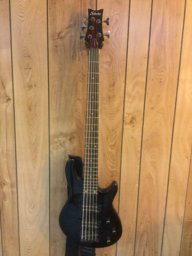
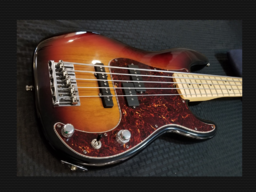
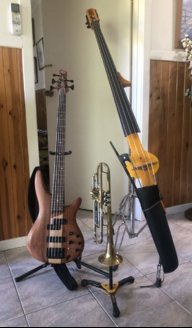
Most five or six string players have a reason for buying a five or six before they buy it.
Either the music they listen to or the music that they have in their heads pulls them to it.

Most don't buy it and then ask why they bought it.
How long did you try to get used to it?

Buying a five when you don't need or have a purpose for one is like selling your house and moving out of it before having another house to move into.
 
Last edited:
Honestly, from my experience, the search function doesn't always work well unless you happen to know the exact combination of words the previous people have used, so I can't get too upset when questions get repeated.

Using bing or google and searching "5 string bass talkbass" actually works better than the internal search engine, but they have improved the internal search engine a lot since the old days
 
  • Like
Reactions: Watchootognbout
I have several 4 strings and one 5. I have never felt comfortable with the 5 although I play it in in rotation with the others. You don’t need to feel diminished playing a 4; acutely it will enhance your skills by causing you to adapt musically. If a 4 is what you like, play it.
 
started playing bass in 98 and up until 2013 only had and played 4 strings. I bought my 5 strings bass then and during the first 8 months i avoided the low B or if i did use it it was rare, until i realized what a 5 strings bass affords namely less shifting and more accessible positions and shapes. it became my main bass although i still play 4 strings any future purchases are going to be 5 strings basses
 
  • Like
Reactions: Helix
I have a five string that I like, but I hardly use the fifth string. Other than that... I have a 6, and a bunch of 4's. I really like the 6 because I dig the C string, but I don't care for the B string. Instead I'm going for the baritone range once I put electronics back in it, it'll be strung EADGCF#

I know: The horror.

Usually, you're facing 35" scale or longer for a good B string. That negates the usefulness of the C string. So... you're trading off, and I'm not a fan of fanned frets. It still compromises my finger reach. I can only kind of do one finger per fret on a 34" scale. I'm sorry for any small fingered folk trying a fanned fret 35" or 36" even though I guess it'd be easier than just a standard 35" or 36" scale.
 
  • Like
Reactions: thabassmon
I can only kind of do one finger per fret on a 34" scale.
At the nut? To me, that demonstrates a huge benefit of a 5. Apart from occasional excursions below the fifth fret to play B0-D#1, or to play in keys lower than E, I play just about everything else at or above the fifth fret. Even on a long-scale instrument, OFPF is a lot easier higher up the neck, even with small hands/fingers.
 
Last edited:
I'll basically repeat what many have said. "Play what your music calls for."

I'm a five only player. "Only", because I don't want to translate. The transition to guitar is mindless for me, but not for bass. Huh.

At any rate, my covers band of the last few years plays 40% of our tunes in altered keys to fit our vocalists. The guitar player usually has three guitars in different tunings, and uses a capo a lot. The 5 accommodates that.

Prior to that I was in a classic/southern rock and blues band that played in standard tuning all the time (even Van Halen/SRV/Jimi songs :D), and a 4 string precision covered all my needs. I wish I was in (a better version of) that band again. Still have two 4s, hoping. :bassist:
 
I played a four string for the first time in ages just yesterday (went to the big smoke) and it really made me wish I had a four string version of my bass. Somehow I think more easily around a four and for the first time in a couple of years I think I preferred the string spacing over the 16.5 of my bass. I certainly play mine as a 4 string with an extended range as I'm not always big on how notes below the low D sit in the mix - although they make great "sounds" that I do use, but probably wouldn't miss them at all. I have a very decent amp too so I don't think that's the problem. Cute burnt orange Fender Jaguar PJ - why did I ever pick it up??? (On special...)
 
I have several 4 strings and one 5. I have never felt comfortable with the 5 although I play it in in rotation with the others. You don’t need to feel diminished playing a 4; acutely it will enhance your skills by causing you to adapt musically. If a 4 is what you like, play it.

I'm just curious. What does the above bolded statement mean? If I am playing a part that requires those lower notes, and I play it an octave higher, it will often sound dinky and clash with the singers. That would be the exact thing that would get me a "look" from the band leader.

A lot of modern music is written for that extra string, and you can't simply play it higher.
I have done theatre shows where the sheet music even said "5-string BG(Low-B)" or "6-string BG (Low-B)"

But if you don't play that stuff, then I suppose it doesn't matter.
 
If you are not feeling it due to the neck size and discomfort, than I would suggest the Squire 5 was not a good starting choice for you. It has a fairly wide nut width (IMHO) and just not as easy to play as many other 5 strings. I bet if you played an Ibanez or Stingray, or one of many other instruments with a 1.75" nut and 17mm-ish bridge spacing, your opinion would change, mine sure did. However, if you are sticking with a 4 banger because you can play anything you desire on it already, and with ease, than no reason to go to 5 strings. Besides increased range, the 5 string made playing easier for me, with less stress and fatigue on my hands because I can stay in one area of the neck (call me lazy I guess).

My 2 cents, but enjoy
 
Last edited:
I was in downtown Nashville one evening. Toured bars and did my own survey of bass players. I saw 10 bands. Eight players were 5-string, only one 4-string, one 6-er. I was very surprised by this. This motivated me to try the 5-er one more time and it finally stuck. I now prefer the horizontal playing on a 5 vs the vertical (up and down the neck) on a 4. The width is not an issue for me. But I have observed that, to me, the larger lumber of a 5-string neck is less aggressive sound overall than any 4-string neck. So, If I need some grit and growl, the 4 gets the call. But for ease of play, the 5 is easier for me now.
 
  • Like
Reactions: Wasnex
@Honcho85 — FWIW, I play four-string a lot (upright and electric), and play 5-string whenever I get the chance. BEADG is great, but so is EADGC.

A BEADG five-string sort of opens up the repertoire and styles where they seem to predominate: Gospel, Modern R&B, Gogo, lots of Latin Jazz, Hawaii Reggae, etc. I have the opportunity to learn by imitation from some of the greatest living players who play fivers. It inspires me to grow.

Perhaps more importantly, I find it affects my creative thinking: a five offers different ways of thinking about lines that cross registers, which in turn changes my technique. I play more "across the neck" on a five. For example, two octave scale-like passages in any key require only one upward position shift. As a result, mixing high and low registers is way more available, so are 2 and 3 note chords—get it funky, Mon!

Tone is also affected because the sound of an E on the B string is so different than an open E, and as one progresses up the B string, the sound of the F, F#, etc. are all darker in the same way a B on the E string is darker than a B on the A string.

For me, the key was to practice 5-string every day—which I still do. I also really like 35" scale, but recently was given a birthday gift that is a great 34" 5-string Metro—I'm in love!

TLDR: all it takes is practice, inspiring models, and a desire to play music that really can use the instrument to good effect.


Well said
 
The more I play a 5, the less I use the low B string for notes below E. The lower notes seem just too big, too much, kind of goofy for the kind of sound I like now.layed but I want them there for some strange reason. Same with my bass now.
Notes below E1 can sound horrible, boomy and indistinct. There are many factors to consider. The bass guitar, strings, technique, rig, EQ, effects, even the room can make a big difference at the extended low frequencies below E1. Setting an HPF above the fundamental frequencies can certainly help.
 
Last edited:
  • Like
Reactions: klokker
Learning a new instrument - or even a new variant on an old instrument, like going from 4 to 5 string bass - is like learning a new language (human or computer). If you don't have a practical problem to solve with it, it's unlikely that you'll learn very well or very quickly. I started playing a 5-string to solve the specific problem that my hard rock band had a set of songs in drop-D that I really liked, but couldn't play properly on a 4-string. Detuning the E made it floppy, and re-arranging the parts to play the lowest notes an octave up was functional but unsatisfying. So I picked up a 5 string. And once I got past the awkwardness of one-string-too-many under my left hand, I realized that not only did it let me get down to those low Ebs and Ds, but it gave me a new fingering position for another dozen notes or so. Now it's all I play.

One thing that proved important to me, though, was finding the right string spacing. My first 5er was a Schecter Stiletto Elite 5, which was an absolutely delightful bass for the money. But going back and forth between a standard 19mm spacing and the Stiletto's 16.5mm was surprisingly hard for me - I would "whiff" with a right finger from time to time - so I gave up on the Schecter and went with 5ers with an 18mm spacing, which seems to be about right for my big hands.
 
Here's another country hit we played that required the low B. I am providing country examples because I think a lot of people think of country as simple/unsophisticated music that should be played on a Fender P bass. But as I mentioned in my previous post, some of the top studio cats in Nashville use 5- and 6-string basses.

This tune went to 14 on Billboards US Hot Country chart in 1998. Lot's of open B string hits in intro, and also a few in the outro that starts at 2:44.


Aside from the low B hits in the intro and outro, all other bass notes in this song are E string and above. IMHO, you don't have to go crazy playing low notes to get good use out of the B string, just a few tastefully place low notes here and there, and you are good to go.

Sure you could play the hits an octave higher, but IMHO they sound a lot cooler on the B string, and using the extra range open ups the bass line and makes the whole song a bit more interesting.