

Enjoy the benefits of a premium membership!
Upgrade Account
-
TalkBass has been independent since 1998. Add your voice.
Create a free account to reply to discussions, view embedded media, and browse with fewer display ads.
Join free Log in
Want zero display ads or expanded classifieds tools? Compare plans.
You are using an out of date browser. It may not display this or other websites correctly.
You should upgrade or use an alternative browser.
You should upgrade or use an alternative browser.
Am I wrong about this being a fake?
- Thread starter H K
- Start date
More options
Who Replied?


For nearly $4000 why do the photos look so lowres and staged for social media rather than hires photos on a stand where we can clearly see everything? The photos are all just good enough to look like a vintage guitar and just bad enough to hide fine details which would give it away. This stinks of perfectly angled duck face catfish photos on a dating site.
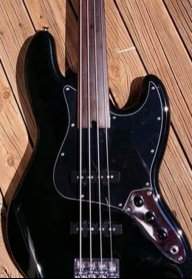

I’ve seen fingerboard wear like that on lots of ‘50s Gibsons with rosewood boards and the very low frets they used back then. Your fingertips contact the board, which I kind of like actually (it’s hard to explain). Frets got taller after the ‘60s to accommodate “modern” playing styles, like string bending and lighter gauge strings.
I’ve never seen that kind of wear on a ‘70s Fender with huge frets, maple neck, and gloopy urethane finish.
I’ve never seen that kind of wear on a ‘70s Fender with huge frets, maple neck, and gloopy urethane finish.

^^^ this !Fretboard wear looks normal to me - the greyness will show where you finger touches the fretboard. That will not happen under the string.
New pickguard?
The bass is refinished and the new finish has been relic'ed. That's why the wear looks suspicious.
Bass was surely re-finished; surf green is not a normal finish colour for a P-bass at the end of the ‘70s.
What leaves me baffled is the price the seller’s asking .. it’s much higher than I’d pay for such an instrument …



The Serial Number says 1977
Because its advertised as a 1976 when the SN clearly says 1977, my best guess is that its a parts "player" bass: Several basses were cannibilized and assembled into very good vintage instruments and this bass is assembled from the leftover from the unwanted and questionable parts .......any parts unaccounted for arent original and probably not Fender
Player basses can be mostly legit Fenders but I wouldnt pay anything close to that advertised price (Players historically go between $700 -$1500)
like I said: just a guess.......
Because its advertised as a 1976 when the SN clearly says 1977, my best guess is that its a parts "player" bass: Several basses were cannibilized and assembled into very good vintage instruments and this bass is assembled from the leftover from the unwanted and questionable parts .......any parts unaccounted for arent original and probably not Fender
Player basses can be mostly legit Fenders but I wouldnt pay anything close to that advertised price (Players historically go between $700 -$1500)
like I said: just a guess.......
Last edited:


I'm also in this camp just because of so much uncertainty about some 'vintage' instruments offered for sale.Not interested in “ vintage “ instruments.
I’d rather spend 3k on a brand new spectacular bass with some kind of warranty and support.
That’s just me. Guess I shouldn’t even commentin this thread.

The very first thing that caught my eye was definitely that serial number. Definitely looks photoshopped in there.

That looks like a real 70s bass that's had a C- relic job, or perhaps one assembled from parts.

You should add a Carrots, or Who Cares Option?Supposedly a 1976 precision; Fender Precision Bass 1976 | Reverb
What do ya think?
Looks hella fake to me, heres why;
-The fretboard wear. The wear is between the strings. Either the guy who played this bent every single note, every single time, or someone took a dremel to it while the strings were still on...
-Very little signs of wear on the pickguard near the pickups, where 90% of Pbass players rest their thumb
-The wear on the back looks intentional, as in "ill do one scratch this way, then one in the opposite direction" literally drawing X's or circles with whatever used to scratch it up
-The wear on the upper horn! This is strange to me. I've seen a legit bass with this kind of wear before, but it surprised me then, and it still does. How to you wear on the top of the upper horn? Especially when the strap is so close. Your hand has no business up there.
-The wear on the treble side on the bottom of the bass. Again, looks way too smooth and "sanded". Does NOT look like it was caused by repeated use of a bad stand or anything like that. Definitely not "drop damage".
and ofcourse the obvious; no pictures of pots or neckpocket.
So what do you think? Fake or not?


The serial number thing seems to be the best evidence. The "S7" serial went for a span of years and 76 wasn't one of them. The color being the other red flag that stands out, as it is obviously a refin.
Anything that throws up a single red flag is enough for me to avoid it. I've learned from experience and got lucky for the fact that the seller was a good person who had also gotten fleeced. We actually teamed up and he was able to return it to Sam Ash, who sold him the faked bass to begin with. It was TB evidence that "won the case" and that was awesome.
Anyway, I think it's a BS listing and would avoid it for even 1/4 of that price.
Anything that throws up a single red flag is enough for me to avoid it. I've learned from experience and got lucky for the fact that the seller was a good person who had also gotten fleeced. We actually teamed up and he was able to return it to Sam Ash, who sold him the faked bass to begin with. It was TB evidence that "won the case" and that was awesome.
Anyway, I think it's a BS listing and would avoid it for even 1/4 of that price.

Why all the hate on Mexicans?
The fact that an instrument has been butchered, doesn’t make it a fake. Stuff happens over 40-odd years.
I put a black Schecter pickguard on my ‘64 Precision in the late ‘70’s. Not because I was trying to rip anybody off, but because the original was gross- warped, stained, scarred and broken. I also opened up the cutaway for better upper-fret access. There wasn’t much of a collector market for player-grade instruments back then, so sue me…
That said, this is exactly the sort of situation where I wouldn’t want to gamble on an online purchase, especially when the instrument is in one of the roughest parts of Mexico.
Given the wood supply and quality issues that Fender was having in the 70’s, you could also be looking at a non-matching neck and body. During that period, a pretty good way to score a nice Fender was to pair your favourite neck with another body. Not original, but still Fender, and also not a fake.
Buyer beware, because if the body and neck aren’t authentic, you’ll never recover the cost of a restoral and refin.
The fact that an instrument has been butchered, doesn’t make it a fake. Stuff happens over 40-odd years.
I put a black Schecter pickguard on my ‘64 Precision in the late ‘70’s. Not because I was trying to rip anybody off, but because the original was gross- warped, stained, scarred and broken. I also opened up the cutaway for better upper-fret access. There wasn’t much of a collector market for player-grade instruments back then, so sue me…
That said, this is exactly the sort of situation where I wouldn’t want to gamble on an online purchase, especially when the instrument is in one of the roughest parts of Mexico.
Given the wood supply and quality issues that Fender was having in the 70’s, you could also be looking at a non-matching neck and body. During that period, a pretty good way to score a nice Fender was to pair your favourite neck with another body. Not original, but still Fender, and also not a fake.
Buyer beware, because if the body and neck aren’t authentic, you’ll never recover the cost of a restoral and refin.
Last edited:

Your comment about the nut made me think, "I wonder if someone played this lefty for a while? Look how wide the G string slot is." If this is the case, maybe thats why some of the wear looks unusual.Nearly no fret wear. The outer edge is totally wrecked yet there’s not a single mark where the hands/picks/fingernails would have contacted the body for 50 years. Body sides beat to hades, neck and headstock somehow spared the abuse.
And OH MY GAWD what kind of mad orangutan cut that nut?
Also, speaking of Nash, Not Every Bass started out as sunburst. It only happened on occasion. They didn’t change the color of every one midway through the build.


