• TalkBass has been independent since 1998. Add your voice.
    Create a free account to reply to discussions, view embedded media, and browse with fewer display ads.
    Join freeLog in
    Want zero display ads or expanded classifieds tools? Compare plans.

Double Bass American Standard: Setup & Strings

I have a '51 American Standard with the long (43.25") string length. The neck was kinda thin, but a new, thick ebony fingerboard helped that a lot. We also put a hardwood sound post in. We ended with oak, after also trying spruce, maple and a couple of others. It was very finicky getting the sound post adjusted for equal volume between E and G strings. I also got a KC Strings carbon fiber/wood end pin. It's got a good sound with good (not great) volume. The strings I've tried on it are: Velvet Blue, Zyex, Spirocore Weich, and now Gamut Lyon. The non gut strings had a reasonable volume, but the volume really is diminished with the gut strings. Much more than I anticipated.

I mostly play bluegrass on this bass, which is why I wanted to try gut strings. I also play blues and a bit of jazz with a small amount of bowing. I've learned to mute notes that sustain, so maybe gut strings aren't really necessary for the bluegrass stuff.

The bass is at the luthier's now for a setup. He suggested a few things to make it louder, but said they may not make the gut strings as loud as I like. He will: reduce the wide string spacing at the nut and at bridge. New nut. Move the (lightweight) tailpiece down a bit. It has flexible (kevlar, I think) attachment to end pin fixture. He will also round the edges of the sound post and readjust it.

My questions here are:

1) Are there any additional areas we should check out or change?
2) If the volume isn't up after the changes, what strings are recommended as loud? Steel core (Spiro Mittel or Stark)? I've never used Starks, but I had Mittels on a different bass once. Sounded pretty good. Would Spiro Mittels or Starks be too much pressure on a '51 Am Standard? Other non-gut, non-steel core (One of the Innovation string models)?

Thanks,
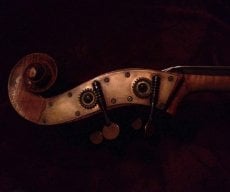
 
'51 was near the dawn of the steel string era, so it's tough to say whether or not the 250 pounds of downward force a set of Spiro Mittels will exert on the table will be too much for that particular bass. I had a full set of Starks on a burly German (Hofner?) that absolutely required the extra tension, but the Kings and American Standards I've had in my hands were not as heavy and tank-like as that German bass.

I'm surprised that your bass isn't playing nice with guts. How high are the strings off the end of the fingerboard? Also, does it seem quiet to you only from the player's perspective, or have you listened while someone else played the bass, in an ensemble, etc?

If your bass is in good order and properly it should sound HUGE strung with gut. It is an entirely different paradigm than, say, Spiros, which have abundant highs and upper midrange over a tight bottom but cannot achieve the huge sub-lows of good gut.
 
KUNGfuSHERIFF, I haven't measured the string height, but they are higher than they were when then the Velvet Blue, Zyex & Spiro Weich were installed. They're not nearly as high as I've seen for gut players that slap a lot. They are high enough that they don't rattle when played "normally" or with a bow. I pull pretty hard when I play pizz, but I pull mostly parallel to the fingerboard, instead of a "slap" pull. It sounds too quiet when I'm standing over it playing. I haven't actually listened to someone else play the bass. I need to do that when I get it back from the luthier. The volume is such that, I'm having trouble hearing me with the guts installed in a jam with a banjo and a couple of mandolins. (Insert banjo joke here). I also had trouble hearing me in a big room gig on Saturday (unamplified), with just guitar and mandolin (also unamped). I didn't have that trouble hearing with the other strings. I do like the tone and the feel of the gut strings.

I'm kinda surprised that it isn't playing nice with guts too. I "researched" gut strings here on talkbass a long time before I ordered them.

Thanks Leni
 
Could be a technique issue. It's not like steel strings where the force with which you pull the string immediately translates to more volume. Gut strings you kinda have to caress...if you pull the string too hard it chokes and sounds like a bunch of nothing.

If everything is hunky-dory it SHOULD be throwing fundamental for a good long way. You may wish to try pushing the string down toward the fingerboard as you pizz, rather than parallel to the board (old jazz trick) and/or bowing the crap out of the bass to wake it up some.
 
  • Like
Reactions: MR PC
I don't know any real bass luthiers who use a hardwood dowel as a soundpost. I would suggest consulting with a more conventional bass mechanic. A 1951 American Standard properly set up with Spirocore mittel strings with the original long string length intact should be able to knock over garbage cans at 30 paces.
 
KUNGfuSHERIFF, I haven't measured the string height, but they are higher than they were when then the Velvet Blue, Zyex & Spiro Weich were installed. They're not nearly as high as I've seen for gut players that slap a lot. They are high enough that they don't rattle when played "normally" or with a bow. I pull pretty hard when I play pizz, but I pull mostly parallel to the fingerboard, instead of a "slap" pull. It sounds too quiet when I'm standing over it playing. I haven't actually listened to someone else play the bass. I need to do that when I get it back from the luthier. The volume is such that, I'm having trouble hearing me with the guts installed in a jam with a banjo and a couple of mandolins. (Insert banjo joke here). I also had trouble hearing me in a big room gig on Saturday (unamplified), with just guitar and mandolin (also unamped). I didn't have that trouble hearing with the other strings. I do like the tone and the feel of the gut strings.

I'm kinda surprised that it isn't playing nice with guts too. I "researched" gut strings here on talkbass a long time before I ordered them.

Thanks Leni
Could be a technique issue. It's not like steel strings where the force with which you pull the string immediately translates to more volume. Gut strings you kinda have to caress...if you pull the string too hard it chokes and sounds like a bunch of nothing.

If everything is hunky-dory it SHOULD be throwing fundamental for a good long way. You may wish to try pushing the string down toward the fingerboard as you pizz, rather than parallel to the board (old jazz trick) and/or bowing the crap out of the bass to wake it up some.

Yes, it's true that I try to get a louder sound by pulling harder. I've not heard of pushing more toward the fingerboard. I will try both of these suggestions when I get the bass back from the luthier.
 
I don't know any real bass luthiers who use a hardwood dowel as a soundpost. I would suggest consulting with a more conventional bass mechanic. A 1951 American Standard properly set up with Spirocore mittel strings with the original long string length intact should be able to knock over garbage cans at 30 paces.

To Steve and to MR PC: I had been reading the Traeger book on bass repair. The sound post that was in the bass when I bought it needed adjustment. We could not get a good sound from both the E and G string at the same time. No matter how the luthier adjusted the sound post only the G or E could be made to sound loud and with good tone. He removed the sound post to look at it and said it was cut wrong. The grain should be across the grain of the bass top and back. This one was "with" the grain. He made a new spruce post and we weren't entirely happy with the sound. We decided to experiment with some hardwood posts. Over the course of about 5 weeks we fitted posts of spruce, oak, maple and birch. After each post was installed 1 day, I took the bass to a local recording studio and recorded a couple of passages. We made sure the bass and microphones and other settings were set exactly the same. I tried very hard to play the passages exactly the same. After we had all four recordings, I had the engineer mix them up, so that we couldn't know which was which. My luthier, a bass player friend (and violin store mgr) and I then listened carefully to each recording. We all agreed on which one sounded best, and it turned out to be the oak post. Spruce came in second.
 
I'd say give it time until your technique can adjust. I put all guts on my New Standard and it's taken me quite a while to really understand the different response of the strings. Once I did, everything opened up like crazy! As is often said, guts are a different thing all together and it takes some time.
 
The Traeger book is full of concepts and described techniques that are "controversial", to put it nicely. It doesn't sound like your local friend has much or any training in bass repair. I would still suggest taking it to one of the most qualified bass luthiers in the greater Dallas area to see what they can do to make it better. Good luck! Let us know how it turns out.
 
The Traeger book is full of concepts and described techniques that are "controversial", to put it nicely. It doesn't sound like your local friend has much or any training in bass repair. I would still suggest taking it to one of the most qualified bass luthiers in the greater Dallas area to see what they can do to make it better. Good luck! Let us know how it turns out.

Thanks, I'm in the Austin area. Although I'm going to Dallas in a couple of weeks. I don't know anything about Dallas area luthiers though. If you have some suggestions, I'd sure appreciate hearing them.

The luthier that has the bass now, is one that is new to me. This is the first time he's seen my bass. He says he's familiar with the Traeger techniques, but does not subscribe to them all. He says some of the ideas are useful and things that most luthiers know to try.

Thanks, Leni
 
We decided to experiment with some hardwood posts. Over the course of about 5 weeks we fitted posts of spruce, oak, maple and birch. After each post was installed 1 day, I took the bass to a local recording studio and recorded a couple of passages. We made sure the bass and microphones and other settings were set exactly the same. I tried very hard to play the passages exactly the same. After we had all four recordings, I had the engineer mix them up, so that we couldn't know which was which. My luthier, a bass player friend (and violin store mgr) and I then listened carefully to each recording. We all agreed on which one sounded best, and it turned out to be the oak post. Spruce came in second.
That's great data Nichols - thanks! For the record my wife's spectacular sounding 1950 Kay M-1 preferred a maple soundpost.
 
Inichols, my old Kay had a maple soundpost. Wow, did it sound way better when I had it switched to spruce. Bigger, and louder, like a night and day change The maple made for a sound more like a electric bass, say a P bass...punchy and mid heavy. Oak as a sound post is an intriguing idea. There are a lot of varieties of Oak, some much heavier and denser than others. Some people have even used graphite as a sound post.

EDIT: Spiro Mittles on the AS are going to be pretty darn stiff..I think Starks would be unplayable, choke the sound, and even distort the top shape over time. You might even notice more wolf tones. Spiro Weichs work really well as a compromise. The older they get, the better they sound (imo), you just have to be patient. Any of the Spiros are twangy and bright out of the package. I'd make a commitment and settle on strings, use a more common soundpost material like spruce before experimenting with alternative materials.
 
Last edited:
I have a '51 American Standard with the long (43.25") string length. The neck was kinda thin, but a new, thick ebony fingerboard helped that a lot. We also put a hardwood sound post in. We ended with oak, after also trying spruce, maple and a couple of others. It was very finicky getting the sound post adjusted for equal volume between E and G strings. I also got a KC Strings carbon fiber/wood end pin. It's got a good sound with good (not great) volume. The strings I've tried on it are: Velvet Blue, Zyex, Spirocore Weich, and now Gamut Lyon. The non gut strings had a reasonable volume, but the volume really is diminished with the gut strings. Much more than I anticipated.

I mostly play bluegrass on this bass, which is why I wanted to try gut strings. I also play blues and a bit of jazz with a small amount of bowing. I've learned to mute notes that sustain, so maybe gut strings aren't really necessary for the bluegrass stuff.

The bass is at the luthier's now for a setup. He suggested a few things to make it louder, but said they may not make the gut strings as loud as I like. He will: reduce the wide string spacing at the nut and at bridge. New nut. Move the (lightweight) tailpiece down a bit. It has flexible (kevlar, I think) attachment to end pin fixture. He will also round the edges of the sound post and readjust it.

My questions here are:

1) Are there any additional areas we should check out or change?
2) If the volume isn't up after the changes, what strings are recommended as loud? Steel core (Spiro Mittel or Stark)? I've never used Starks, but I had Mittels on a different bass once. Sounded pretty good. Would Spiro Mittels or Starks be too much pressure on a '51 Am Standard? Other non-gut, non-steel core (One of the Innovation string models)?

Thanks,

I 'misremembered' which sound post we ended up with in the bass. It's the Birch post that sounded best in the recordings. That's what's actually in the bass.

L.
 
There is nothing that will substitute for a combination of good training and lots of experience. James Condino is widely recognized as being able to do wonders with vintage american plywood basses. His future book will be very instructive and will probably be a good read, based on what I have read in published articles and his posts here on Talkbass. James is one of the serious specialists in the country who deals a lot with vintage american plywood instruments, such as Epiphone, Kay, and the H.N. White instruments. In various sub-genres of folk, americana, bluegrass, musics, these basses are most sought after.
 
Last edited:
  • Like
Reactions: Ed Fuqua