• TalkBass has been independent since 1998. Add your voice.
    Create a free account to reply to discussions, view embedded media, and browse with fewer display ads.
    Join freeLog in
    Want zero display ads or expanded classifieds tools? Compare plans.

Ampeg B-15 thread... first ever?

1) Should I consider the solid state rectifier vs. the tube, if the mod hasn't already been done? Do I need to have any adjustments done by my amp guy to accomodate such a mod? Can I just stick a solid state rectifier in there and swap it out for the tube unit if I want that "lag" that everyone talks about?

If you want to do that, just get a Weber copper cap. It's direct replacement for the 5AR4 rectifier tube. It's even built into an octal base and has the same voltage drop for power supply sag. There are other plug in s/s rectifiers, but the cheapies like Sovtek don't have the same voltage drop and can damage the amp.

2) What power tubes can I interchange for different sounds? I've read that 6L6s are standard. Some folks, I've read, have used 5691s, 350Bs, or 7027As. (Can you use 7027As in an "N" model? I know those only came originally in the "S" model.)

5691's are the industrial versions of the 6SL7 preamp tubes. Portaflex amps really rattle their amp chassis and the extra bracing in a 5691 versus a standard 6SL7 does help. As far as power tubes, in that amp a 6L6GC and a 7027(A) are the same and won't sound any different. 5881's will give you less power, not a good thing with a 35 watt amp.

3) Can I easily pop in some 5881s, or any other 6L6 substitutes? If so, what sonic differences might I expect from tube type to tube type, or brand to brand?

ANY time you replace output tubes the amp will need to have its bias checked. As far as tonal differences between brands, GE's will be more midrangey than RCA and Sylvania/Philips will have more high end.

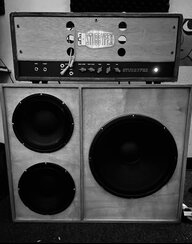
I own a thiele cab b-15n and I do like the sound. One thing I've read is that people love the sound because of the old Motown recordings and James Jamerson. However, I've read Jamerson recorded direct. The B-15n was only used in live performance.

Jamerson used a s/s Kustom 200 w a 2X15 cab live. A B15N and a P-Bass with flatwounds gets you Motown tone instantly.
 
more football, more posts...

I own a B15S which I got almost brand new 30 years ago.
I had to change the speaker 15 years ago for an EV which was recommended by Valley Arts in LA.
I took the head off the Porta-Flex because there was just too much rumble for the tubes. I played that amp so much in my life.
Plus,everyday at the school where I teach I play an original B15N and an B18. I just love the sound of tubes for bass.

I have a big question for the experts here because I love to record with that amp but it is a little tricky direct:

I own an Avalon U5 that I got especcially for the speaker input.
I bought a Bergantino 1x12 to use with my Ampeg because of the in-out speaker plugs so that I can feed the Avalon with the sound of the Ampeg head. Can I use the speaker out from the back or use the ext. amp?
I did blow my head once in studio and I don't want that to happen again.

Thanks,
Sly

On my b-15n, if I turn it up past 9-10 o'clock everything in the room starts sympathetically vibrating.

regarding your recording question, I would use the Avalon BEFORE the amp. plug your bass directly into the Avalon and use the thru output to your amp and use the xlr balanced out to the board.

http://www.soundonsound.com/sos/mar99/articles/recordingbass.htm


edit:

actually as I re-read your post, I think I see what you meant. You want to record the ampeg's preamp. I'm not exactly sure, but perhaps you can use the preamp out to the DI box. However, make sure you keep your amp connected to a speaker. Tube amps need an output load or the power transformer will be destroyed. (that is the most important thing in your amp!) I think you can just turn down the volume knob so no sound will come out.

However, I would think the Avalon may actually be able to approximate the ampeg preamp sound. also, much of the "sound" of the ampeg is from it's cabinet and it's output transformer, which you would be bypassing if you just used the ampeg's preamp.

also, if you record di to the board, you will have a signal that you can "model" using software or other effects/eq to approximate the sound of the b-15n.


more edit:

just took a look at the avalon site.

[Invalid or Expired Link Removed]

although it seems to suggest it will provide a load for the tube amp, further investigation seems to suggest otherwise. Their diagram indicates that you still need to plug a speaker into the amp.

Therefore you might as well as do what I first suggested...
 
If you want to do that, just get a Weber copper cap. It's direct replacement for the 5AR4 rectifier tube. It's even built into an octal base and has the same voltage drop for power supply sag. There are other plug in s/s rectifiers, but the cheapies like Sovtek don't have the same voltage drop and can damage the amp.


5691's are the industrial versions of the 6SL7 preamp tubes. Portaflex amps really rattle their amp chassis and the extra bracing in a 5691 versus a standard 6SL7 does help. As far as power tubes, in that amp a 6L6GC and a 7027(A) are the same and won't sound any different. 5881's will give you less power, not a good thing with a 35 watt amp.


ANY time you replace output tubes the amp will need to have its bias checked. As far as tonal differences between brands, GE's will be more midrangey than RCA and Sylvania/Philips will have more high end.


Jamerson used a s/s Kustom 200 w a 2X15 cab live. A B15N and a P-Bass with flatwounds gets you Motown tone instantly.



I recently played thru a kustom b-200 with a 2x15 and it sounded awesome. The size and weight seems to be a stopper as a gig setup and it's size seems to prevent me from putting it in the living room.

That's interesting about the sound of the different brands of power tubes. can you recommend a tube tester??
 
I had a B15 blue diamond version back in the day when I first started...that'd be, uhhh, 'bout 1971....
Foolishly parted with it when I needed more volume.
I tried the new B15R at the sotre once. Pretty decent. Didn't feel like it had enough grunt to warrant carrying it: it is heavy!
Interstingly, I feel the solid state B100R came closer to sounding like my original. It's smaller and lighter, and I bought one of those and had fun with it for a while.
Ultimately, I didn't like it with DB, and it wasn't lloud enough either.
I'm spoiled by my TFB420 and Schroeder 1210...
 
I'm looking at getting new power tubes for my B25B as it has two different 7027A's. One is a RCA, and the other is a Magnavox. The RCA has black spots on the sides, and runs hotter than the Magnavox. I'm looking at replacing them with either JJ's or Sovtek. What do you guys say?
 
I'm looking at getting new power tubes for my B25B as it has two different 7027A's. One is a RCA, and the other is a Magnavox. The RCA has black spots on the sides, and runs hotter than the Magnavox. I'm looking at replacing them with either JJ's or Sovtek. What do you guys say?

the black spots are probably the remnants from the getter. This is on all tubes.

http://en.wikipedia.org/wiki/Getter

the one thing I have read that seems to make a lot of sense is getting extra matched power tubes.
 
Well if you spend some time with the reissue you can dial in the classis type sound. When I bought mine, I tried it at the same place with a '66, both sounded great. I wanted to use it live, and the reissue was it.

But the best thing I did was swap out those crappy Groove Tubes for some much better sounding JJ/Teslas in both preamp and power, and the biggest change was putting in the EL34 instead of the 6L6...big difference, it sounds like a monster in the studio.
 
more football, more posts...


On my b-15n, if I turn it up past 9-10 o'clock everything in the room starts sympathetically vibrating.

regarding your recording question, I would use the Avalon BEFORE the amp. plug your bass directly into the Avalon and use the thru output to your amp and use the xlr balanced out to the board.

http://www.soundonsound.com/sos/mar99/articles/recordingbass.htm


edit:

actually as I re-read your post, I think I see what you meant. You want to record the ampeg's preamp. I'm not exactly sure, but perhaps you can use the preamp out to the DI box. However, make sure you keep your amp connected to a speaker. Tube amps need an output load or the power transformer will be destroyed. (that is the most important thing in your amp!) I think you can just turn down the volume knob so no sound will come out.

However, I would think the Avalon may actually be able to approximate the ampeg preamp sound. also, much of the "sound" of the ampeg is from it's cabinet and it's output transformer, which you would be bypassing if you just used the ampeg's preamp.

also, if you record di to the board, you will have a signal that you can "model" using software or other effects/eq to approximate the sound of the b-15n.


more edit:

just took a look at the avalon site.

[Invalid or Expired Link Removed]

although it seems to suggest it will provide a load for the tube amp, further investigation seems to suggest otherwise. Their diagram indicates that you still need to plug a speaker into the amp.

Therefore you might as well as do what I first suggested...

Thanks for the reply!
By using the speaker out from the amp to the input of the Avalon you get the sound of the head direct. I wasn't sure if I can use the ext. speaker out of the amp or the output link of a cab.
I'll do some testing.

SB
 
Thanks for all the answers on my tube-swap questions, you guys. For the record, I always take my tube amps to my local tech for biasing when I swap tubes. When I asked about being able to "pop in" different tube variations, I just wanted to make sure I wouldn't have to have the amp modded for different pin configurations or anything weird that would add significantly to service/maintenance costs. And I do get a little confused on tube compatibility sometimes...

Tone is always a concern, of course, but I also place a fairly high priority on tube durability, so it sounds like swapping the 6SL7s with 5691s would be beneficial. Still unsure about the benefits of the solid state rectifier. From what I'm reading here, sounds like using the s/s rectifier would stress the output transformer less, right? (Just want to make sure I read that correctly.) How big a concern is that, by the way? And by that I mean, do I really need to be concerned about the transformer taking a dive when playing the amp at moderate volume levels, or is this the sort of thing that comes up when really pushing an amp? Is the transformer such a weak component that every little thing I can do to protect it is a step in the right direction, or does it depend largely on the application?

Lastly, PBG mentioned the Weber solid state rectifier had "sag." Does that mean it's going to sound pretty close to a tube rectifier? (I only understand the term "sag" in the context of what some people consider to be a positive sonic benefit, via tube compression, if I recall correctly. At least I think that's what I've read here. Pardon the question--I tend to "get" some of this stuff more when I actually hear it, and I get a little confused sometimes reading people's descriptions of these concepts.) Generally speaking, I don't think I'd really notice a big difference picking up an extra five watts or so, but I definitely don't want to lose any power, and I am curious about the tonal differences.

Thanks again for putting all of this in layman's terms for me, everyone. I really appreciate it.

Matt
 
When I asked about being able to "pop in" different tube variations, I just wanted to make sure I wouldn't have to have the amp modded for different pin configurations or anything weird that would add significantly to service/maintenance costs. And I do get a little confused on tube compatibility sometimes...

The biggest concern among octal based tubes is that sometimes EL34 based amps use unused pins on EL34's as circuit tie points. When those pins ARE used in 6L6 family tubes, you can get some funky stuff, even major electrocution hazards.

Tone is always a concern, of course, but I also place a fairly high priority on tube durability, so it sounds like swapping the 6SL7s with 5691s would be beneficial.

If you want to save some money look for 6SL7WGT's; they're the same thing, but since they don't have that "magic number" attached to them, you'll find them MUCH cheaper.

Still unsure about the benefits of the solid state rectifier. From what I'm reading here, sounds like using the s/s rectifier would stress the output transformer less, right?

...not the output transformer, the POWER transformer. A tube rectifier draws a significant amount of current for its filament and that current generates heat. Heat is the most common cause of transformer failure, so you want as little as possible.

How big a concern is that, by the way? And by that I mean, do I really need to be concerned about the transformer taking a dive when playing the amp at moderate volume levels, or is this the sort of thing that comes up when really pushing an amp? Is the transformer such a weak component that every little thing I can do to protect it is a step in the right direction, or does it depend largely on the application?

It has nothing to do with playing or volume. Even in standby, the heater filaments are active. Because heat damage is cumulative, sometimes transformer failures that have been building for years may appear sudden.

Lastly, PBG mentioned the Weber solid state rectifier had "sag." Does that mean it's going to sound pretty close to a tube rectifier?

Yes.

(I only understand the term "sag" in the context of what some people consider to be a positive sonic benefit, via tube compression, if I recall correctly. At least I think that's what I've read here.

Tube rectifiers have a voltage drop under high current. That means during large demands on the power supply, the amp "runs low" on power to feed the tubes and they compress, because their cathodes are still being driven hard, but the plate voltage has dropped, so there is less potential output power. Weber's copper cap has a built in resistor network that reproduces the sag.

Generally speaking, I don't think I'd really notice a big difference picking up an extra five watts or so, but I definitely don't want to lose any power, and I am curious about the tonal differences.

If you get a "sagging" s/s rectifier, you won't gain any power or experience any difference in tone. If you don't get a sagging rectifier, you'll have to make sure that the amp's filter capacitors are rated high enough so the higher supply voltage doesn't exceed their capabilities and blow them up.

BTW, I don't know anything about the JJ rectifier.
 
Great info, PBG. Thank you very much!

That makes sense to me now about the PT (and not the OT). I wasn't really thinking that through when I asked the question.

Thanks to everyone who contributed to my questions. I should have my new baby on Thursday. I may have more questions then. Hope you all don't mind me picking your brains again at that point.

Matt
 
I'd love to have a B-15, but I do have an SB12 with an EV 12" in it. I've had it for while and used it for coffehouse / radio broadcast stuff, but I finally got around to cutting some tracks through it last weekend - it sounded absolutely killer on playback. Smooth, slightly colored and FAT (I had it down around 10 o'clock on the volume so as not fart it out no matter how hard I hit the bass) - wound up using that alone with no DI.
 
Thanks for the reply!
By using the speaker out from the amp to the input of the Avalon you get the sound of the head direct. I wasn't sure if I can use the ext. speaker out of the amp or the output link of a cab.
I'll do some testing.

SB

I guess the point I'm trying to make is keep your amp connected to the B-15n's cab regardless of what you do, otherwise you are going to destroy the output transformer.

Although I haven't looked at the schematic, I'm assuming the following is true:
You can use the "EXT. SPEAKER" connection and that will go through the power section, (tubes, output transformer).

Or, you can plug into the "EXT. AMP" connection which I believe bypasses the power section.

BUT MAKE SURE YOUR AMP IS ALWAYS CONNECTED TO THE CAB!
 
I guess the point I'm trying to make is keep your amp connected to the B-15n's cab regardless of what you do, otherwise you are going to destroy the output transformer.

You probably won't hurt the output transfromer, but you'll put a SERIOUS hurting on your power tubes which themselves could/most likely will arc which will burn out their sockets, take a whole lot of resistors with them, possibly short the rectifier tube and burn out the power transformer. The output transformer will CAUSE this to happen, but generally, the damage occurs elsewhere.