• TalkBass has been independent since 1998. Add your voice.
    Create a free account to reply to discussions, view embedded media, and browse with fewer display ads.
    Join freeLog in
    Want zero display ads or expanded classifieds tools? Compare plans.

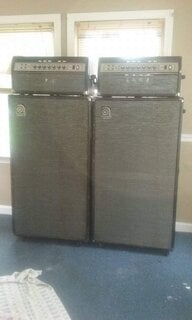
Ampeg SVT--favored mid-frequencies

One: choice of cabs matters a lot for the sound, especially when the brands are different. Your bass will sound different with an Ampeg cab compared to your Rumble cabs, for instance. So trying out another cab (the Ampeg PF115HE cab for example) will probably tell you a lot.

Two: I find (on the whole) the Fender Jazz Bass a good match with a 450 Hz boost and the Fender Precision Bass a good match with a 800 Hz boost.

IMHO YMMV

Hope this will help you a bit.

I really think you nailed it! I definitely preferred #2 when I was playing a Jazz Bass, and #3 when I was playing a P-Bass.

And when I needed to find a spot between the kick drum and the guitar and vocals, #1 always worked well for me.

IMO whomever developed the Ampeg’s 5-way selector switch and it’s EQ points was/is a genius, and is worthy of Sainthood.

For me, Ampeg’s Baxandall EQ is the best there is.
 
  • Like
Reactions: Jim C
I don't agree with this.
It's not any kind of modeling amp and the EQ is straight ahead. Boosting one frequency over the other does not send one toward a particular voicing of a different brand of amp.
It is a bass amp that has cut and boost EQ circuity that sounds very musical.

Never played a Marshall Super Bass but did have a 400 watt Marshall SS head that sounded like it's own thing going on.

There is a reason why the Ampeg SVT was the most popular bass amps in the world for over 40 years and the reason is tone.
In the future I think one of the new class D heads will become king as the difference between tone and weight has gotten smaller very quickly. Mesa is certainly leading this although I'm happy with Ampeg tube pre's and Class D power amps right now.

And IMHO should Mesa ever offer a channel with a Baxandall type of EQ, and please, no graphic EQs, they’ll be draining a bit of my savings account! :D
 
  • Like
Reactions: Jim C
I usually use the 800 position too and use the knob judiciously depending on which bass I am using, a little bit goes a long way on an SVT. I have the three way switch on an old SVT, I have occasionally used the 220 hz position for a slight low mid boost and have also used the 3000 Hz position for a click sound using fingers with flat wound strings. But normally I use 800 and play with bass and treble almost like there is no mid control especially with a Fender P bass with flats, with a Ric with flats I'll sometimes add a little 800 mid for presence. For me the mid control is like a presence control for a bass.
 
  • Like
Reactions: Wasnex
The layout of the Marshall tone stack is pretty much the same as the Fender tone stack. Different component values are used so the controls behave and sound a bit different. This relates to the bass, mid and treble controls.

The presences control is not actually part of the tone stack. It's a variable control built into the global feedback loop. The global feedback is applied between the output transformer and the phase inverter. Negative feedback is used to decrease distortion. In essence the presence control varies the amount of high frequency global feedback. Turning up the presence decreases the high frequency freedback. This increases the amplification factor of the high frequencies.


Very interesting, I never knew that, I have a Marshall Major and the presence control does increase the mids/highs it does actually work and really increases the presence of the bass sound in a mix and I always wondered where it fit in in the tone control scheme of things.
 
  • Like
Reactions: Wasnex

Latest posts