• TalkBass has been independent since 1998. Add your voice.
    Create a free account to reply to discussions, view embedded media, and browse with fewer display ads.
    Join freeLog in
    Want zero display ads or expanded classifieds tools? Compare plans.

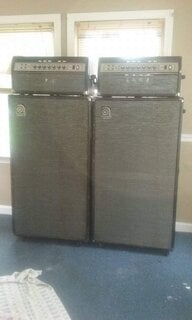
Ampeg SVT-II & Trace Elliot cabs STUFF ARRIVED!

I have years of experience around CRT tech, so HV is not really an issue for me. The first time you get zapped by anode voltage you learn to respect the sucker. :D

I'm under the impression that if a tube was a goner, I'd be listening at crackling or other sound artifacts as well? But at turn-on it's dead quiet.

When I get home in the evening, I'm going to get a bunch of patch cables and hook up some music to the amp. When it starts to fart, I'll patch it direct into the endstage and see if that works. That should tell me if it's an end-stage problem to start with.
 
I have years of experience around CRT tech, so HV is not really an issue for me. The first time you get zapped by anode voltage you learn to respect the sucker. :D

I'm under the impression that if a tube was a goner, I'd be listening at crackling or other sound artifacts as well? But at turn-on it's dead quiet.

When I get home in the evening, I'm going to get a bunch of patch cables and hook up some music to the amp. When it starts to fart, I'll patch it direct into the endstage and see if that works. That should tell me if it's an end-stage problem to start with.

Usually when power tubes go they red plate (the surrounding metal around the filament glows red hot) and takes that plate resister with it i mentioned before. I have never heard any noise from a power tube when it's bad unless it was microphonic which is rare, but if you have several of those plate resisters opened that will make the amp crackle and pop, the thing that puzzles me is that it sounds good until it warms up. Have you tried the power amp alone yet? You could also try the preamp alone too. @beans-on-toast must be AWOL, he usually checks these things right out and he knws his stuff.
 
  • Like
Reactions: Rattanee
So... could someone with tube-knowhow chime in on this?

Basically, amp has no noise, bass sound is... well... no better way to put it... It has balls. It is pure greatness, and even without EQ to boot! Friggin awesome.
But two songs later, I end up cranking the volume a litte higher, and during the third song, volume is gone. Even on full volume, all I get is a weak fart out of the amp. I had a look, at the endstage tubes, and I found it a little odd that the two outer tubes on each side had blue glow, but the middle two did not(or just very minor. I could not tell if it was just reflection). So I turn it off, switched over to my Tech head, played rehearsal. Out of curiosity, I plugged the SVT back in afterwards, and it fired up fine again with great sound and no noise at all.

I am well versed in more modern electronics, but no experience with tubes. My understanding was that when tubes start going, they'd start humming bad, or turn microphonic before actually dieing completely? Soo... am I looking at bad tubes, or should I just be hunting for a contact fault somewhere ?

Here are some guidelines as to when to change tubes: How Do I Know When to Change My Tubes?

The glow of the tubes can vary depending the make and model. The blue color is an impurity that is glowing. It isn't normally a problem. The middle two tubes could be fine.

It appears that you have a heat related intermittent problem.

It always a good idea to have any new old amp checked out to bring it up to spec. The process starts with a good cleaning. All metal-to-metal contacts such as jacks, tube sockets, tube pins, and connectors are cleaned and inspected. Pots are cleaned. If necessary, tube sockets are re-tensioned. Loose contacts can cause static or a scratching sound. Oxidation is common on these contacts and can affect the performance of the amp. It needs to be cleaned, Deoxit is a good product to use. Solder joints need to be inspected and reflowed if necessary.

All this prepares the amp, diagnostics come next. Voltage readings should then be taken and compared to references on the schematic.

In a case like this, there is no magic solution. You have to sweat through the details.
 
  • Like
Reactions: Rattanee
Here are some guidelines as to when to change tubes: How Do I Know When to Change My Tubes?

The glow of the tubes can vary depending the make and model. The blue color is an impurity that is glowing. It isn't normally a problem. The middle two tubes could be fine.

It appears that you have a heat related intermittent problem.

It always a good idea to have any new old amp checked out to bring it up to spec. The process starts with a good cleaning. All metal-to-metal contacts such as jacks, tube sockets, tube pins, and connectors are cleaned and inspected. Pots are cleaned. If necessary, tube sockets are re-tensioned. Loose contacts can cause static or a scratching sound. Oxidation is common on these contacts and can affect the performance of the amp. It needs to be cleaned, Deoxit is a good product to use. Solder joints need to be inspected and reflowed if necessary.

All this prepares the amp, diagnostics come next. Voltage readings should then be taken and compared to references on the schematic.

In a case like this, there is no magic solution. You have to sweat through the details.

There is no red-plating on the tubes, and the blue glow seems to be on the glass rather then inside/near the plates. From what I read earlier, this should not be a problem. There is also no visible change in this when it starts to loose power.

If it was a problem with a resistor, I'm sure that would have to affect the sound right from power-on.

Would you happen to have a copy of the non-pro schematics? The only one I could dig up is sh*t-tier resolution. I can't really read anything off of it.

I also had a long day yesterday so I didn't have the time to check it, but I will check if it's a pre or power amp section problem. I might as well check the tube sockets as well. It's a possible cause as the amp was stored (albeit in a rack) in a cellar for a while.
 
  • Like
Reactions: beans-on-toast
There is no red-plating on the tubes, and the blue glow seems to be on the glass rather then inside/near the plates. From what I read earlier, this should not be a problem. There is also no visible change in this when it starts to loose power.

If it was a problem with a resistor, I'm sure that would have to affect the sound right from power-on.

Would you happen to have a copy of the non-pro schematics? The only one I could dig up is sh*t-tier resolution. I can't really read anything off of it.

I also had a long day yesterday so I didn't have the time to check it, but I will check if it's a pre or power amp section problem. I might as well check the tube sockets as well. It's a possible cause as the amp was stored (albeit in a rack) in a cellar for a while.


Yes, try isolating the pre and power amp to determine where the issue lies. Also connect an instrument cable from the pre-out to power-amp in.

Next is to clean and check the tube sockets. If the tube slides in and out too easily, the socket terminals need to be carefully re-tensioned. It can very well be a tube, more often a pre-amp one. Swap them out, one at a time starting with the first pre-amp tube. Fortunately these small signal tubes are the least expensive.

A problem with a component such as a resistor can manifest itself when it comes up to temperature. It can take about 20 minutes with the amp in playing mode, standby off, for the components to fully heat up. Playing through the amp makes it heat up faster.

The schematics are available here: Link Removed, search for SVT II. Also check out this site, some of the updates are posted: Dropbox - SVT II (non pro)

If the issue is in the power amp, swapout the small signal tubes first. Next, I would trace and check the power tube plate, screen and cathode circuits. A bad solder joint can be an issue. On the power board, there is either a plate resistor or an inductor on each plate. A short between traces where these components are when the amp heats up is a known issue. Check that area carefully. If you have plate resistors, Ampeg recommends that they be replaced with the inductors. The inductors are what are in their current amps, they can help supress oscillations.
 
Last edited:
  • Like
Reactions: bobyoung53
Well at this point I'm more or less convinced that it is a problem with one of the jacks, possibly even the speaker jack itself. I abused the poor SVT at three quarters volume for over two hours. I only had it go quiet and fart a bit for about two seconds, and the next note I played came out perfectly again. It's like it was with the cabinet jack and my Tech head. It would sometimes cut out, and on a louder note came back again simply because the jacks were too old (switched to using the XLR on the cab now) I guess simply due to it's age, all the jacks feel a little loose. I kinda wish there was speakon on this amp... I'd even love to install one, but I don't want to drill into the backplate that big a hole...
 
Well at this point I'm more or less convinced that it is a problem with one of the jacks, possibly even the speaker jack itself. I abused the poor SVT at three quarters volume for over two hours. I only had it go quiet and fart a bit for about two seconds, and the next note I played came out perfectly again. It's like it was with the cabinet jack and my Tech head. It would sometimes cut out, and on a louder note came back again simply because the jacks were too old (switched to using the XLR on the cab now) I guess simply due to it's age, all the jacks feel a little loose. I kinda wish there was speakon on this amp... I'd even love to install one, but I don't want to drill into the backplate that big a hole...

Some jacks have shunts in them. These are normally closed switches. When a jack is not inserted, the signal flows through the shunt. When the contacts have oxidation on them, the signal flow is impeded. To clean them, you should insert a plug to open the shunt, then apply the Deoxit.

26FD3DFB-C3D0-4C99-9F9F-A91FCC8DDA1B.jpeg
 
  • Like
Reactions: anderbass
Interested in what you come up with on the Trace 410 speaker replacement. I too had a dud and the
Speaker I replaced it with was an Eminence Beta 10A. Totally different sounding speaker. The originals are way more mid forward.
 
Interested in what you come up with on the Trace 410 speaker replacement. I too had a dud and the
Speaker I replaced it with was an Eminence Beta 10A. Totally different sounding speaker. The originals are way more mid forward.
I'm getting the voice coils re-wound to spec, though I might look into other solutions once I size up the internal volumes. Thing is, if it's anything but the old speakers, it'll sound different.
 
Some jacks have shunts in them. These are normally closed switches. When a jack is not inserted, the signal flows through the shunt. When the contacts have oxidation on them, the signal flow is impeded. To clean them, you should insert a plug to open the shunt, then apply the Deoxit.

View attachment 2831260

I will clean all the jacks and have a look at the interconnect cables as well while I'm in there. I have a feeling that will have the problem sorted.

As far as impedance matching between cab and head goes... Do you think the SVT-II could handle a 2.6 ohm total impedance setup in the long run when set to 2 ohms, or would that be wearing on the tubes/playing with the life of the output transformer?
I just snagged an EBS 212 Classic cab for about 40% of retail price, and that has juicy lows and a tweeter to boot. I'd love to combine it with one of the trace speakers' nasal bite. Unfortunately it's the 4ohm and 8 ohm game.. so it'd be a total of 2.66666666... ohms if I hook them in parallel.
 
I will clean all the jacks and have a look at the interconnect cables as well while I'm in there. I have a feeling that will have the problem sorted.

As far as impedance matching between cab and head goes... Do you think the SVT-II could handle a 2.6 ohm total impedance setup in the long run when set to 2 ohms, or would that be wearing on the tubes/playing with the life of the output transformer?
I just snagged an EBS 212 Classic cab for about 40% of retail price, and that has juicy lows and a tweeter to boot. I'd love to combine it with one of the trace speakers' nasal bite. Unfortunately it's the 4ohm and 8 ohm game.. so it'd be a total of 2.66666666... ohms if I hook them in parallel.

The amp should be fine running cabs with 2.6 ohms on the 2 ohm tap. The problem is running 4 and 8 ohm cabs together, they won't be balanced. More power will be going into the 4 ohms cab so that one will probably be louder. The efficiencies of the cabs will come into play.
 
The amp should be fine running cabs with 2.6 ohms on the 2 ohm tap. The problem is running 4 and 8 ohm cabs together, they won't be balanced. More power will be going into the 4 ohms cab so that one will probably be louder. The efficiencies of the cabs will come into play.

Yeah I realize that, but I think I will be fine with that if I get what I anticipate as the result. If math serves right, that'll get me 100 watts into the trace, and 200 into the EBS. See my only gripe with the trace cab is that it dies under the B string. Obviously it was not designed for 5/6 strings. I'm kinda expecting the EBS' brutal low end to fix that, and the tweeter I can adjust to taste.
If It's not what I expect, I can possibly trade the working trace towards a 4x10 EBS from the same series (although I would prefer another 212 but I don't see much of a chance of another one coming by at an acceptable price).
 
  • Like
Reactions: beans-on-toast