

Enjoy the benefits of a premium membership!
Upgrade Account
-
TalkBass has been independent since 1998. Add your voice.
Create a free account to reply to discussions, view embedded media, and browse with fewer display ads.
Join free Log in
Want zero display ads or expanded classifieds tools? Compare plans.
You are using an out of date browser. It may not display this or other websites correctly.
You should upgrade or use an alternative browser.
You should upgrade or use an alternative browser.
Ampless Rig Search/Experiences
- Thread starter BaltBass5
- Start date
More options
Who Replied?
There's several Noble captures on Tone.net for Tonex.
You don't need to own the Tonex pedal if you have decent PC or iPad with a good interface, you can try the Tonex software for free.
You don't need to own the Tonex pedal if you have decent PC or iPad with a good interface, you can try the Tonex software for free.

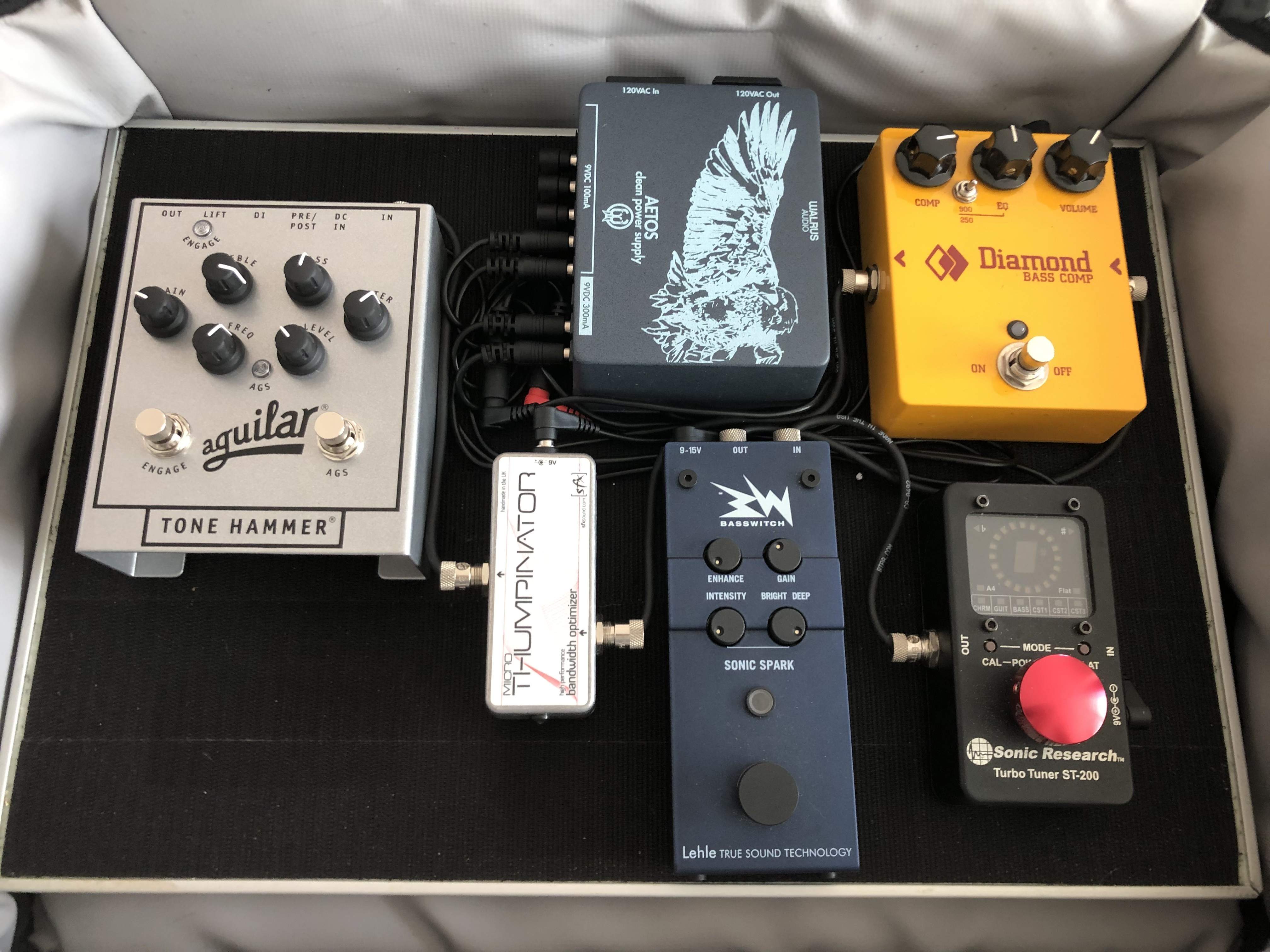
So I want to add a little more to this thread besides just recommending the Noble. As I mentioned previously, I've owned the Noble 3x's. I sold my last one earlier this year. What drove my previous sales was either I wasn't using it at the time, I felt guilty for having a 1300 pedal, and/or I was worried about my 1300 pedal getting trashed on a gig from a drunk patron or inadvertent drink spill. In either case, I subbed in an Aguilar TH pre/DI. I can honestly say, I didn't feel I was missing much from not using the Noble. For your average working musician, the Aguilar is THE BEST bang for your buck in-regards to form and function over price. And if the Aggie was out of commission for whatever reason and I needed a replacement, I can get one delivered to my house in a day. The sound from the Noble and Aguilar are in the same tone universe. In a mix, it would be hard pressed to tell the two apart. Obviously, where the Noble shines is in the studio. If I was playing uber large stages, didn't have to worry about anybody getting in "my space", and drunk people, I would still own the Noble....only because (1) I can afford it and, (2) I like gear. Is the Noble 1000 dollars better than the Aggie, IMO, no it is not. FWIW, the board pictured below was fairly consistent iteration of my Noble-less IEM board. Prob didn't need the SFX Thumpinator. But the RMI Sonic Spark was a really cool pedal to add some harmonic content to my signal chain. The Sonic Spark is no longer being made. So they are a little hard to find. But they are so worth it. If you want to add harmonic content to your signal, this is the pedal. Nothing does what this pedal does. The Diamond BCJR is one of the best bass pedals IMO. It just adds some awesome mojo I've found nothing else can mimic. And of course, the Aguilar pre/DI. This board is really hard to beat for IEMs. You could sub a cab-sim for the Thumpinator and all it a day. If I was going ampless tomorrow, this is what I would use. I'd love a Noble again....but I'd prob just end up feel guilty about owing one and flipping it for a Tonehammer, again. LOL

Firstly, I'll just say I have never found something that sounds as good in my IEMs as it does through FOH. It's a compromise, as long as I sound good out there I'm content to sound almost that good in my monitors as long as I can hear myself.
Secondly, for me one of the benefits of going ampless would be an all-in-one solution. In other words, one box, one power supply, plug in, out to FOH/monitors. I use Fractal stuff in my home studio and would totally run it live if I was never using an amp. Of course there are many great all-in-one solutions from Line 6, Fractal, Neural DSP, etc.
Secondly, for me one of the benefits of going ampless would be an all-in-one solution. In other words, one box, one power supply, plug in, out to FOH/monitors. I use Fractal stuff in my home studio and would totally run it live if I was never using an amp. Of course there are many great all-in-one solutions from Line 6, Fractal, Neural DSP, etc.

HX Stomp through any tube DI. You have the option of several amp models and do not have to run the cab sims.
The Jad Freer Capo has been my rig for nearly everything the last year. It’s fantastic. Highly highly recommend.

- I don't want cab sims because with IEM's I've never mic'ed cabs I've always gone direct from my amp DI's POST EQ.
If you want the sound of a real, live bass rig in your IEMS, then IMHO you most likely need something that will emulate a speaker and room acoustics.
I suggest taking a look at these videos.
Before we get into it again...UNSUB.
Good luck and have a nice day.

BP-1 Compact.
I’ve tried fractal, MXR, Walrus, Oracle, then the BP-1 did THE TRICK. 64audio CIEMs; and the BP-1 fits and punches in the mix unlike the others. The uppers and mids aren’t as “tubey” as the Oracle, but it fits in the mix clearly and again, PUNCHES.
I’ve tried fractal, MXR, Walrus, Oracle, then the BP-1 did THE TRICK. 64audio CIEMs; and the BP-1 fits and punches in the mix unlike the others. The uppers and mids aren’t as “tubey” as the Oracle, but it fits in the mix clearly and again, PUNCHES.


There are only two preamps I like for my IEM setups. The one I use most is a Sansamp BDDI. There's no lack of low-end there. The other is an EBS Microbass 3 - also tonnes of bottom if you want that - you can even feed one channel into the other to double up your EQ points and "EQ" the distortion component.
I did use a VTDI for a little while, but I didn't like the EQ points on it as much as the BDDI. The BDDI is deeper.
If you're having trouble with actually bass, have you looked at how good of a seal you're getting with your earbuds? Are you using foam-type seals, or are you using silicon seals? Sometimes all it takes is for you to smile and your seal will break enough to lose most of your bottom end.
I did use a VTDI for a little while, but I didn't like the EQ points on it as much as the BDDI. The BDDI is deeper.
If you're having trouble with actually bass, have you looked at how good of a seal you're getting with your earbuds? Are you using foam-type seals, or are you using silicon seals? Sometimes all it takes is for you to smile and your seal will break enough to lose most of your bottom end.


All my gigs are ampless (and have been for most of a decade). The key is getting a good sound out of a pedalboard. You're replacing an amp, so you need to understand what an amp does, if you want to replace it. In an amp (walking through the schematic of a Marshall), you find a stage that is simple voltage gain, a stage that overdrives, a stage that does eq, and then the power amp, which drives a speaker.
The first stage isn't completely necessary, but I do have a boost pedal first on my pedalboard - one with very low noise. That gain raises the signal above the noice level of the chain - it helps with that, so I use it al the time, with varying gains according to what bass I'm playing at the moment - basses with more output get less gain, and vice versa.
The next pedal on my pedalboard is an overdrive - what one specifically changes from time to time, depending on the needs of the gig and my mood. IO't son when i want it, which is usually less than half the time, but on some gigs....more.
The next pedal is an eq pedal - a Source Audio EQ 2. This is always on. It functions as the eq in the rig, the high pass (which is set really low - I play 5'ers, and I'm just trying to keep subsonic stuff out), it has a limiter that probably never gets triggered, it helps equalize gain, and it has a low pass filter - if you're used to playing through cabinets that don't have tweeters, you probably want a lowpass to de-fizz any dirt pedals, and to take some of the bite out of your signal. I don't use speaker IR's to do this, because they roll off low end - with a 5'er through a very capable PA, there is no need to roll off your fundamentals - it actually takes away impact through a great PA - if FOH needs to do that, fine, but they know the room and the system better than you do, that's their job. With you listening through in ears, you really have to learn to trust the sound person(s) - your ears are not in a place to judge anything - you do your job, let them do theirs.
On other thing to like about that eq pedal - it includes a great tuner. all that functionality in one pedal is great - it earns its real estate.
One word about setting eq in a scenario like this - most bass amps scoop mids - a lot of them scoop mids a lot. A fender tone stack, for example, is flat with the mids at 10, the treble at zero, and the bass between zero and 1 - any other setting (which is pretty much all of them), your are scooping mids. Folks on here tell you to boost your mids - fair advice, but what they don't realize is that, even with the controls set to where it looks like you're boosting mids, you're probably still scooping them. This is perfectly understandable - a bass guitar without any eq is a mid heavy instrument. Anyway, when you start working with eq pedals (like the one I referenced), They don' t have baked in mid scoops - you find that you do want to scoop low mids a bit (not a lot) - that gives you the same result as many amps with what looks like mid boost. Anyway, enough of that.
On a pedalboard, you don't need a power amp, you need a DI as your "output stage" - you can let FOH supply one, gut if have your own, it's one less variable in your sound.
The point of al this is that you are responsible for sending a good sounding signal to FOH - if what you send them sounds good when they bring up a fader without doing anything to the signal, you'll be a hit wherever you play (and you get called back). Your job ends at the xlr - do it well up to that point, then leave the rest to the other folks on your team.
The first stage isn't completely necessary, but I do have a boost pedal first on my pedalboard - one with very low noise. That gain raises the signal above the noice level of the chain - it helps with that, so I use it al the time, with varying gains according to what bass I'm playing at the moment - basses with more output get less gain, and vice versa.
The next pedal on my pedalboard is an overdrive - what one specifically changes from time to time, depending on the needs of the gig and my mood. IO't son when i want it, which is usually less than half the time, but on some gigs....more.
The next pedal is an eq pedal - a Source Audio EQ 2. This is always on. It functions as the eq in the rig, the high pass (which is set really low - I play 5'ers, and I'm just trying to keep subsonic stuff out), it has a limiter that probably never gets triggered, it helps equalize gain, and it has a low pass filter - if you're used to playing through cabinets that don't have tweeters, you probably want a lowpass to de-fizz any dirt pedals, and to take some of the bite out of your signal. I don't use speaker IR's to do this, because they roll off low end - with a 5'er through a very capable PA, there is no need to roll off your fundamentals - it actually takes away impact through a great PA - if FOH needs to do that, fine, but they know the room and the system better than you do, that's their job. With you listening through in ears, you really have to learn to trust the sound person(s) - your ears are not in a place to judge anything - you do your job, let them do theirs.
On other thing to like about that eq pedal - it includes a great tuner. all that functionality in one pedal is great - it earns its real estate.
One word about setting eq in a scenario like this - most bass amps scoop mids - a lot of them scoop mids a lot. A fender tone stack, for example, is flat with the mids at 10, the treble at zero, and the bass between zero and 1 - any other setting (which is pretty much all of them), your are scooping mids. Folks on here tell you to boost your mids - fair advice, but what they don't realize is that, even with the controls set to where it looks like you're boosting mids, you're probably still scooping them. This is perfectly understandable - a bass guitar without any eq is a mid heavy instrument. Anyway, when you start working with eq pedals (like the one I referenced), They don' t have baked in mid scoops - you find that you do want to scoop low mids a bit (not a lot) - that gives you the same result as many amps with what looks like mid boost. Anyway, enough of that.
On a pedalboard, you don't need a power amp, you need a DI as your "output stage" - you can let FOH supply one, gut if have your own, it's one less variable in your sound.
The point of al this is that you are responsible for sending a good sounding signal to FOH - if what you send them sounds good when they bring up a fader without doing anything to the signal, you'll be a hit wherever you play (and you get called back). Your job ends at the xlr - do it well up to that point, then leave the rest to the other folks on your team.
Last edited:
Sansamp BDDI with IEM’s. The band has a permanent sound guy, I trust him completely and an incredible PA, my IEM’s never sound as good as the FOH sounds. I rarely go out front to hear it, but I did the other night and it sounded great. As someone else said, IEM’s are a compromise, I’m not looking for them to sound like the FOH, just sound good and let me hear what I need to hear at a volume I can tolerate.

I’ve not been happy with most built in cabsims. I have the SGT, the origin SV and a bunch of others, but my current favorite is the capo. It has a ton of flexibility.The Jad Freer Capo has been my rig for nearly everything the last year. It’s fantastic. Highly highly recommend.
The other option I like is the Dsm Humboldt simplifier. It has some quirks but the cabsim is analog knob adjustable and it has two simultaneous preamp channels with a blend. It’s also less expensive than many others. It’s also crazy small.
I do very much love the origin SV but I actually run the amp out into a radial DI so I can forego the cabsim or add something different down the line (if only the cabsim switch was a 3-way with “always off” as an option for the DI.
I liked the twonotes LeBass but not the new one because I must have direct control of my mids.
I'll start by saying that maybe this is in the wrong place? I'm essentially going to discuss ampless options that can replicate amps.
...
OP, what IEMs do you have? I'm curious.


On my amp-less board I've shuffled around preamps over the years. It started with a Mesa Subway DI, then the Plus version, Shift Line Olympic MKIII, Nordstrand Starlifter, and now I'm using the Genzler Magellan Pre.
The Genzler is very well designed and you can dial in to taste and switch between one of two tone shaping options (Modern or Vintage), or have nothing at all. Definitely don't overlook this one and it should be readily available. The Starlifter did a great job as well, but two potential downsides - 1. It runs on AC power, and 2. It weighs as much as a brick.
The Genzler is very well designed and you can dial in to taste and switch between one of two tone shaping options (Modern or Vintage), or have nothing at all. Definitely don't overlook this one and it should be readily available. The Starlifter did a great job as well, but two potential downsides - 1. It runs on AC power, and 2. It weighs as much as a brick.

I have a broughton messenger jr. That I’m a very big fan of. Really simple, sounds great and doesn’t take up that much space!
I also have an Arkham Oracle for the bigger board and it sounds amazing.
I also have an Arkham Oracle for the bigger board and it sounds amazing.


