• TalkBass has been independent since 1998. Add your voice.
    Create a free account to reply to discussions, view embedded media, and browse with fewer display ads.
    Join freeLog in
    Want zero display ads or expanded classifieds tools? Compare plans.

Analogue Vs. Digital

...
Asking exactly the right question is a bit of an art form. This is a primary subject of an excellent sci-fi book by Ursula LeGuinn named 'The Left Hand Of Darkness.'

Sounds alot like the hitchhikers guide through the galaxy ;-)
"Yes, the answer is 42, I checked it, but it is complete nonsense as long as you do not know the question"

Nevertheless you are right. Asking the right question is nearly an art. I know that from making requirement/specification documents...
 
This is my first question on this topic"Will and can a digital amp sound as good as a analogue amp"? Apparently there all analog. Complete answer... Yes but not a complete schooling in electronics... Now that I know there all analog,I will have to give one of those tiny,light weight guys a try. I like analog....It just sounds better even when you say it..ANALOG vs DIGITIZED...

I'm of two minds about this generalization. In the first place, digital technology has created a world with fantastic video quality and mediocre audio quality. On the other hand, the technology popularized for audio (e.g. mp3, aac, etc.) has been adopted based on low cost and convenience. This consumer choice is not indicative of the full capability of digital audio processing. Having said that, I'll bet that other than live performance that I haven't heard any audio in the past decade where digital wasn't somewhere in the chain; either storage, transmission, processing, or most likely all of the above.
 
This consumer choice is not indicative of the full capability of digital audio processing.
Yes. The bar was set when the president of Sony decreed he would accept no Compact Disc standard that did not permit the complete performance of Beethoven's 9th Symphony on one side.

And while studios could afford quality samplers, mixers, and mastering equipment, the consumer playback equipment was stuffed with cheap DACs to deliver products at a $100 price point. The fact that a lot of early CDs were simply digitised analog masters with a RIAA curve baked in didn't help the 'digital quality' stigma.

Then along comes MP3 with its aggressive compression to minimise transmision time over dialup and increase the number of songs storable on small flash-memory players and the bar for 'acceptable sound' is lowered some more.

It doesn't _have_ to be that way - witness SACD. I've got a handful and they sound great. At home, where the expensive 30-lb player the size of a breadbox lives. The new high bitrate sound formats used in BluRay movies also have the potential for really good sound - especially with better DACs available in high-end home-theater gear.

I think 'persons of a certain age' (I am in this demographic) have often forgotten how we used to simply tune out vinyl clicks and pops, and cassette-tape hiss.

And naturally, as manufacturers responded to a demand for higher quality (after the format was established on volume...) we got metal tape and Dolby hiss reduction. Just in time to repeat the process with the Compact Disc...
 
Digital audio does not have to be inferior to analog. In fact, IMO it can be as good or better! Just like analog, it depends on the thoroughness of design and execution
 
As designer and engineer of digital, programmable logic, I insist to disagree.
Ever used an analogue PC? Well, it exist(ed), but... well, I guess you know what that one looked like?
Remember these analogue screens?? UAAAH, horrible, I have to wear glasses because I used these ****ers too much! And do not forget the analogue telefones. Not speaking of analogue cellphones :smug:

I know, a digitalised copy of an analogue signal is always just a compromise, but novadays it is a quite good one, at least as long as you use high-quality components. But that counts for analogue circuits as well. And who said you have to digitalise analogue signals? You can create sound digitally as well, and I would keep it digital until it reaches the amplifier!!!

Digital signal processing has a bad reputation, I know. But that is for most parts because the designers always puts EVERYTHING possible in one module/unit and have to do it as cheap as possible.Most companies have cut their own flesh when they decided to go for the all-in-one-and-cheap option. Yeah, it sells, but the image is bad! It does what is said on the box, but... Not as good as expected, right?

I design digital signal processing units (video, not audio) and I can tell you, we can do wonderful things you would never be able to achieve in any analogue way, and we do it on the surface of a coin. But, it is the same with everything else: You get what you paid for. The stuff we make costs time and a ******** of money, but it works!!!

there are certainly amazing things you can do in DSP. For example you can create EQ filters in the digital realm that no analogue eq can ever replicate.
However, even with my half-deaf ears I like the sound of analog eq, warts and all.

PS I work in broadcast, you work for any company I may have heard of? Abekas? Harris? Grass Valley?
 
Quality of answers would improve if questions included all the facts too, but this too rarely happens. Then there's half a dozen people answering what they thought the question was before we finally get to understand the _real_ question...

Each answer to the wrong question begets bickering from the people who had a different interpretation of the original question...

Asking exactly the right question is a bit of an art form. This is a primary subject of an excellent sci-fi book by Ursula LeGuinn named 'The Left Hand Of Darkness.'

thing is, we aren't paid bass guitar support specialists. We are a bunch of goofs screwing around on line. You can't expect straightforward discourses from people that are essentially procrastinating while they kill their morning coffee.

Besides, most of us are just here because "analog vs digital" is the message board equivalent of blood in the water. :D


PS: "Left Hand of Darkness" is an AMAZING book. I tried to change my bands name to that after I finished reading it. It's that good. Though if you are politically/socially conservative some of the themes in the book are kind of hard to take. (similar to Dhalgren in that way)
 
there are certainly amazing things you can do in DSP. For example you can create EQ filters in the digital realm that no analogue eq can ever replicate.
However, even with my half-deaf ears I like the sound of analog eq, warts and all.

PS I work in broadcast, you work for any company I may have heard of? Abekas? Harris? Grass Valley?

You may have heard of my ex employer although it was geared to Radio. At it's peak we manufactured almost everything you needed for radio broadcast except the people.
 
From what I've seen, digital needs plenty of processing power to be on a level with analog, like large desktop-level processing power. The cheaper stuff just doesn't get it done for me...to me they're more like what MP3 is to the original master tapes.
 
We play a lot of early 60's rock. Our keyboard player was using a digital(synth) Farfisa sound,well we had loaned out a Farfisa years ago and just got it back. There is no comparison in sound. The analog Farfisa is all over the synthesised sound. It's the real thing...
 
Well whatever the reason, my desktop loaded with a good plugin like GR or Amplitube sounds way better than a commercial grade digital bass amp, and the really good digital standalones cost a couple grand.
 
Digital audio stored in a good format (flac or other lossless format) and played back through a good, well-isolated DAC is hard to beat. Needless to say, most portable music players have neither the storage space or quality of DAC to do a good job. Many don't even support the best formats.

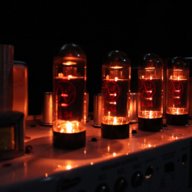
That said, I like a purely analog signal path for my instrument, preferably with tubes in the early stages. I use a class D power amp.

SMPS powered class D amps can do a very good job, although depending on the implementation they CAN also sound a little "thin" with the higher frequencies not quite perfect. Lows are usually fine, even in the early, poor implementations. The better brands' PA level class D amps are hard to fault, doing a great job over the whole audible frequency range.

To the OP: After all that, I think the Gallien Krueger MB Fusion is worth a try. Quite decent tube preamp into a light and small class D power section. Or an Ampeg Portaflex, 500 or 800 depending on your power requirements...
 
Well whatever the reason, my desktop loaded with a good plugin like GR or Amplitube sounds way better than a commercial grade digital bass amp, and the really good digital standalones cost a couple grand.

What you're talking about there is full digital processing (usually from analog to digital, then heavily processed, then back to analog), whereas music storage and playback is a lot simpler, processing-wise (just lining up the bits and converting to analog).

I agree that you need a good amount of processing power to do digital signal processing well.
 
Digital audio stored in a good format (flac or other lossless format) and played back through a good, well-isolated DAC is hard to beat. Needless to say, most portable music players have neither the storage space or quality of DAC to do a good job. Many don't even support the best formats.

That said, I like a purely analog signal path for my instrument, preferably with tubes in the early stages. I use a class D power amp.

SMPS powered class D amps can do a very good job, although depending on the implementation they CAN also sound a little "thin" with the higher frequencies not quite perfect. Lows are usually fine, even in the early, poor implementations. The better brands' PA level class D amps are hard to fault, doing a great job over the whole audible frequency range.

To the OP: After all that, I think the Gallien Krueger MB Fusion is worth a try. Quite decent tube preamp into a light and small class D power section. Or an Ampeg Portaflex, 500 or 800 depending on your power requirements...
I agree... I listen to internet radio and Flac off my hard drive through a Logitech Touch into a Grant Fidelity DAC 11 and then into my Fisher 500B receiver out to a pair of JBL Apollo C51's. You can't beat this sound, but I think for instruments playing live it's a different story. Digital is good but needs to get back to analog to sound better.
 
From what I've seen, digital needs plenty of processing power to be on a level with analog, like large desktop-level processing power. The cheaper stuff just doesn't get it done for me...to me they're more like what MP3 is to the original master tapes.

I tend to agree.

...but then, I expect that is a situation that is rapidly disappearing.

My first computer cost $2000 and had 64K of RAM. Less than 30 years later I own a $100 calculator with more memory and processing power.

Remember - processing power approximately doubles every 18 months.