OK, with the semester over, I'm going to rant about a different kind of tech; medical tech, specifically, trepanation (also spelling "trephination" and various other ways). This is surgery that removes bone from the skull.
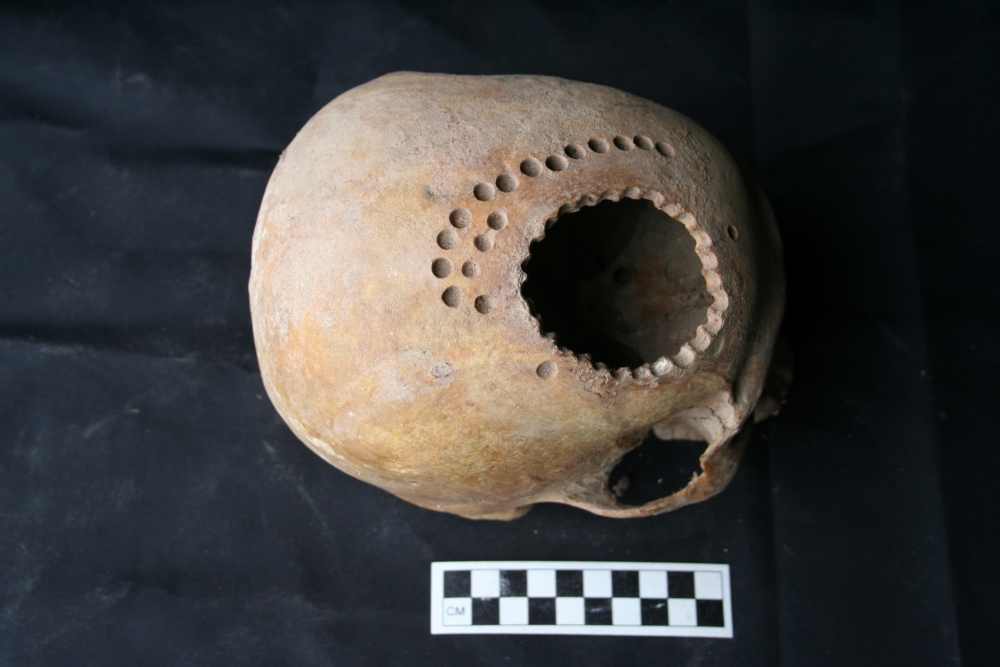
We have neolithic examples - thousands of them, actually. The reason I'm calling this a "rant" is because I just finished teaching a course on the history of mental illness, and lots of my students got from the internet that ancient peoples trepanned mentally ill people because they believed they were possessed by evil spirits and cutting a hole in the skull would let the spirits out.
There's one slight problem with this interpretation: there's precisely zero evidence for it.
No ancient source says anything of the kind. In fact, the ancient Egyptians (who did a lot of trepanning) didn't even associate the brain with mental illness (or mental anything) at all; they thought these functions happened in the heart. When ancients do talk about trepanation, it's normally for one of two purposes; either the patient had suffered a head injury and the physician was removing fractured bone so that you wouldn't have sharp splinters poking around the brain; or they were suffering pain from brain swelling and the trepanation was to ease the pressure.
Later Greek and Roman physicians did figure out that the brain was the seat of mental function, and there are a couple of rare references to using trepanation for mental illness or epilepsy. In those cases, though, it wasn't thought of as a way to release supernatural forces from the head, but humors, according to the prevailing science of the day.
So where does the interpretation that trepanation was a solution for spirit possession come from? I only know of one source; the writings of Usama ibn Munqidh, a 12th century Syrian nobleman in the age of Crusades. He tells a story of a Middle Eastern Christian physician named Thabit, who was hired to work in a crusader lord's household. Then a "Frankish" (European) physician arrived and took over his patients. One of them, a woman suffering "idiocy" (probably what we today would call severely learning-disabled or autistic), the newcomer proclaimed to be demon-possessed and carved a cross into her scalp, down to the bone, in order to let it out. But she just died instead. Thabit returned to ibn Munqidh's household, complaining about his incompetent foreign rival.
The story is constantly repeated in history books about the era, but it's also suspect; Ibn Munqidh has it at second hand, and his informant is a person with an axe to grind because he lost his job to the foreigner. But it's so vivid and it plays beautifully into our modern stereotypes about past "dark ages" awash with superstition and cruelty that we constantly rehash it and let it become a trope, that ancient peoples liked to drill holes in each others' skulls to let demons out.
I used to think that ibn Munqidh was doubly suspect because I had never seen anything like the Frankish physician's procedure described in any western medical treatise of the time. But double-checking in preparation for this post, I cam across this quote:
"Another use of trephining was as a treatment for mental disease. In his “Practica Chirurgiae,” Roger of Parma (ca. 1170) wrote:
"For mania or melancholy a cruciate incision is made in the top of the head and the cranium is penetrated, to permit the noxious material to exhale to the outside. The patient is held in chains and the wound is treated, as above, under treatment of wounds."
1170 is right about the same time that ibn Munqidh was writing. So it's possible that Thabit's rival was attempting the same procedure Roger of Parma was advocating, and Thabit misrepresented it as supernatural rather than medical in character.
We have neolithic examples - thousands of them, actually. The reason I'm calling this a "rant" is because I just finished teaching a course on the history of mental illness, and lots of my students got from the internet that ancient peoples trepanned mentally ill people because they believed they were possessed by evil spirits and cutting a hole in the skull would let the spirits out.
There's one slight problem with this interpretation: there's precisely zero evidence for it.
No ancient source says anything of the kind. In fact, the ancient Egyptians (who did a lot of trepanning) didn't even associate the brain with mental illness (or mental anything) at all; they thought these functions happened in the heart. When ancients do talk about trepanation, it's normally for one of two purposes; either the patient had suffered a head injury and the physician was removing fractured bone so that you wouldn't have sharp splinters poking around the brain; or they were suffering pain from brain swelling and the trepanation was to ease the pressure.
Later Greek and Roman physicians did figure out that the brain was the seat of mental function, and there are a couple of rare references to using trepanation for mental illness or epilepsy. In those cases, though, it wasn't thought of as a way to release supernatural forces from the head, but humors, according to the prevailing science of the day.
So where does the interpretation that trepanation was a solution for spirit possession come from? I only know of one source; the writings of Usama ibn Munqidh, a 12th century Syrian nobleman in the age of Crusades. He tells a story of a Middle Eastern Christian physician named Thabit, who was hired to work in a crusader lord's household. Then a "Frankish" (European) physician arrived and took over his patients. One of them, a woman suffering "idiocy" (probably what we today would call severely learning-disabled or autistic), the newcomer proclaimed to be demon-possessed and carved a cross into her scalp, down to the bone, in order to let it out. But she just died instead. Thabit returned to ibn Munqidh's household, complaining about his incompetent foreign rival.
The story is constantly repeated in history books about the era, but it's also suspect; Ibn Munqidh has it at second hand, and his informant is a person with an axe to grind because he lost his job to the foreigner. But it's so vivid and it plays beautifully into our modern stereotypes about past "dark ages" awash with superstition and cruelty that we constantly rehash it and let it become a trope, that ancient peoples liked to drill holes in each others' skulls to let demons out.
I used to think that ibn Munqidh was doubly suspect because I had never seen anything like the Frankish physician's procedure described in any western medical treatise of the time. But double-checking in preparation for this post, I cam across this quote:
"Another use of trephining was as a treatment for mental disease. In his “Practica Chirurgiae,” Roger of Parma (ca. 1170) wrote:
"For mania or melancholy a cruciate incision is made in the top of the head and the cranium is penetrated, to permit the noxious material to exhale to the outside. The patient is held in chains and the wound is treated, as above, under treatment of wounds."
1170 is right about the same time that ibn Munqidh was writing. So it's possible that Thabit's rival was attempting the same procedure Roger of Parma was advocating, and Thabit misrepresented it as supernatural rather than medical in character.


 Rivers have always carried, transported, technologies becoming, as a consequence, an intrinsic aspect of all of it — the parade, the trade and all the trappings. Food and nutrition have fueled countless formulations and fabrications driving and improving, among other things, farming technologies, some as old as the hills.