• TalkBass has been independent since 1998. Add your voice.
    Create a free account to reply to discussions, view embedded media, and browse with fewer display ads.
    Join freeLog in
    Want zero display ads or expanded classifieds tools? Compare plans.

Ancient Technology Enthusiasts Club!

So I've been listening to the Rest is History podcast, going through old episodes, and it turns out they did one on Stonehenge a year and a half ago or so. It featured the archeologist Mike Pitts, who, fittingly for that surname, is an archeologist. He actually has a book out titled How to Build Stonehenge.

Someone on the thread a while back insisted that massive blocks of stone couldn't have been moved by a bunch of guys with ropes. Well, actually they could. Pitts explained we know this for a fact because there are islands in Indonesia where the inhabitants still do it, or at least were still doing it in the mid-20th century.

Here's a video Pitts shared on his blog, showing a large block being moved. It's from an island tourist board. Probably not meant to attract western tourists: it's in the local language and there are some violent animal sacrifices as part of the festival depicted in the last three minutes or so of it.


In the process of looking for more about it, I also found this video of a guy in the midwest moving massive blocks in his backyard as a hobby, all with very low tech - he doesn't even use pulleys. And he does it by himself, not with gangs of laborers. It's all balance, gravity, and leverage.


And finally, I also came across this image. Kind of amazing that people dispute the Egyptians could move heavy objects with gangs of labor, ropes, and sledges, when in fact their art depicts them doing exactly that. This is carved in the tomb of Djehuhihotep:
image_1894e-Djehutihotep-painting.jpg
 
Oh, one additional thing Pitts mentioned in the podcast, that I should have included. It kind of comes across in the videos. In modern times, we tend to look at this as an engineering thing, and we default to thinking about how to accomplish the task with minimal effort, and assume limited manpower. But in the Indonesian societies shown, and presumably in ancient Egypt or the prehistoric Brits building Stonehenge, it's fundamentally a ritual thing, and the mass participation is the point of it. They weren't thinking about how to get it done with a minimum of people and time; they were thinking they had all these people and all this time, and what would be a monumental task everyone could play a role in that would glorify their community, gods, or leaders.
 
So a pic popped up in my facebook feed, which I followed up on to see if it was real, and it was. In the 15th century, China's Ming Dynasty (same folks who built the Great Wall in its current form) set out to put up a monument of mind-boggling size. It would have been a stele with a 16,000-ton base, a 9,000-ton body and 6,000-ton head. They began quarrying the stone at a place called Yangshan but then abandoned it when they realized they wouldn't be able to move the stones.

By comparison, the Forgotten Stone at Baalbek in Lebanon (never moved) is 1,650 tons; the largest stone ever moved in ancient times is the Ramesseum in Egypt, 1,000 tons. The largest slabs in the Great Pyramid at Giza are just 80 tons and the largest blocks at Stonehenge are about 40.

That's the numbers. But what's interesting to me about the Yangshan quarry is that it shows something about the quarrying of these stones which, together with some of the videos I shared earlier, suggest how they would have been moved. The Chinese cut UNDER the stones, from the face of the quarry. In that case they bit off more than they could chew, but what it suggests to me is that we modern people tend to think about LIFTING stones, from above, but the people who built these complexes were smarter than that; they would work from UNDER the stone to move it.

1280px-Yangshan_Quarry_-_Monument_Base_-_P1060848.JPG


Yangshan Quarry - Wikipedia

List of largest monoliths - Wikipedia
 
So totally unrelated, but if we define "technology" in the broad sense, not just machinery but know-how:

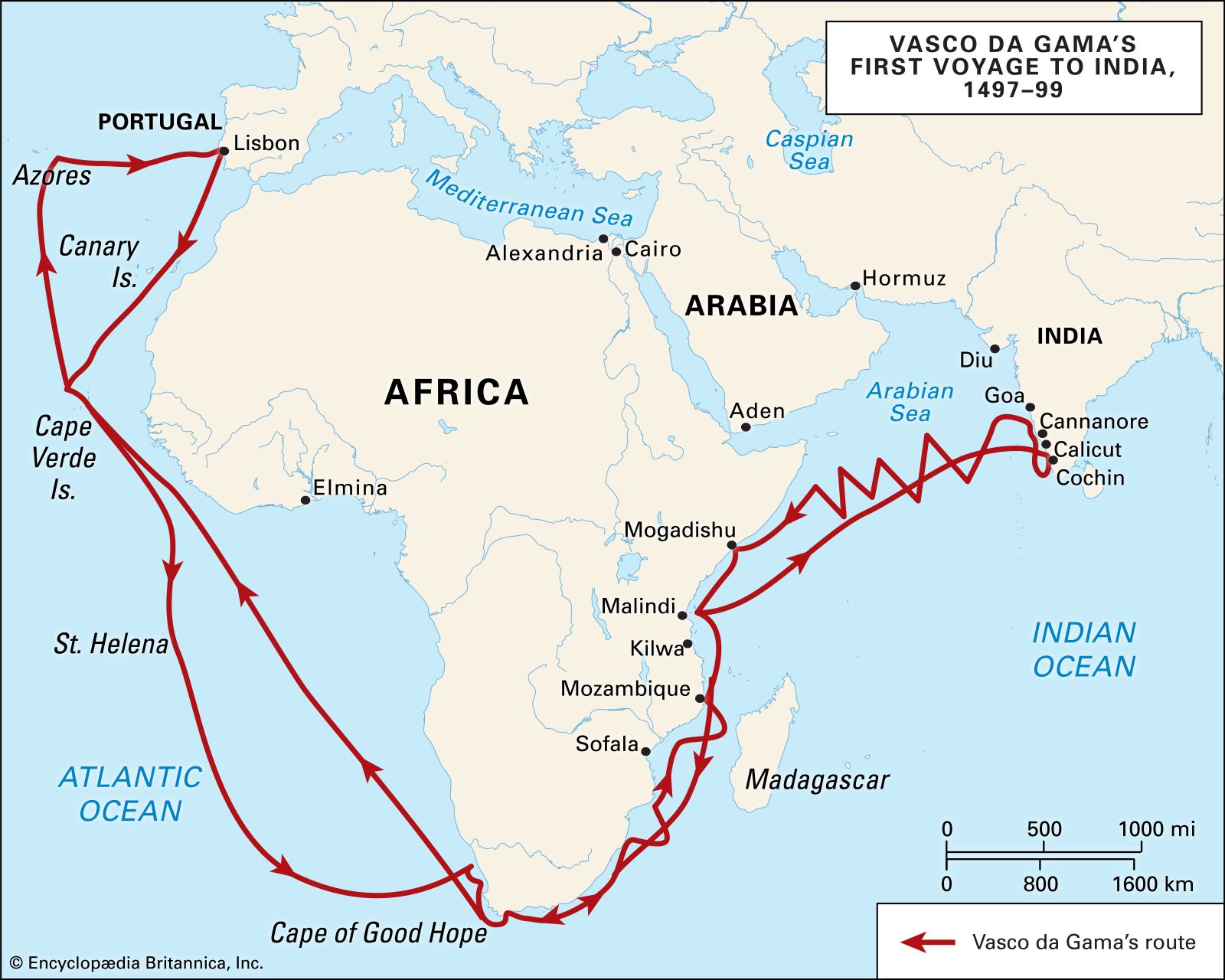
I also came across this map recently, of Vasco da Gama's voyage to India at the end of the Middle Ages:
Map-voyage-Vasco-da-Gama.jpg

Notice how in the Indian Ocean, he sticks pretty close to land, but in the Atlantic you get these wide curves out into open ocean? Premodern sailors mostly preferred to sail in sight of land. But in the course of exploring down the coast of Africa in the 1400s, the Portuguese had encountered a difficulty; the prevailing winds were at their back going south, but to return home you were sailing into the wind, which is hard and requires tacking, slowly zig-zagging back and forth. Then they got blown out to sea and discovered that the north wind in the Atlantic was actually blowing in a giant clockwise circle, so you could sail out into open ocean and then get blown home to Portugal faster than trying to tack straight home. The same applies in the South Atlantic except the Trade Winds blow counter-clockwise, which is why it's the trip to the Cape of Good Hope that sweeps out into open ocean more than the return trip.

Using the Trade Winds that way, in turn, set up Christopher Columbus' voyages. Everyone knew the world was round, but Columbus thought it was smaller than it really was. So he got the idea that if, instead of letting the Trade Wind blow you home to Europe, you kept on going, the islands off the coast of Asia - Indonesia, the Philippines, Japan - ought to be right about at their furthest curve. The Portuguese, who were experienced in the Atlantic by then, thought it was a dumb idea, but the Spanish, who were not, were willing to give it a try. This map is a great representation of what Columbus thought he was doing:
14664.png


So when he got to the Bahamas, Cuba, and Hispaniola, he thought he was in Indonesia or the Philippines.
 
So a pic popped up in my facebook feed, which I followed up on to see if it was real, and it was. In the 15th century, China's Ming Dynasty (same folks who built the Great Wall in its current form) set out to put up a monument of mind-boggling size. It would have been a stele with a 16,000-ton base, a 9,000-ton body and 6,000-ton head. They began quarrying the stone at a place called Yangshan but then abandoned it when they realized they wouldn't be able to move the stones.

By comparison, the Forgotten Stone at Baalbek in Lebanon (never moved) is 1,650 tons; the largest stone ever moved in ancient times is the Ramesseum in Egypt, 1,000 tons. The largest slabs in the Great Pyramid at Giza are just 80 tons and the largest blocks at Stonehenge are about 40.

That's the numbers. But what's interesting to me about the Yangshan quarry is that it shows something about the quarrying of these stones which, together with some of the videos I shared earlier, suggest how they would have been moved. The Chinese cut UNDER the stones, from the face of the quarry. In that case they bit off more than they could chew, but what it suggests to me is that we modern people tend to think about LIFTING stones, from above, but the people who built these complexes were smarter than that; they would work from UNDER the stone to move it.

1280px-Yangshan_Quarry_-_Monument_Base_-_P1060848.JPG


Yangshan Quarry - Wikipedia

List of largest monoliths - Wikipedia

Looks like they got a good start but then the aliens up and left.
 
  • Like
Reactions: hrodbert696
I watch Ancient Aliens on the History Channel a lot. It seems that aliens are responsible for cell phones and the pyramids were their cell towers.
I have watched Ancient Aliens once or twice just out of curiosity and it has given me a new career goal: I want to be an "Ancient Alien Theorist"! You just make up nonsense, pitch it with total confidence and end up on TV!
 

As long as language is a technology, ancient enough, going back here to the 10th Century …


image-20160913-19258-111qa0f.jpg

"Language could be humankind’s most impressive technological invention." That's one way of looking at it, we're told. I can dig this standpoint, digging as I do, this language of ours. There's much to explore if we're to make sense of it.

I bumped into a vlog — the hellish landscape of published AI poetry — where a gent goes to painstaking lengths exploring the available artifice in the world of fake lit. fauxetry.

Getting a feel for the genre, fashioning a line or two that could've been blurted out by a bot,

Hymie Hymie Hymie gets smart art arts,
irksome irksome irksome irks something horrid.
It's not easy to write poetry that bad. I guess that's something in their favour. Does happen perhaps to help firm up the technology hypothesis. I dare say poets can rest easy, at this stage. Theirs is clearly a unique human gift. Those published poseybots — Urkel the Irksome & Co. — they're not even in the race:)
 
Last edited by a moderator:
Looks like they got a good start but then the aliens up and left.

LOL reviving your old comment, but it does make me think about the whole "aliens" nonsense. Why are all these monuments made from quarried stone? Why isn't there any plastic or steel in their construction? Why are there stones quarried but not moved? Did aliens who had traveled across the galaxy to get here have limits on how much weight their spaceships could lift? Why don't any Egyptian sites have weight-bearing architectural features like domes or pointed arches or flying buttresses, like Romans and medieval Europeans used? Did aliens not know how to build those kinds of structures?

 
  • Like
Reactions: MoireBass
LOL reviving your old comment, but it does make me think about the whole "aliens" nonsense. Why are all these monuments made from quarried stone? Why isn't there any plastic or steel in their construction? Why are there stones quarried but not moved? Did aliens who had traveled across the galaxy to get here have limits on how much weight their spaceships could lift? Why don't any Egyptian sites have weight-bearing architectural features like domes or pointed arches or flying buttresses, like Romans and medieval Europeans used? Did aliens not know how to build those kinds of structures?

Throughout history, people have explained that which we don't understand to supernatural powers. Magical spirits caused natural phenomena to happen. The most powerful spirits were gods. Shamans and witches were special people who could tap into certain supernatural powers.

Something interesting happened after the industrial revolution, when science and technology began to replace superstition. Belief in supernatural causes for unexplained phenomena didn't necessarily go away, it was just supplanted by a different type of magical source.

Instead of spirits, sorcerers, angels, and fairies, we now see a wide variety of aliens, extraterrestrials, alternate realities and multidimensional spacetime.

It really doesn't matter what form the explanation takes, as long as it serves the purpose of a magical cause for that which we don't understand.
 
LOL reviving your old comment, but it does make me think about the whole "aliens" nonsense. Why are all these monuments made from quarried stone? Why isn't there any plastic or steel in their construction? Why are there stones quarried but not moved? Did aliens who had traveled across the galaxy to get here have limits on how much weight their spaceships could lift? Why don't any Egyptian sites have weight-bearing architectural features like domes or pointed arches or flying buttresses, like Romans and medieval Europeans used? Did aliens not know how to build those kinds of structures?

And if a civilization has solved the problems of interstellar travel and navigation, AND found a solution to the bigger problem of the immense distances involved (e.g. hibernation, faster-than-light travel, or intelligent robots), why would they be interested in spending centuries hauling stone for earthly stone-and-copper age rulers who maintained their power by pretending to do battle to bring the sun back each morning (Pharaohs) or the rains back every year (Mayan kings)?

Here's a very good NOVA program from 2019 that I just discovered in February:
Decoding the Great Pyramid

I had not given enough thought to the many clever ways that they used the annual flooding of the Nile to enable the construction.
 
  • Like
Reactions: hrodbert696 and fig