

Enjoy the benefits of a premium membership!
Upgrade Account
-
TalkBass has been independent since 1998. Add your voice.
Create a free account to reply to discussions, view embedded media, and browse with fewer display ads.
Join free Log in
Want zero display ads or expanded classifieds tools? Compare plans.
You are using an out of date browser. It may not display this or other websites correctly.
You should upgrade or use an alternative browser.
You should upgrade or use an alternative browser.
Announcing "The Bergonzifying Transmogrifier" for Bass
- Thread starter Intenzity
- Start date
More options
Who Replied?

Now is a great time for all of us to get rid of any miserable version of Internet Explorer.
Works on Windows 7 + Chrome v11
Works on Windows 7 + Chrome v11
The Transmogrifier has been updated!
Yes, this was so much fun that I just couldn't resist.
You can read about how the new feature work here -
Basso Ridiculoso: Transmogrifier 2.0 Released
And it STILL doesn't work in IE8. Bummer.
Yes, this was so much fun that I just couldn't resist.
You can read about how the new feature work here -
Basso Ridiculoso: Transmogrifier 2.0 Released
And it STILL doesn't work in IE8. Bummer.
Here is an example of what you get using the Invalid Link Removed.
I put in a Gmin7 arpeggio, G, Bb, D, F, and chose 16th notes, but you can do 8ths or quarters (for walking lines). Each measure below represents one of the 24 different ways you can play that set of 4 notes.
You can put in any 4 notes you want, and you get an Mp3 of the combinations as well.
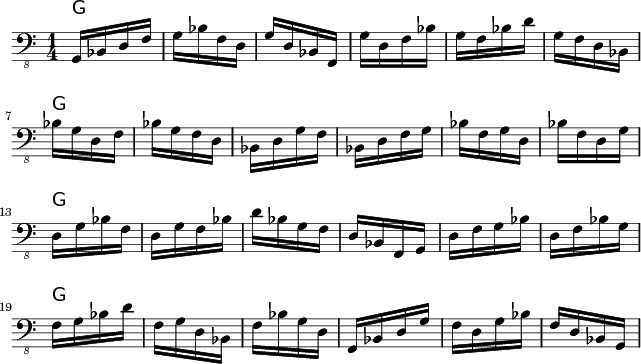
I put in a Gmin7 arpeggio, G, Bb, D, F, and chose 16th notes, but you can do 8ths or quarters (for walking lines). Each measure below represents one of the 24 different ways you can play that set of 4 notes.
You can put in any 4 notes you want, and you get an Mp3 of the combinations as well.
Attachments

Okay.. I took out the frames so now it is just one page without any frames (AND there is a DOCTYPE too. ahem).
Checked with Firefox and safari, and looks good.
Maybe it works with IE8 now? Dunno. If it does, someone holler about it.
Thanks!
Checked with Firefox and safari, and looks good.
Maybe it works with IE8 now? Dunno. If it does, someone holler about it.
Thanks!
Here is an example of what you get using the Transmogrifier ...[snip]...
This would be so much cooler if it could A) handle more than 4 pitch classes; and B) allow you to toggle between unordered and ordered pitch class collections.
This would be so much cooler if it could A) handle more than 4 pitch classes; and B) allow you to toggle between unordered and ordered pitch class collections.
Huh?
Dude, don't insult the Transmorgrifier.
Its beautiful.
Love your blog BassoRidiculoso!!!
This would be so much cooler if it could A) handle more than 4 pitch classes; and B) allow you to toggle between unordered and ordered pitch class collections.
Ok, I get the "it should do more notes" one, but I have no idea what I would even toggle to move between ordered and unordered pitch classes. Or what that even means. You are gonna have to explain that one.
As far as the more notes...5 notes and 6 notes are much larger sets (120 measures and 720 measures respectively) soooo, it just gets out of hand really quick. And anything above 6 notes is just ridiculoso!
But yes, it is possible, I have versions that do 5 and 6 notes, but turning it into readable notation has to be done by hand, so its not practical. BopLand.org: Free Jazz Lick Database was made for licks and short phrases, not 100 measure extravaganzas. The owner of Bopland was kind enough to add a feature so even the 4 note version will display within a fixed (bass guitar) range.
I have no idea what I would even toggle to move between ordered and unordered pitch classes. Or what that even means. You are gonna have to explain that one.
"Unordered" is exactly what it's doing now: It takes those four note names you enter (eg., G-Bb-D-F in the example you showed) and essentially randomizes the sequential ordering of every iteration of those four notes. Sometimes you get G-Bb-D-F, sometimmes you get F-Bb-G-D, sometimes you get G-F-D-Bb, etc. etc. This is (arguably) a good thing when the four notes you've entered constitute a recognizeable chord, because otherwise it would just spew out incessantly repeating identical arrpeggios.
"Ordered" means it would maintain the original sequence of four notes that you entered. So if you entered G-Bb-D-F, every variation (sic) would be G-Bb-D-F. Not a lot of variety there, huh? But...if you are thinking serially rather than in a traditional common-practice vertical tonality, maintaining the sequence of intervals between those notes become very important structurally and motifically. So while G-Bb-D-F might not yield much interest, if your four notes are, say, Db-C-E-F and your piece is all about antipodal half step motion surrounding a symmetical leap, a Transmogrifier that could maintain that pitch class ordering (such that every instance was some form of the exact sequence Db-C-E-F) would be a neat tool for instantly revealing gestural shapes that had an identifiable intervallic content.
Of course, that would be even more useful if it could handle more than four notes, because then it could be applied to hexachords or entire 12-tone rows.
As far as the more notes...5 notes and 6 notes are much larger sets (120 measures and 720 measures respectively) soooo, it just gets out of hand really quick. And anything above 6 notes is just ridiculoso!
Dude, it's a computer! this is exactly the sort of thing computers are good at!
Well, someone has a library card, don't they. And I am not antipodal, I have always believed podals should have the same rights as you and I. I resent that remark.
Hmmm, not exactly. It is not really random, it follows the same algorithm, no matter what notes you put into it. And you will never get any items that repeat, the notes will always stay limited to the original 4 you put in, but only the unique orderings are shown. There are no dupes.
Check out the chart at the bottom of the page below, that shows the transmogrification process with numbers instead of notes, just substitute each of the 4 notes you pick for the numbers 1,2,3,4 respectively. That table relates it to the fingers on your left hand, but the process is the same for any set of 4 things.
Invalid Link Removed
Don't you just mean "I wish it would transpose"?
Well, it does. Click on the notes once, and there is a tab for other keys, and so if you entered G-Bb-D-F, you can get all 12 version of that relationship starting from each different note so - Minor 3rd, major 3rd, minor 3rd, with it starting on G, then Ab, A, Bb, etc. Click the tab that says "Other Keys" after you click on the notation once.
Yea, the problem isn't the computer horsepower its the presentation of it, like I said, Bopland is for short phrases and licks, not 720 measure long things, but if you download the free app that Bopland is based on, Lilypond, you can do that kind of stuff all day long. And the lilypond community has built all kinds of tools to facilitate that kind of stuff. It outputs midi too.
It just takes more formatting and error checking to make it look pretty and useful for humans. But yes, any desktop machine can easily generate all the combinations of 8, 10 or even all 12 notes if you wanted to. Compared to decompressing a DVD, the math is trivial.
And as far as the 4 notes, there are all kinds of non-tertial arpeggio sets of 4 notes that are quite handy. Check out this article for more details and suggestions from a Berklee prof. about them.
All Things Vibraphone: Four Note Groupings
This is (arguably) a good thing when the four notes you've entered constitute a recognizeable chord, because otherwise it would just spew out incessantly repeating identical arrpeggios.
Hmmm, not exactly. It is not really random, it follows the same algorithm, no matter what notes you put into it. And you will never get any items that repeat, the notes will always stay limited to the original 4 you put in, but only the unique orderings are shown. There are no dupes.
Check out the chart at the bottom of the page below, that shows the transmogrification process with numbers instead of notes, just substitute each of the 4 notes you pick for the numbers 1,2,3,4 respectively. That table relates it to the fingers on your left hand, but the process is the same for any set of 4 things.
Invalid Link Removed
"Ordered" means it would maintain the original sequence of four notes that you entered. So if you entered G-Bb-D-F, every variation (sic) would be G-Bb-D-F
Of course, that would be even more useful if it could handle more than four notes, because then it could be applied to hexachords or entire 12-tone rows.
Don't you just mean "I wish it would transpose"?
Well, it does. Click on the notes once, and there is a tab for other keys, and so if you entered G-Bb-D-F, you can get all 12 version of that relationship starting from each different note so - Minor 3rd, major 3rd, minor 3rd, with it starting on G, then Ab, A, Bb, etc. Click the tab that says "Other Keys" after you click on the notation once.
Yea, the problem isn't the computer horsepower its the presentation of it, like I said, Bopland is for short phrases and licks, not 720 measure long things, but if you download the free app that Bopland is based on, Lilypond, you can do that kind of stuff all day long. And the lilypond community has built all kinds of tools to facilitate that kind of stuff. It outputs midi too.
It just takes more formatting and error checking to make it look pretty and useful for humans. But yes, any desktop machine can easily generate all the combinations of 8, 10 or even all 12 notes if you wanted to. Compared to decompressing a DVD, the math is trivial.
And as far as the 4 notes, there are all kinds of non-tertial arpeggio sets of 4 notes that are quite handy. Check out this article for more details and suggestions from a Berklee prof. about them.
All Things Vibraphone: Four Note Groupings

Mark Wilson
Supporting Member
I made a program just for you Kron, its called "The Feildy-ifier" it takes away everything but 200k from your EQ and then just bangs on a low C string until your meth is done cooking.
Enjoy.
lmfao!
Sigged. (If I can)
Anyway, I love the site. Sittin in the woodshed tomorrow!
Mark Wilson
Supporting Member
Don't you just mean "I wish it would transpose"?
No, not at all.
"ordered" versus "unordered" refers to the order (duh) that the notes follow. The transmogrifier appears to currently create unordered variations from the pitch class collection you specify: It doesn't care whether the G comes first before the Bb or 3rd after the D or whatever...any permutation of G-Bb-D-F in any sequence is fair game, so long as all four notes get used, right?
If it could do ordered variations and you specified G-Bb-D-F, then G would always be the first note in the permutation, it would always be followed by Bb as the second note in the permutation, always follwed by D as the third, and F would always be the last note in the series before it would move on to the next permutation. You would always get G followed by Bb followed by D followed by F; the only thing that would change would be the register of those notes.
Ahhh. Got it.
Well that is pretty easy to do, you would just push up everything an octave at a time it sounds like.
Yea, sounds more useful for over all composition, but for bass, especially on just 4 strings, depending on the range and notes, it might on be possible to do only one full shift through the notes.
Good to know what it is though, I don't know anything about 20th century composition. I am only sorta clear on what a tone row is. Very sorta.
Well that is pretty easy to do, you would just push up everything an octave at a time it sounds like.
Yea, sounds more useful for over all composition, but for bass, especially on just 4 strings, depending on the range and notes, it might on be possible to do only one full shift through the notes.
Good to know what it is though, I don't know anything about 20th century composition. I am only sorta clear on what a tone row is. Very sorta.


Working on Win 7 in Chrome browser....nice work Intenz.
You should also write comedy....my side is in spasm from laffin so hard.
You should also write comedy....my side is in spasm from laffin so hard.
Oh good, that's at least 3 browsers it works in, so my work is done.
And you are too kind sir, flattery will get you everywhere.
Believe me, If someone was gullible enough to pay me to write things, I would exploit that like Willie Nelson with a medical marijuana card saying he had "glaucoma".
Especially since my career as a plus sized male underwear model has not really worked out like I had envisioned, so I am in need of a new income source.
And you are too kind sir, flattery will get you everywhere.
Believe me, If someone was gullible enough to pay me to write things, I would exploit that like Willie Nelson with a medical marijuana card saying he had "glaucoma".
Especially since my career as a plus sized male underwear model has not really worked out like I had envisioned, so I am in need of a new income source.
Just added a feature to the Bergonzifying Transmogrifier.
Now you can get permutations with combinations of notes and, wait for it, RESTS.
Like this:

Or you can add different notes and multiples rests and get all the combinations of that arrangement:
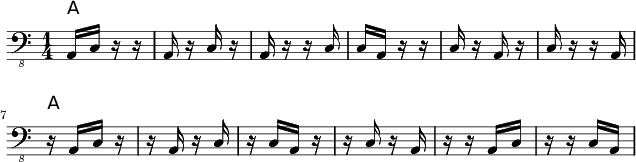
Check it out.
Now you can get permutations with combinations of notes and, wait for it, RESTS.
Like this:
Or you can add different notes and multiples rests and get all the combinations of that arrangement:
Check it out.

OK, the app is really cool, but I have a potentially dumb question:
Why is "rest" missing from the first note in Step 1, and Ab missing from note 2? Oversight, or some theory thing I'm too dull to understand? Yes, I realize I can put those things in notes 3 or 4... just wondering.
EDIT: Oh yeah... Google Chrome in Ubuntu (natty) is what I normally use, in the event the issue is browser/OS specific. Did the same thing in Chromium and FF, too, tho.
Why is "rest" missing from the first note in Step 1, and Ab missing from note 2? Oversight, or some theory thing I'm too dull to understand? Yes, I realize I can put those things in notes 3 or 4... just wondering.
EDIT: Oh yeah... Google Chrome in Ubuntu (natty) is what I normally use, in the event the issue is browser/OS specific. Did the same thing in Chromium and FF, too, tho.


