
Horizontal wheels under the tone pin are adjustable. There are several holes like the ones (vertical) to adjust the intonation. Brilliant design. You can adjust it with a screw.String height adjustment? Where? How?

Enjoy the benefits of a premium membership!
Upgrade Account
-
TalkBass has been independent since 1998. Add your voice.
Create a free account to reply to discussions, view embedded media, and browse with fewer display ads.
Join free Log in
Want zero display ads or expanded classifieds tools? Compare plans.
You are using an out of date browser. It may not display this or other websites correctly.
You should upgrade or use an alternative browser.
You should upgrade or use an alternative browser.
Announcing The Ray Ross™ Saddle-Less Bass Bridge
- Thread starter TalkBass
- Start date
More options
Who Replied?

Neat, but I can't see this being a viable drop-in upgrade without custom string winding lengths designed for it. For say 34" scale basses, the same strings used with a conventional bridge will be too long and may cause the fat portion of the string wrap onto the tuning posts, especially on the posts closest to the nut. I doubt using medium scale strings would work reliably either. I'm pretty sure he takes this into account on his custom instruments though.
How is scale measured when there is no saddle? Isn’t it usually measured nut to saddle? I’m sure there’s an obvious answer I’m stupidly overlooking...

Must try that. Something I like is that there is some fencing on each side of the bridge to keep the saddles from moving laterally as well. This looks very promising.

From my point of view, it's a shame that the studs are "thread-through" instead of "drop-in Quick-release".
Really hard to tell from the photo resolution, but on the gold bridge, the a string saddle looks like it's facing the opposite direction and does indeed have a quick-release opening on the side. I agree, definitely prefer quick release style bridges.
Hmm, how does not having a break angle @ the bridge end effect tone & intonation?
Plus, wouldn't this render most Fender length strings sets too long?
Plus, wouldn't this render most Fender length strings sets too long?

I have a Fender Fender Jazz 5 with the 5 inline headstock that I have this very problem with because the B string tuner is so close to the nut. I'm about to put a string through ferrule on it for the B string so I can avoid using the aluminum spacer shown below. A spacer would be required for this to work on a Fender with stock Fender strings....
Plus, wouldn't this render most Fender length strings sets too long?
It's the length of the vibrating string, so the playing side of the nut to the playing side of the saddle. In this case it looks like it would be nut to "tone pin", which appears might actually be to the end of the core wire just in front of the ball, if the holes in the tone pin are large enough to allow the string to vibrate freely.How is scale measured when there is no saddle? Isn’t it usually measured nut to saddle? I’m sure there’s an obvious answer I’m stupidly overlooking...
I'm thinking the next natural step after this is the nutless bass, using double ball strings and non-wrapping tuners arranged horizontally. .

I do not see the advantage. The tone pin is subjected to bending. The intonation screw is overloaded too much.

I don't understand how this is supposed to increase vibrational energy to the body. It seems to assume that there is significant energy loss through the non vibrating portion of the string (e.g., the part that's between the saddle and the ball-end retainer). Is this really correct? I once heavily muted that portion of the strings with foam on a J to see how it affected the tone and could find little difference from when it was unmuted.
Beautiful design though...might need special strings to work optimally.
Beautiful design though...might need special strings to work optimally.
my initial ambivalent feelings: This is a very cool design. This is also very stupid.
When I think of the force pulling on certain sections, and also pushing on opposing sections, it seems unlikely that it could offer an advantage.
When I think of the force pulling on certain sections, and also pushing on opposing sections, it seems unlikely that it could offer an advantage.
Last edited:
I am questioning if the very end of the string (the portion of ball end to where a bridge normally would be) is meant to vibrate. The core is looped around the ball end, back over itself and then "tied" in place with outer wraps. Those wraps are sometime sloppy and then there are exposed core strings to think about. Looks cool at first but ...
A solution in search of a problem, I think.
I mean, what, are we supposed to be thinking that if Jamerson had had one of these, he'd have been really really super DUPER good?
I mean, what, are we supposed to be thinking that if Jamerson had had one of these, he'd have been really really super DUPER good?

Saaaaalteeeee:
The engineering issues have already been hit. The machining... beautiful little spokewheel nuts, nice "tone"? "pins"?
But why not more fully countersink the mounting screws?
The engineering issues have already been hit. The machining... beautiful little spokewheel nuts, nice "tone"? "pins"?
But why not more fully countersink the mounting screws?
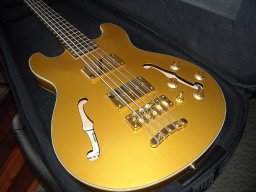
I like the idea; I’ve always felt a straight string functions best.
But an old fender bent plate bridge does all I need it to and is relatively straight pull.
Also works with stock lengths where this one may not.
But an old fender bent plate bridge does all I need it to and is relatively straight pull.
Also works with stock lengths where this one may not.

Looks like a recipe for Kool Aid to me...

After reading the replies, I feel Picton said it best, a solution looking for a problem. I can't imagine this would make things better, but it's something different and it sure looks cool. I do dig the intonation adjustment screws. The elimination of potential (however unlikely in this case)screw head/hex key strippage is never a bad idea IMO. My S.U.B. did the same exact thing with the truss rod adjuster, which I thought was brilliantly simple and effective.
I like the idea with the "saddles" being a hogged out stud, eliminating the middle man of braking the strings over a saddle, however I don't see how they're an advancement over a perfectly good and reliable system that's been in use for decades. If anything, one shortcoming is that if you wanna use fatter strings, it could be a pain to hog that out, and also limit how thick you can go, compared to simply filing a nut slot. Yaknow?
I think I like it simply because it's different, not better.
I like the idea with the "saddles" being a hogged out stud, eliminating the middle man of braking the strings over a saddle, however I don't see how they're an advancement over a perfectly good and reliable system that's been in use for decades. If anything, one shortcoming is that if you wanna use fatter strings, it could be a pain to hog that out, and also limit how thick you can go, compared to simply filing a nut slot. Yaknow?
I think I like it simply because it's different, not better.

The 'saddle' or 'witness point' is the point at which the string leaves the post on its way toward the nut. Or, it's where the ball end bears against the backside of the post. Which case is true depends on how much clearance there is for the string to pass through the post. If it were me I'd make the holes generous at the exit (I'd use a 'taper pin' reamer) to prevent string vibration against the post bores. In either case the open length of the string applies as usual.How is scale measured when there is no saddle? Isn’t it usually measured nut to saddle? I’m sure there’s an obvious answer I’m stupidly overlooking...
Last edited:
How is scale measured when there is no saddle? Isn’t it usually measured nut to saddle? I’m sure there’s an obvious answer I’m stupidly overlooking...
No. Scale is nominal, and is twice the distance from nut to 12th fret.

Does it come with a purpose built wrench or adjustment tool?
IME with non conventional fasteners of the type used on this bridge, if you use even slightly undersized round tools to turn them under tension, which most people do when making intonation and height adjustments, you quickly wallow out the adjustment holes. Being the parts are made of brass it would happen pretty fast without a proper spanner style wrench to adjust it with.
Just one guys opinion, but a simple 12 point nut would make it easy to adjust with a tool you can pick up at any auto parts or hardware store. Granted, it wouldn’t look as cool, but there is nothing more frustrating than misplacing a small special tool and ruining your nice looking bridge because the allen wrench you wound up using was not a proper fit for the holes and wallowed them out as they kept slipping until you gave up and spent a couple extra frustrating hours loosening and tightening your strings to set height and intonation.
IME with non conventional fasteners of the type used on this bridge, if you use even slightly undersized round tools to turn them under tension, which most people do when making intonation and height adjustments, you quickly wallow out the adjustment holes. Being the parts are made of brass it would happen pretty fast without a proper spanner style wrench to adjust it with.
Just one guys opinion, but a simple 12 point nut would make it easy to adjust with a tool you can pick up at any auto parts or hardware store. Granted, it wouldn’t look as cool, but there is nothing more frustrating than misplacing a small special tool and ruining your nice looking bridge because the allen wrench you wound up using was not a proper fit for the holes and wallowed them out as they kept slipping until you gave up and spent a couple extra frustrating hours loosening and tightening your strings to set height and intonation.
Last edited:


