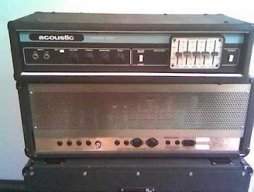
And that's a bit of a problem. Assuming each cab gets 100 watts, also means the 15 gets a 100 watts and each 10" gets 25 watts. A much better solution would be to slave a line level outpot signal to a second amp, power amp only would be fine, so you can run the cabs up to their full power handling capabilities. Possibly with a little power reduction to the 15 and the 4x10 could probably take some extra juice.
I'm sure the combo will look cool, but I am not sure halving the available power output by reducing the loads on the amp (increasing the system impedance) is a step in the right direction. I will avoid the mixed speaker debate. I always shoot to have the maximum available the system is designed for, you can always turn down.
And for the sake of clarity, amplifier circuits at the output stage have 3 components. The voltage, current and resistance. With the voltage constant, the increasing the resistance DECREASES the current in the circuit, as stated in Ohm's Law V = IR. As noted above, amps do not deliver power per se, but the amp produces Voltage at some available Amperage and depending on the load you provide, you can affect that. However, the Voltage and amperage are related to Power in watts. That equation is P = I x V. And since V = I x R Power in watts can be expressed in terms of Amps and Resistance only as P = I x I x R or P = I2 x R. (superscript doesn't display, not sure why...)
So as an example, if the power available is 300 watts and the impedance is 4 ohms, then the current is 8.66 amps. Theoretically, if we increased R to 8, then 6.1 Amps would be the draw. But we can't ignore the voltage drop and the designer tells us that P = 180 , using the equation we find that the current is now 4.7 Amps at 38 Volts as opposed to 8.66 amps at 34 volts.
So, basically you want to use half the current at a negligibly higher voltage to drive the system. Go to plan B. You'll be a lot happier.