- May 20, 2026
- 15
- 49
- Disclosures
- longtime friend colleague of Bruce Johnson - maker of GuitarViols.
OK I know that the overwhelming majority of Lutherie involves woodworking. I'm just seeing if there are any others on talk bass who have gone heretic (composites and mold making).
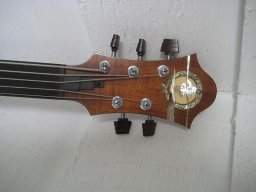
I have been ripping guitar as a part since I was a kid 50 years ago and I've been pretty active as a builder for the last quarter century. (One of your TB regulars Bruce Johnson knows me well and we've collaborated over the years since about 2003). I am best known for an unusual instrument called the TogaMan GuitarViol (guitar formatted viola) which is had a very strong cult following in the film and TV scoring industry of the last 24 years and the majority of them were typical woodworking. (I even got freakish about multi colored French polishing). About 430+ instruments and Bruce actually machined the parts on quite a number of them.
At some point I had hit frustration points with The terrible things that woods do. The initial foray into composites came after much frustration with the geometrically complex fingerboards (bruce's wonderful fret sliding machine was perfect for the job!) however consistency and increasing complexity of curve particularly on the bass side made a difficult job even more difficult as I optimized for the string tensions assigned to the instrument. I also tried CNC which actually became a labor multiplier (many man hours getting jewelry wire frets in and sanding to a polish - only to have climate whiplash - rain and drought - Southern California Santa Ana - shipping all over the world) at some point about 2014 I was beyond frustrated and begin R&D on a composite "ViolGlide" fingerboard; and Johnson was helpful in the initial guidance in mold making. The early molds were silicon which meant they were good enough for Proto types but not for repetitive production. The early examples took a lot of secondary hand work but the end product was amazing!
But the thought process came more from " regardless of tradition regardless of materials wood-biases be damned - what would the ultimate playing surface actually be like?" What came out of it was a one piece casted fingerboard with a nut and string lines already in place. No more putting 24 frets in - fighting physics and nature! This was about getting a precise repeatable result every time.
In those 2015 days I was just freshly moved in to The secret underground laboratory in Fillmore with Bruce across the hall. I went from initial silicon molds I had made before to Creating a legit composite mold (reverse engineered from one that Alastair Hay Emerald guitars Ireland had made off one of my plugs - that particular one did not work out but was an $$$ investment in education apparently). Anyway, transitioning from fine woodwork to composite part making is no joke! There is definitely a disconnect between people who make boats, drones, Ferraris and high-performance musical instruments. Thermoplastics engineers can't wrap their head around requirements of high impact sure hardness combined with high-performance lubricity. There may be some trade schools for guitar and violin making and separate ones for composites an industrial design. But there's a very big gulf between the two worlds! Perhaps as a age I might be attempting to bridge that gap a bit.
So the fingerboards have been a success and 100s of them have been made since 2016 - all of my instruments after basically. The actual performance benefits alone were worth it! But also having something that's not going to change Micro dimensions with seasonal shifts is a big deal (particularly if you have stuff it's shipped all over the world).
Eventually I got into building the entire instrument out of composites. Initially I shot for carbon fiber and absolutely hated it. It's light weight and residence we're not the problem; just a freaking nightmare to finish or repair. Eventually I drifted into other substrates like flax and hemp particularly. When treated right it can be a real super wood!
Of course I have found out the hard way just what the struggles were much like Ken Parker did with his Fly and perhaps modulus. It's not for everybody but for certain applications where you want nothing to move - I'm sure I can go on and on about this stuff! Composites have been around forever; just not in the way people think! Lutes are made of The nearest strips and linens soaked with hide glue. Same concept just different materials. Like high tech papier-mâché; instead of paper layered with water down wood glue/flour like piñata, you have cloth and epoxy of different grades Applied with skill.
Anyway I'm just wondering if there are any luthiers on talk bass who have applied composites to their builds? If so what drove that?
I have been ripping guitar as a part since I was a kid 50 years ago and I've been pretty active as a builder for the last quarter century. (One of your TB regulars Bruce Johnson knows me well and we've collaborated over the years since about 2003). I am best known for an unusual instrument called the TogaMan GuitarViol (guitar formatted viola) which is had a very strong cult following in the film and TV scoring industry of the last 24 years and the majority of them were typical woodworking. (I even got freakish about multi colored French polishing). About 430+ instruments and Bruce actually machined the parts on quite a number of them.
At some point I had hit frustration points with The terrible things that woods do. The initial foray into composites came after much frustration with the geometrically complex fingerboards (bruce's wonderful fret sliding machine was perfect for the job!) however consistency and increasing complexity of curve particularly on the bass side made a difficult job even more difficult as I optimized for the string tensions assigned to the instrument. I also tried CNC which actually became a labor multiplier (many man hours getting jewelry wire frets in and sanding to a polish - only to have climate whiplash - rain and drought - Southern California Santa Ana - shipping all over the world) at some point about 2014 I was beyond frustrated and begin R&D on a composite "ViolGlide" fingerboard; and Johnson was helpful in the initial guidance in mold making. The early molds were silicon which meant they were good enough for Proto types but not for repetitive production. The early examples took a lot of secondary hand work but the end product was amazing!
But the thought process came more from " regardless of tradition regardless of materials wood-biases be damned - what would the ultimate playing surface actually be like?" What came out of it was a one piece casted fingerboard with a nut and string lines already in place. No more putting 24 frets in - fighting physics and nature! This was about getting a precise repeatable result every time.
In those 2015 days I was just freshly moved in to The secret underground laboratory in Fillmore with Bruce across the hall. I went from initial silicon molds I had made before to Creating a legit composite mold (reverse engineered from one that Alastair Hay Emerald guitars Ireland had made off one of my plugs - that particular one did not work out but was an $$$ investment in education apparently). Anyway, transitioning from fine woodwork to composite part making is no joke! There is definitely a disconnect between people who make boats, drones, Ferraris and high-performance musical instruments. Thermoplastics engineers can't wrap their head around requirements of high impact sure hardness combined with high-performance lubricity. There may be some trade schools for guitar and violin making and separate ones for composites an industrial design. But there's a very big gulf between the two worlds! Perhaps as a age I might be attempting to bridge that gap a bit.
So the fingerboards have been a success and 100s of them have been made since 2016 - all of my instruments after basically. The actual performance benefits alone were worth it! But also having something that's not going to change Micro dimensions with seasonal shifts is a big deal (particularly if you have stuff it's shipped all over the world).
Eventually I got into building the entire instrument out of composites. Initially I shot for carbon fiber and absolutely hated it. It's light weight and residence we're not the problem; just a freaking nightmare to finish or repair. Eventually I drifted into other substrates like flax and hemp particularly. When treated right it can be a real super wood!
Of course I have found out the hard way just what the struggles were much like Ken Parker did with his Fly and perhaps modulus. It's not for everybody but for certain applications where you want nothing to move - I'm sure I can go on and on about this stuff! Composites have been around forever; just not in the way people think! Lutes are made of The nearest strips and linens soaked with hide glue. Same concept just different materials. Like high tech papier-mâché; instead of paper layered with water down wood glue/flour like piñata, you have cloth and epoxy of different grades Applied with skill.
Anyway I'm just wondering if there are any luthiers on talk bass who have applied composites to their builds? If so what drove that?



 Bruce has written about it before so I should have done a deep dive then but wow great tone