• TalkBass has been independent since 1998. Add your voice.
    Create a free account to reply to discussions, view embedded media, and browse with fewer display ads.
    Join freeLog in
    Want zero display ads or expanded classifieds tools? Compare plans.

Anybody switching between 6 and 5 or 4?

Mar 30, 2023
1,449
2,317
I’ve been playing a 6 string bass exclusively for a year now, and I’ve just started taking lessons after playing for some 20 years. But I don’t know which instrument to learn on — the 4 or the 6 string?

More specifically, I’m learning scales/modes. My goal is to be able to start on any note and from there play any scale fluently on the entire neck.

Thing is, we usually tell people to start learning on a 4 before going to a 5 or 6. On the other hand, the 6 is my main bass. It’s the one I play with in my bands because I use the B string, and quite frankly, my 4 doesn’t sound all that good (Fender MusicMaster Bass).

There are also people on here who preach the importance of committing to a 6 string if that’s what you want to play because it allows you to play more vertically than horizontally, like on 4.

Which brings me to my second question — I also want to get another bass to pair with the 6. I want something lighter, passive and without the C string for the bands. Would it be easier to go from 6 to 5 or does it not matter?

Thanks.
 
  • Like
Reactions: ColinR
I'd say get whatever inspires you – or seems like it would best fit your anticipated projects – then practice on both so you're fluent in the horizontal and vertical approach.
FWIW I have been slightly favoring 5-strings for modern pop, then veering back to 4-strings for old-school rock & country – and the occasional 6-string for "smooth" jazz. I guess I like my variety.
 
  • Like
Reactions: RGerhart
I switch across all 3, but you should learn on whatever you are comfortable on. You might be able to find more instructional material on scales that are written for 4 string bass. You can use those materials just fine on 6 strings. The scale shapes stay the same regardless of string count (other than more strings let you move up strings rather than down the neck if you want).
 
I just switched to 6 this spring after 20 years on 5's. 20 years prior to that it was a 4. The 4 feels like a foreign object at this point.

Learning: I've read in a number of places that it is not unusual for a teacher to send a beginner out for a super cheap 6, just to learn on. I see it in my transition. Contrary to my fears of too many strings, the 6 seems even more natural, and indeed, I understand fingerboard flow even better now. You can just see scales and chord patterns better across the neck.

To your point, If you want to be able to play scales from the bottom to top of any string count, then be sure to do so on the 4, as it will have you shuffling and sliding that fretting hand a lot more.
 
Over the last 45 years, most of my playing was on 5 string basses, though I started on 4 string basses.

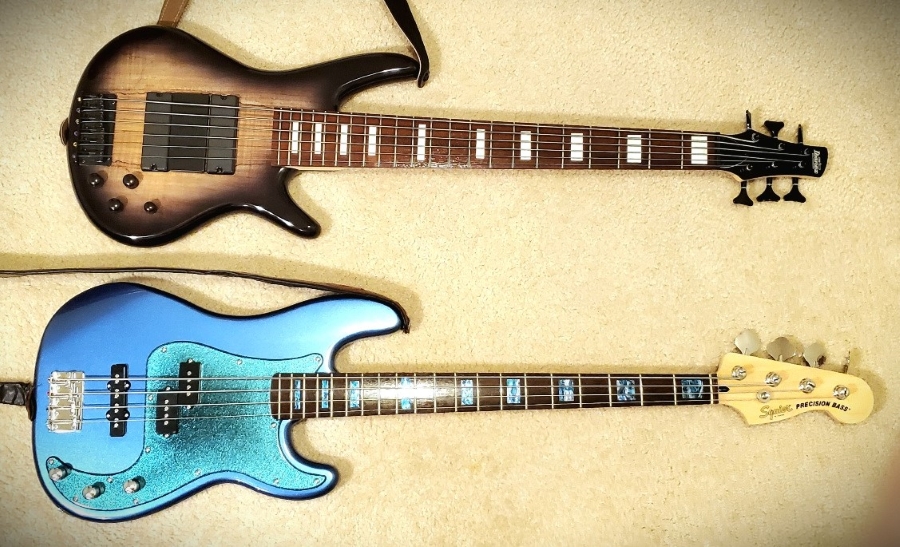
I only have two basses now...a 4 string and 6 string. Decidedly different feel as the necks are so different, but really most of the issues with playing either/or are mental.

My sixer is strung up BEADGC (all in fourths), so the inner 4 are the same as my 4 string and I find it easy to switch back and forth without issue. It just takes practice, and just letting go of the mental block.

Every single note on a 4 string can be played between the 5th and 12th frets on a 6 string, so a 6 string is effectively "shorter" than any "short scale" 4 stringer, so there is much less reach required.

2-basses-After.jpg
 
Last edited:
Learn on the one you mean to use.
This!

FWIW: after 20 years of playing 4 string (5 wasn't a viable option when I started) I switched to 5 in Y2K. I've tried a number 6 stringers, but either the neck is too wide or string spacing too narrow. If I go back to 4, I miss the B string too much. So 5 is Just Right for me, I'm not comfortable on any other number.

That's just me, of course. If you prefer 6, then learn on 6 whether you plan to switch or not.
 
The annoying but real answer:
It doesn't matter.
Learn on whichever bass you use. Learn on whichever bass you feel like playing that day. Learn on both and don't overthink it.

If your 4, 5, or 6 string basses are using standard tuning (each string tuned to perfect 4ths), everything you learn scale/mode-wise on one bass is transferable to other basses. The patterns are all the same. Only difference is you can go further across the neck with them on the 6.

If you know the major scale on a 4 string from the 3 positions (starting index finger, starting middle finger, starting pinky), you know how to play the scale across the 6 string because when you get to the octave, you just start playing the same major scale in the next finger position. That's it. And when you jump back to the 4 string, you have to play the same scale patterns but shifting them up the neck instead of across, which you can also do on a 5 or 6 if you wanted to. Same goes for all the other scales & modes. The patterns are the same on the 4, 5, and 6.

--

When i was 16 i had a 4 string and got a 6 string and was still taking lessons. I started taking my 6 to lessons to learn 6 string bass. It was a very short time before i realized that there really wasn't anything "new" to learn on the 6 string other than muting the unplayed strings better. All the intervals are in the same spots. All the patterns are the same.

Played with a 4 and 6 interchangeably for about 25+ years. These days i play primarily 4. But if i need a single note below low E, i play my 5. It's not an issue.
 
Last edited:
I don't think there is an "answer" to this question. It's all about what works for you, which you don't really know until you try it. There are plenty of people who switch between 4, 5, and 6 regularly, and maybe even on the same gig, and plenty of people who stick to one forever. IMO it is more important to determine what you want to be able to do with a bass and what combination of basses covers that best for you, and then figure out a way to make that work, rather than focusing on which basses are easier to switch between.

Personally, even as a lifetime four-string player, I think the concept of encouraging someone to start on a 4 if they really want to play a 5 or 6 is nonsense, and I don't find jumping between a four and five especially complicated either way.
 
I was thinking about picking up the 6 string bass, I guess because I wanted a challenge. I thought about it and realized that the time and energy would be better spent learning 6 string guitar. I like keeping all my bases at 4 strings, since I also play upright bass. I'd just learn on what you plan to play most.
 
  • Like
Reactions: Wasnex
I think just like anything else, if you practice switching, then switching won't be difficult. If you don't practice switching, then switching will be difficult.
+1 on this

I switch between 4-, 5-, and 6-string and the easiest way I got used to it was to just bring a couple of basses every show. I switch between the two every set to keep it interesting. It's definitely easier to switch between adjacent string counts (4 and 5, 5 and 6) as opposed to 4- to 6-string.

Once you are familiar with the fretboard on the 6-string, the other ones are cake. Oddly enough, playing 6-string for years really made me appreciate my 4- and 5-string basses even more when switching back.
 
Stay home. If you play sixes exclusively, take your lessons on that.

There is nothing you will learn on the six that will not work on a four or a five, you will just have less maneuvering room !

We see this in keys, where often electronic keyboards are rarely a full 88-note scale like a piano, often they are 60 keys or 72. The fingerings are exactly the same (technique can vary for unweighted keys, aftertouch, and so forth) unless you need to play low C's on a 60, or need to go way up there past where a 60 or 72 stops. But the essentials of technique are identical.
 
  • Like
Reactions: Wasnex
I’ve been playing a 6 string bass exclusively for a year now, and I’ve just started taking lessons after playing for some 20 years. But I don’t know which instrument to learn on — the 4 or the 6 string?

More specifically, I’m learning scales/modes. My goal is to be able to start on any note and from there play any scale fluently on the entire neck.

Thing is, we usually tell people to start learning on a 4 before going to a 5 or 6. On the other hand, the 6 is my main bass. It’s the one I play with in my bands because I use the B string, and quite frankly, my 4 doesn’t sound all that good (Fender MusicMaster Bass).

There are also people on here who preach the importance of committing to a 6 string if that’s what you want to play because it allows you to play more vertically than horizontally, like on 4.

Which brings me to my second question — I also want to get another bass to pair with the 6. I want something lighter, passive and without the C string for the bands. Would it be easier to go from 6 to 5 or does it not matter?

Thanks.
I don't think it matters if you learn on a 4,5, or 6 as the shapes remain the same. I used 5's and 6's many years but now only play my 4's. Mostly cause they are lighter and more manageable. I enjoy hunting for the notes in a different places and all my players are now passives with my favorite being single coil. Regardless of how many strings, short or long scale... you get used to it very quickly. IMHO