
Enjoy the benefits of a premium membership!
Upgrade Account
-
TalkBass has been independent since 1998. Add your voice.
Create a free account to reply to discussions, view embedded media, and browse with fewer display ads.
Join free Log in
Want zero display ads or expanded classifieds tools? Compare plans.
You are using an out of date browser. It may not display this or other websites correctly.
You should upgrade or use an alternative browser.
You should upgrade or use an alternative browser.
Anybody switching between 6 and 5 or 4?
- Thread starter Just Wrong
- Start date
More options
Who Replied?
I switch between a fretless 7, twos fretless 6s, a 5 and two 4s. All of them are 34” scale. Spacing is 18mm on all of the 5+ stringers, which helps, but my 4s are 18mm and 19 mm. I’ve never needed more than a couple seconds to adapt…After I got used to a B string and started using floating thumb technique, that is. On the 4s my thumb anchors on a pickup and away I go.
On the 4s my thumb anchors on a pickup and away I go.
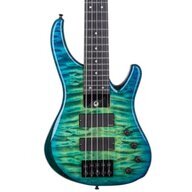

I’m kinda opposite. Started on 4, then exclusively 5 for many years. My venues changed to small low key restaurant. So I went back to 4. Yeah I know my 5 would work, it gave me the excuse to buy a few 4 bangers ! I do get the 5 out, I seem to be able to play it ok. Thinking about auditioning at my church so I may swing back to 5 more. But we need to always be learning. Learning on a 4 makes you learn the basics & roots and keeps you focused. Like learning to paint. Start with a few colors, learn basics of mixing colors.I just switched to 6 this spring after 20 years on 5's. 20 years prior to that it was a 4. The 4 feels like a foreign object at this point.
Learning: I've read in a number of places that it is not unusual for a teacher to send a beginner out for a super cheap 6, just to learn on. I see it in my transition. Contrary to my fears of too many strings, the 6 seems even more natural, and indeed, I understand fingerboard flow even better now. You can just see scales and chord patterns better across the neck.
To your point, If you want to be able to play scales from the bottom to top of any string count, then be sure to do so on the 4, as it will have you shuffling and sliding that fretting hand a lot more.

A moment of devil's advocacy, though, just for fun: from a practical standpoint the vast majority of sound reproduction equipment, including most bass guitar cabinets, don't really go much below the mid-40Hz range, so there's not much loss in terms of what it'll sound like to most audiences by simply going up an octave for anything below probably low D. That is, a 4-string in drop D gives one all the notes that most gear can meaningfully reproduce anyway. Saw an interview with one of my favorites, Justin Chancellor (almost always plays a 4 in drop D), who said anything he couldn't get to on drop D he could just use an octave pedal for anyway. He was half just being snarky, but still.
The fact that most bass cabs are not flat to 30hz doesn't really matter as much as you might think. It's usually very easy to differentiate between B1 (~61.74) and B0 (~30.87hz).
Using the same logic, there would be no point in playing notes on the E string with a lot of bass cabs. This image has a response plot for the Ampeg SVT210AV
My understanding is the response of an Ampeg 810E is pretty similar. Notice the low end starts to roll off around 150hz.
Per the following document, both the 210AV and 810E have usable response (-10dB) to 40hz. Response to 58hz is +/- 3dB


That’s just wrong…
I have a 6 that I have no business owning, used to play 5’s exclusively and switched to 4’s about a year ago just for comfort/weight reasons.
I have a 6 that I have no business owning, used to play 5’s exclusively and switched to 4’s about a year ago just for comfort/weight reasons.

I bop between 4, 5, and 6 all the time depending on what the gig is. With rock or country bands I'm usually using a J or P bass. With my Brazilian outfit I'm on either 5 or 6. Jazz gigs can be upright or 4/5/6. If I'm subbing for Chuck Sher it's an electric 4 (because that's what he plays). Theater gigs 5 or 6 for sure because of all the low notes. I like to sight read on 6 because there are more notes available in a single position and I don't have to read ahead and prepare for shifts nearly as much. Tonewise, my Sadowsky 5 and Roscoe 6 are incredible for sure but for me, for the sound and response I prefer, they can't really compare to the tone I can get from my Fodera and Fender 4 strings. There's an incredible texture in the lows and in the midrange that I just don't get with 5 or 6 strings.
4 is about all I can handle. lol I had a 5 string jazz bass at one point but it wasn't for me.

I just went back to 4 string. Going back to old school and learning grooves from the 60’s and 70’s.

The fact that most bass cabs are not flat to 30hz doesn't really matter as much as you might think. It's usually very easy to differentiate between B1 (~61.74) and B0 (~30.87hz).
For you? Or even me? Sure, yes, absolutely—especially if you’re alternating between them.
For the average music listener in the context of a song on a speaker with an F10 of 45Hz? There I’m not so sure. I bet you could switch half the B0s with B1s in the track without them batting en eyelash, especially if the song isn’t in B. Would be an interesting experiment.
Okay.Would be an interesting experiment.
Listen to this on a laptop and tell me if the low note is C1 or C0.
It sounds like C0 to me. Do you disagree? Imagine how embarrassed I will be if it's C1
 .
.

Learn on what you use.
I've played a six virtually exclusively for over 30 years now. It is a completely different instrument than a four, and I play them in a completely different way. Because they are so different, you'll do yourself a favor by learning on what you play.
As for a five? Personally, I have no use for them. They have most of the limitations of a four and few of the advantages of a six. This is a far more complex statement than it seems, but if you know, well, you know.
I've played a six virtually exclusively for over 30 years now. It is a completely different instrument than a four, and I play them in a completely different way. Because they are so different, you'll do yourself a favor by learning on what you play.
As for a five? Personally, I have no use for them. They have most of the limitations of a four and few of the advantages of a six. This is a far more complex statement than it seems, but if you know, well, you know.

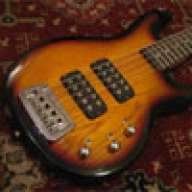
I only had two fivers in standard tuning for a long while, but the last couple of years I have been more comfortable with 4 strings and I prefer that these days. That said, I don't have any problems switching between 4 strings, 5 strings in both BEADG and EADGC tuning as well as fretless, guitar and a bass VI either. After playing them all a while, it is like my brain just instantly switches itself into the right mode for the bass I currently play, and I don't really think about it.
I saw an ad for a 6-string that was strung lower: G2-D2-A1-E1-B0-F♯0. I briefly considered it, then realized F♯0 is ~23 Hz and I don't even have a speaker that would play 23 Hz.I will say that a 6 perplexes me, not because I can't understand how to play one, but because I can't figure out what I'd ever use the C string for. But that's more about the music I tend to play, not anything inherent to 6 strings. If the stuff you're trying to play needs the high C, then go for it.
That would at least be a reasonable guitar for someone used to playing standard EADG, since the most accessible strings are in standard 4-string tuning.
And every time I get a hankering for a 5-string, I remind myself that I don't even have equipment that would play the ~31 Hz of B0 (I understand the additional benefit of having more positions to play the lowest notes, but I guess I should play what I own more than look at stuff that won't ever improve my playing, and will impact it negatively for at least a while).
It probably does. Your speaker simply get progressively quieter as the frequency drops. It's not a brick wall that silences all frequencies below 41 Hz.I don't even have equipment that would play the ~31 Hz of B0
I have a practice amp with a single 10" speaker and I can't find specs on it but the roll-off point is pretty high. Despite that I can hear a low B on it just fine.
You're right it will just roll off and if I don't use it at full volume, I can boost the bass and get some useful volume at 31 Hz, but looking at Ampeg specs that @Wasnex posted yesterday, a lot of bass cabs get -10 dB at 40 Hz, so they're barely acceptable for a standard 4-string, you'll probably get -20 dB at 30 Hz. If the values in the tables are A-weighted (dubious), then that's all you need to consider. But if it's not weighted, then you need to consider the equal loudness curve and they might be a lot quieter at 30 Hz. Still plenty loud for rehearsal (120-129 dB -20 dB is still 100-109 dB maximum), but will definitely be too quiet for a concert.

I’ve been playing a 6 string bass exclusively for a year now, and I’ve just started taking lessons after playing for some 20 years. But I don’t know which instrument to learn on — the 4 or the 6 string?
Why are you even asking?
You're playing 6 string basses and want lessons. . . . why would you even consider learning on a format you don't play, and has limitations in comparison to the format you do play!!?

I play 5 string and 4 string bass guitars and 4 string upright bass.
I used to practice only on the upright because that’s what most of my gigs called for and anything I did on upright was easily transferred to the bass guitar.
When I finally decided to stick with 5 strings just prior to the pandemic, I was playing mostly bass guitar on gigs, so I did most of my practicing on the 5.
For learning new material for an upcoming gig I’ll pull out the bass I'll be using for that gig.
I used to practice only on the upright because that’s what most of my gigs called for and anything I did on upright was easily transferred to the bass guitar.
When I finally decided to stick with 5 strings just prior to the pandemic, I was playing mostly bass guitar on gigs, so I did most of my practicing on the 5.
For learning new material for an upcoming gig I’ll pull out the bass I'll be using for that gig.

I don't think there is an "answer" to this question. It's all about what works for you, which you don't really know until you try it. There are plenty of people who switch between 4, 5, and 6 regularly, and maybe even on the same gig, and plenty of people who stick to one forever. IMO it is more important to determine what you want to be able to do with a bass and what combination of basses covers that best for you, and then figure out a way to make that work, rather than focusing on which basses are easier to switch between.
Personally, even as a lifetime four-string player, I think the concept of encouraging someone to start on a 4 if they really want to play a 5 or 6 is nonsense, and I don't find jumping between a four and five especially complicated either way.
I have a similar circumstance. I promised myself when I moved primarily to 5 strings that I would maintain my 4 string chops, given upright and some 4-strings I love, and need on occasion. It wasn’t easy, especially at first, but after 25 years I think I got it. I did flirt with a 6 briefly but don’t really have a need for the care and feeding required.I play 5 string and 4 string bass guitars and 4 string upright bass.
I used to practice only on the upright because that’s what most of my gigs called for and anything I did on upright was easily transferred to the bass guitar.
When I finally decided to stick with 5 strings just prior to the pandemic, I was playing mostly bass guitar on gigs, so I did most of my practicing on the 5.
For learning new material for an upcoming gig I’ll pull out the bass I'll be using for that gig.
But as I said in an earlier post, it's not necessary for the speaker to be able to faithfully reproduce the fundamental of the notes on the B string for you to hear the notes clearly. Two explanations are commonly given:You're right it will just roll off and if I don't use it at full volume, I can boost the bass and get some useful volume at 31 Hz, but looking at Ampeg specs that @Wasnex posted yesterday, a lot of bass cabs get -10 dB at 40 Hz, so they're barely acceptable for a standard 4-string, you'll probably get -20 dB at 30 Hz. If the values in the tables are A-weighted (dubious), then that's all you need to consider. But if it's not weighted, then you need to consider the equal loudness curve and they might be a lot quieter at 30 Hz. Still plenty loud for rehearsal (120-129 dB -20 dB is still 100-109 dB maximum), but will definitely be too quiet for a concert.
- A note is not just the pure fundamental. It also includes the harmonic, which are frequencies above the fundamental that occur in certain ratios. When your brain hears the harmonics in the proper ratios, it sort of fills in the fundamental for you.
- Bass guitar does not produce a super strong fundamental in the first place. This makes it even less necessary for the speaker to have strong response to the fundamental. There is a long thread you can wade through if you like. Here is an image from the first post, a waterfall plot of a bass guitar playing F1, to wet your appetite.
The second harmonic in this image is stronger than the fundamental.

I've got a rather extreme visual example of bass guitar output here, showing frequencies of the fundamental and overtones across the plot, and the timeline starting where the note is just struck at the back, leading to the front as it sustains and decays. You can see each partial of significant energy as its envelope changes.

Why is this example extreme? Well, for starters it's a very dark fretless bass/strings combination taken at F1 - 43.65 Hz fundamental - where the first fret would be. Also the sample was taken with both pickups blended about 50/50, which because...
Why is this example extreme? Well, for starters it's a very dark fretless bass/strings combination taken at F1 - 43.65 Hz fundamental - where the first fret would be. Also the sample was taken with both pickups blended about 50/50, which because...
I am not saying that it won't sound different if you have a cab that can play flat to 30hz, only that it's not necessary for the open B of a bass guitar to be useful.
Also basses with a longer string can produce a stronger fundamental. I own an NS Design EU6 which is about 42" scale. My perception is the EU6 produces a lot stronger fundamental than all of my bass guitars. The difference is apparent through may GB1288T-UQ cabs which only have usable response (-10dB) to 45hz. The difference is also apparent through my EV TL405 cabs which are supposed to have usable response to 24hz.
Which of these cabs produces a better B string. IMHO it depends on the amp. The extended LF response of the TL405 is definitely part of the answer, but it's not the only factor that matters.
The problem you are so worried about goes way beyond bass cabs. My guess is most of us are not using huge PA subs with strong response to 30hz.
Here are the response specs for the JBL VRX918S
Here is the natural response plot:
This is the response plot of the powered version of the cab (VRX918SP), which applies corrective EQ for flat response
Both plots start to roll off at about 50hz.


