

Enjoy the benefits of a premium membership!
Upgrade Account
-
TalkBass has been independent since 1998. Add your voice.
Create a free account to reply to discussions, view embedded media, and browse with fewer display ads.
Join free Log in
Want zero display ads or expanded classifieds tools? Compare plans.
You are using an out of date browser. It may not display this or other websites correctly.
You should upgrade or use an alternative browser.
You should upgrade or use an alternative browser.
Anyone else use paper on their nuts?
- Thread starter Dr. Cheese
- Start date
More options
Who Replied?
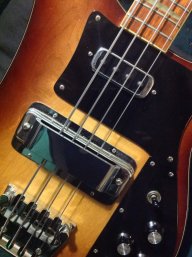
I used a bit of paper under my G string.* 1970 Dan Armstrong/Ampeg See Through. I put up with it for about twenty or twenty-five years and finally got around to the baking soda/super glue trick. The only real annoyance for me with the paper was that as I tuned up, the stretching string would pull the paper out of the nut.
*I'm not in the habit of collecting paper under my G strings, but I hear tell there are those that make a career of it.
*I'm not in the habit of collecting paper under my G strings, but I hear tell there are those that make a career of it.

The paper is going to move or tear when you tune the string. Shimming the nut looks and works better.
I love a good tacky pun but the paper under the string trick is like saying let me show you how to do a bad job. It’s ok for testing purposes to see if the nut is too low, but your luthier will roll his/her eyes if you exhibit bits of paper between your nut and G string.
That piece of paper on my Pedulla has held for nearly three years.
No, I would not do that. I might do the baking-soda + super-glue trick for a quick-fix, but then I would take it to a pro & have a new nut cut properly.
Sometimes spending the money to have it done correctly is worth it.
I agree, but this lasts a long time. The fix on my Pedulla is three years old.

It seems to me the nut is the most critical adjustment to be made at setup time. If the nut is not right, the bass will never play properly to it’s full potential. Saddle height and relief are flexible measurements; some like the neck flat while others like some curve...some like low action while some like the action higher. But if the nut isn’t right, the strings are unbalanced geometrically with resultant strings noises, uneven tone between strings, and uneven tension between strings.
The picture below shows 4 seesaws, 3 of which appear to be parallel. But they are not parallel because the ground (nut) upon which the seesaws rest is uneven. String makers design strings to be parallel in a curved plane for proper balance of tone and tension.
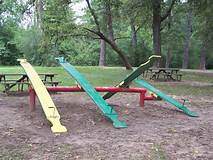
Also using the seesaw analogy, the only point where the seesaws are parallel (assuming the ground is not level) is at the fulcrum. So setting string height at just the 12th fret or at the 17th fret (i.e., at just one point) is useless unless the nut is cut perfect because the string heights will be different at every other point along the neck.
The picture below shows 4 seesaws, 3 of which appear to be parallel. But they are not parallel because the ground (nut) upon which the seesaws rest is uneven. String makers design strings to be parallel in a curved plane for proper balance of tone and tension.
Also using the seesaw analogy, the only point where the seesaws are parallel (assuming the ground is not level) is at the fulcrum. So setting string height at just the 12th fret or at the 17th fret (i.e., at just one point) is useless unless the nut is cut perfect because the string heights will be different at every other point along the neck.

Normally use a bit plastic cut from a pill blister pack.
Same principle. You're not alone @Dr. Cheese
Same principle. You're not alone @Dr. Cheese
Normally use a bit plastic cut from a pill blister pack.
Same principle. You're not alone @Dr. Cheese
I might try that myself!
Probably best just to do it properly. The Ernie Balls people may not care, but Mr. Pedulla is gonna have a heart attack if he sees that bass.

Man that was one loaded question which could have a bunch of colorful answers !

I used the paper trick for the last several years on one of my builds and I would leave it be, but I have it torn apart right now anyway, so I’m gonna try the permanent fix.

Agreed that it can be a temporary fix. But come on!....it’s a Pedulla! Fix it right!I agree, but this lasts a long time. The fix on my Pedulla is three years old.
Probably best just to do it properly. The Ernie Balls people may not care, but Mr. Pedulla is gonna have a heart attack if he sees that bass.
Dude is retired and shut down his business.

i've done it. but i didn't tell anyone...until now.


I've done it a pinch Doc.. i used the shiny metal paper from a pack of cigarettes and if memory serves, it's still in there! LOL
Fishheadjoe
Fishheadjoe
It works. I've done it. I have found that the mileage you can get varies, but hey, it's paper, make another one when you need to... For a more permanent solution, there is the baking soda trick I saw already posted. Also, if you have a bone nut, what my bass repair guy has done for me before is to make this little concoction of nut filings that he has saved and super glue. Not sure about proportions, or flavor of superglue, but it lasts for quite a while.
A lifetime of work and now it will only be remembered as a piece of toilet paper stuck in the crack. Kinda sad.Dude is retired and shut down his business.

Those are some pretty fancy paper nut jobs!Anyone else use paper on their nuts?
I had done that on my 4005WB as they were quite worn down after many decades of roundwound string tuning up. But, mine were done with special Invis-O-Paper®.

Not on a bass but my Gibson SG still has a piece of paper under the B string from when I got too enthusiastic with a nut file in about 1983.
I did cut the paper to the thickness of the nut so it isn't quite as obvious as yours Doc.
I did cut the paper to the thickness of the nut so it isn't quite as obvious as yours Doc.


