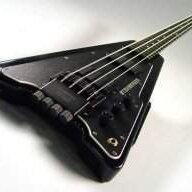
Years ago, I had a Westone Thunder headless bass. The whole bass was one big dead spot. A totally lifeless and toneless piece of ***p.
See there, but then it was equal along the whole neck, and the whole bass. It was at least even along all strings, across the fretboard.

Still no dead spots, since the lot of the bass was a serious dud. It was actually equally balanced then. Regardless of how crappy it sounded.
...but that's a lined fretless and it's hard to find a dead spot on a fretless.
Maybe because it's lined?
I've heard dead spots on a fretless (still not headless) and when starting a glissando on a spot that is not dead and glide it through and past the dead spot, the rest of the notes past the dead spots "disappears" as well, or sounding dead. A big no no. Fretless with dead spots (any) are a little more PIA than on fretted ones.
I find that headless basses suffer with dead spots less than big head stock (4 in a line) basses. But every bass has a dead spot somewhere and I think headless designs push the dead spot up the fret board more, so it's less of an issue for some.
That's what my intent was with this thread. Especially compared to Fender ones, big headstock, 4 in a line... so we have one more that agrees with me, but I wanted to ask those who had a headless with deadspots at the same place as Fender ones. 5-6-7 fret on the g-string, and some on other strings too, regardless of which position or string you play these frequencies in.
Headless basses have none of this stuff and the tuners are down passed the bridge.
For me, the most obvious difference in tone between headed and headless basses is that the headless tends to sound more punchy and with more attack. We often talk about the sonic differences between all through and bolt on designs, but I think that a headless design is a similar consideration.
Yes, of course. That's what people misses out on on headless. I've found out that - on headless guitars - the strings pops out and oscillates more, very reminiscent of a regular headstocked guitar with a locking nut system. Some kind of rubber band feel, actually. The strings stops at one point, just as on a headless, half a centimer behind the zero fret. No extra tension there. And same behind the bridge saddle. Not even an inch before the ball end comes. However, if these punch and more attack is something to everybodys liking is just up to personal taste.
A funny conclusion or "selective deduction" could be made with that statement on Status FAQ: "
Graphite necks tends to have less pronounced dead spots" PLUS the added notion of
"Headless necks tends to have less pronounced dead spots" = You have hedged your bets as much as you can, thinking that both these things put on top of each other, and mixed, should eliminate dead spots entirely. IRL it's not that easy.
You do move them up the neck, to where it's no problem, above 12th or 14th fret, and if present there anyway, they're still not as pronounced.
My friends Klein replica, with a Moses graphite headless neck had a very slight weak or dead spot in the 13 th fret D-string. The Eb. When stuck to any wall, which is easier on a headless bass it disappeared. Now, he sent it in for plekking and it came back with that Eb dead spot totally removed. It's very very picky - too - on and how the strings resides on the top of each fret. The less point, there's less fundamental, no firm and fat spot to reside on. The "witness point" as it is called in some circles.