• TalkBass has been independent since 1998. Add your voice.
    Create a free account to reply to discussions, view embedded media, and browse with fewer display ads.
    Join freeLog in
    Want zero display ads or expanded classifieds tools? Compare plans.

Anyone heard a headless with any dead spots?

Funny, just wriote this in another thread. I picked up (didn't buy, just physically picked up) a headless traveller bass in GC recently. The thing had the worst dead spot I've ever encountered - the open A string. The whole thing shook when you hit that note, but not for long - really fast decay/thud. Never bothered to plug the thing in - stuck it back on the wall.
I had the same problem with the traveller. I managed to move it on fairly quickly though.

I play a one piece carbon fibre headless built by tber MPU. I haven't noticed any dead spots. Fricken awesome bass.

Cheers

Tim
 
  • Like
Reactions: Honch
Is the neck solely causative with regards to the presence of dead spots? Reason I'm asking is there are several references to shaving headstocks, changing tuners, adding Fat Fingers all in the interest of modifying mass...fair enough. Seems we're overly-focused on the headstock end of the stick but failing to address that huge-ass mass clamped to the other end, ie. the body.

If we were take a neck with a well-defined dead spot and bolt it to a variety of different hosts (bass bodies, steel rail, 2 X 4, etc), would the character, intensity, and location of the dead spot change? How 'bout the addition of inserts which is highly-touted by the pros?

Per the original question, my NS Design CR5 has no dead spots but I also use the piezo which may be more forgiving.

Riis
 
  • Like
Reactions: Honch
The neck on a bass is a mass loaded bar. Yes, the body's presence affects that end of the bar, but most bodies are so much heavier than the neck that their influence on things is telatively constant. It's what us Physicists call a "fixed end" condition. The other end - headstock and tuners (or lack thereof) is way more variable. That mass, the linear density and stiffness of the neck, and you have an assymetrical loaded bar - sort of like a marimba bar with a big lump of mass added to one end, or one end clamped to a table. Changing the body end will, in theory, change things, but practically speaking, things will change much more with changes at the headstock.
 
I've got a headless Status Graphite S3 fretless with 32" scale that has a dead spot at the 11th fret on the G string and a hot spot on the 3rd fret of the low B. I went headless more for the compact factor as opposed to trying to eliminate dead spots. But the presence of the dead spot proves to me that they are not eliminated by shorter scales, headless, type of string, graphite materials, etc.
 
  • Like
Reactions: Honch and yodedude2
Is the neck solely causative with regards to the presence of dead spots?

nope. it is a package deal.


If we were take a neck with a well-defined dead spot and bolt it to a variety of different hosts (bass bodies, steel rail, 2 X 4, etc), would the character, intensity, and location of the dead spot change?

almost certainly; however, it is impossible to predict 100%.

How 'bout the addition of inserts which is highly-touted by the pros?...
Riis

i am not a pro, but i have gotten great results using threaded neck heel inserts and proper neck bolts as opposed to neck screws. i recommend them. 8-)
 
I've got a headless Status Graphite S3 fretless with 32" scale that has a dead spot at the 11th fret on the G string and a hot spot on the 3rd fret of the low B. I went headless more for the compact factor as opposed to trying to eliminate dead spots. But the presence of the dead spot proves to me that they are not eliminated by shorter scales, headless, type of string, graphite materials, etc.

perhaps it is the influence of that antarctic climate...8-)
 
  • Like
Reactions: pingvuiini
My Steinberger XP-2 has no discernible dead spots. I'm sure if you ran it through some kind of audio analyzer, plucked and fingered by a Robot, you'd find a less responsive note. If i cant hear it, its kind of irrelevant. I don't think the presence or lack of a head has much to do with it, more likely how consistent the material is at transmitting string vibration. I've played a number of Steinbergers over the years, and never noticed a dead spot, and lots of wood basses, some with noticeabe dead spots, some not. Based on that entirely un-scientific experience, I can only say that graphite necks seem to be much less prone to dead spots.
 
  • Like
Reactions: Honch
Funny, just wriote this in another thread. I picked up (didn't buy, just physically picked up) a headless traveller bass in GC recently. The thing had the worst dead spot I've ever encountered - the open A string. The whole thing shook when you hit that note, but not for long - really fast decay/thud. Never bothered to plug the thing in - stuck it back on the wall.

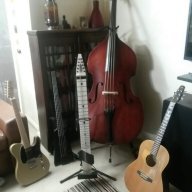
It wasn't this one was it? ;)

img_2792-edit-jpg.858847
 
We may not be able to marshal enough deductive individual cases upon which to bass an inductive premise for your question.

Of course not. I just wanted those who actually owns a headless do a comparison of dead spots to Fender ones, especially. Dead spots. While I don't think ever anyone buys any headless just because it has no dead spots, or reduce risk of it, I thought it would be interesting. There may be a lot here on TB who doesn't own any headless anymore, but when they where around, and they owned one, if they had any dead spots as severe as those of Fenders. Me too, has detected some not so severe deadspots up the neck, past 12th fret, and for some reason, I don't care as much about them up there as if they were apparent and blatant in the "-money-" range. 5th or 6th 7th fret. Actually within the first 12 frets.

Interesting thread, though. I do very well know that other factors, strings, fret crowning/polishing can wreak havoc. A number of basses has their dead spots removed by just "PLEKKING" the instrument, when all fret wires are shaped into the uptenth decimal. As well as changing out to new strings. As for the number of basses I've repaired and owned throughout the years, I find headless basses, regardless of scale or wood, and price, had the least dead spots of them all, without any prior design alteration to buck them, i e fatheads (how now that is possible on a headless....;)) or whatever method used to buck dead spots.

Anyone had a Hohner one?
 
Last edited:
Just as they say on FAQ on Status site, like this:

- - - - - -

Q: Is it correct that graphite basses do not have dead spots ? :

A: All basses, no matter how they are made will have some natural resonances.
If these resonances happen to coincide with a particular note on a neck this may make it either louder or quieter.
I'm sure you have heard of the classic dead spots on many regular wooden basses.

Dead spots can happen on any bass, whether graphite or wood, but tends to be much less pronounced on graphite basses due to the higher natural resonant frequency of the material. The construction : bolt-on, through-neck, different woods and lacquer finishes, all contribute to the overall instrument and there are always slight variations.

The action, intonation and general set-up also makes a difference. Make sure the strings are OK and that the small locking screws on the bridge are holding the saddles in place. All these factors will have an effect on the way notes resonate.

- - - - - -

I just think that the same answer would be appropriate for answering the question, but change out graphite to headless. I e the underlined statement "but tends to be much less pronounced" on a headless bass, whether graphite or wood.
 
Last edited:
  • Like
Reactions: yodedude2
There was a device a long time ago (a metal plate) called The Fat Head that added mass to the head stock to eliminate/move dead spots. So what's the deal more mass, fewer dead spots or less mass and fewer dead spots ????

Just move it around. From the place it was before. And with Fat Head, increasing mass at the headstock, inducing severe neck dive...;)
 
Mind you we should make a clear difference this thread from "change" dead spots to "removing" them. While removing headstock material you may move or remove dead spots, but can as well introduce new ones at places there wasn't any before.
 
... then I put on new strings, taking care that they weren't twisted - the
dead spots disappeared!...

+this!
I am very wary of this too. But when you use double ball end strings on a headless, they strap on without ever twisting. You have to be pretty blatant and force them to twist then. Maybe it's that causing all dead spots? ;) and why headless doesn't because of the un-twisted stringing of double ball end strings?

 
I play the Hohner as well. Again, I haven't noticed dead spots and I was all over the neck last Saturday night. The Hohner does suffer from a quiet low E but that's the electronics, not the construction.

I have had good luck with threaded neck inserts on Fender basses as well. I don't know the science, I just go blindly forth until the result is manageable!

Cheers,

tim
 
  • Like
Reactions: Honch
Years ago, I had a Westone Thunder headless bass. The whole bass was one big dead spot. A totally lifeless and toneless piece of ***p. I have built two headless basses with multi laminate all through necks at 24 fret fingerboards. My 5 string has a note around the 14th fret on the high G string that's a little dull and short on sustain. But if I swap brand of string (currently Status Hotwires) it moves to a different fret. My 7 string is clear on each of the frets...but that's a lined fretless and it's hard to find a dead spot on a fretless. I find that headless basses suffer with dead spots less than big head stock (4 in a line) basses. But every bass has a dead spot somewhere and I think headless designs push the dead spot up the fret board more, so it's less of an issue for some. I also think that some basses the dead spot is a real clunker...on other basses it's just a little less sustain. I think that some strings carry different tension to make the same tuning depending on the wire used, so I think that string choice can affect a dead spot too.

With a headed design, it's not just the mass of the wood of the head stock to consider, it's the shape and length of the head stock. 2 a side tuner design is going to take up less space than a trad 4 in a line, I guessing a 2 a side head stock will have a lower resonance. I Also think that the choice of tuners is going to have a big effect on the head stock mass. Trad fender clover leaf tuners are a lot heavier and more bulky than a modern Hipshot Ultralite. Some basses with angled back necks have a volute behind the nut which also adds mass to a neck. Headless basses have none of this stuff and the tuners are down passed the bridge.
For me, the most obvious difference in tone between headed and headless basses is that the headless tends to sound more punchy and with more attack. We often talk about the sonic differences between all through and bolt on designs, but I think that a headless design is a similar consideration.
 
  • Like
Reactions: Honch